- cross-posted to:
- politicalmemes@lemmy.world
- cross-posted to:
- politicalmemes@lemmy.world
cross-posted from: https://feddit.org/post/1097575
You must log in or register to comment.
This is a false choice between huge lifestyle changes for everyday people and regulating the polluters. Regulating the polluters is going to cause huge lifestyle changes for everyday people.
The idea that any of us get to go on as usual is the main roadblock to meaningful climate action.
Well can’t we just ban Shell from selling oil, and then get in our F150s to drive to the airport?
Or, better yet, people who “love nature”, so they drive an SUV every weekend for an hour to get to a cottage / camp / cabin. Or go camping, or canoeing, or whatever.
To the people who are saying “Yeah but you’re the one who buys the oil!!!” Please stop. Please think about any of the context surrounding those supposedly individualist decisions. Please think about what the most practical solutions are for fixing the problem. You can do that and be helpful or you can be smug and look down on others.
Sure, you buy and drive the car, but you didn’t:
- Design towns and cities that can only be easily traversed by car.
- Decide where jobs and housing were located.
- Spend millions of dollars to lobby against public transit.
- Spend millions of dollars to lobby against regulations.
- Spend millions of dollars to lobby against green energy investments.
- Spend millions of dollars to lobby for imperialist wars to access oil.
- Spend millions of dollars to spread misinformation about climate change.
- Decide what cars were available to buy and at what price. (Demand driving supply only makes sense if consumers have a way to signal that they want something that isn’t being offered. The main market way of doing that would be to not buy anything until the right good is offered… but as stated above, people can’t just opt out of needing a car if the places where they can live and work are built around cars.)
- Decide to be too poor to buy luxury goods masquerading as green alternatives.
Framing the issue in terms of individual decisions lets the people who have most actively stood in the way of progress off the hook and ironically shirks any real responsibility to fix the issue. You think by saying that it’s us doing it that you take responsibility for your actions and therefore because YOU got a hybrid car or some shit, you did your part and everyone else needs to do the same and it’s not your responsibility anymore. Needing to put in the political struggle to take on the corporate interests destroying the planet takes effort that deviates from your normal life. You have to actually talk to people, work with them, and take part in collective action. And your responsibility isn’t over until the problem is solved.
Also, sort of related: I always take issue with how dealing with issues like climate change is framed in terms of making sacrifices. Like sure, are we going to be able to do as much excessive consumption as we do now? No. But there are so many climate policies that would also just make life better for people in the short/medium term. We would be happier, healthier, and safer in a world where we got rid of our dependence on cars and replaced it with walkable cities and good mass transit. But instead of talking about how good it could be, instead the message ends up being “You’re a bad person for diving a car. You need to give up using your car and go either walk to your job which is too far away and across a bunch of busy streets or cram yourself onto the underfunded public transportation that is crowded, slow, unreliable, and falling apart.” No wonder people get so defensive. We don’t want them to have to use the bad infrastructure. We want it to be so good that it’s the best option by far. Pitch that future instead of lecturing people.
TL;DR: I WANT TRAINS! GIVE TRAINS!
Shell also dodge paying fair taxes. https://www.ftm.eu/articles/shell-shifted-billions-in-profits-to-tax-havens-leaked-files-reveal
Please, dodging taxes is the least of Shell’s atrocities.
And God said “LET CORPORATIONS DESTROY THE PLANET AND ERADICATE ALL LIFE”.
Guess this is the modern alternative to the flood.

every big oil company have alot of controversies wtf
Godammit. I’ve boycotted Exxon and BP, for their negligence that led to spills, for a long time. I knew shell probably wasn’t much better but I’ve preferred them anyhow. Turns out I was helping the worst offender. Awesome.
It in fact doesn’t matter much which one you buy from, they all sell the same product and the product they sell is the problem.
Yes, it’s impossible to effect change as a single person so government action is needed… But the necessary consequence of that is that we also stop consuming as much fuel.
if it’s impossible to affect change as a single person, then why do anything at all? Why bother to vote? I hear this logic all the time and it doesn’t make sense to me.
- “Don’t bother making personal changes, voting will save us!”
- people vote for Trump
- “Wait not like that”
That’s not to say that public policy is pointless. “Tragedy of the commons” tells us that regulation is necessary. But I think the framing is wrong. The culprit here is not oil companies. It’s oil. If you tell people “oil companies are evil”, and tax the oil companies more, these people are just going to get mad when the taxes trickle down to them in the form of higher gas prices.
The correct framing is “Oil and gas cost more to us, than the cost of simply digging it out of the ground. The added taxes are to reflect the true cost”. Then people will understand why gas prices need to go up.
Then add on some Infographics and memes that show how much more efficient public transit is. How solar panels pay off over the long term. Etc. Because personal responsibility does in fact make a difference.
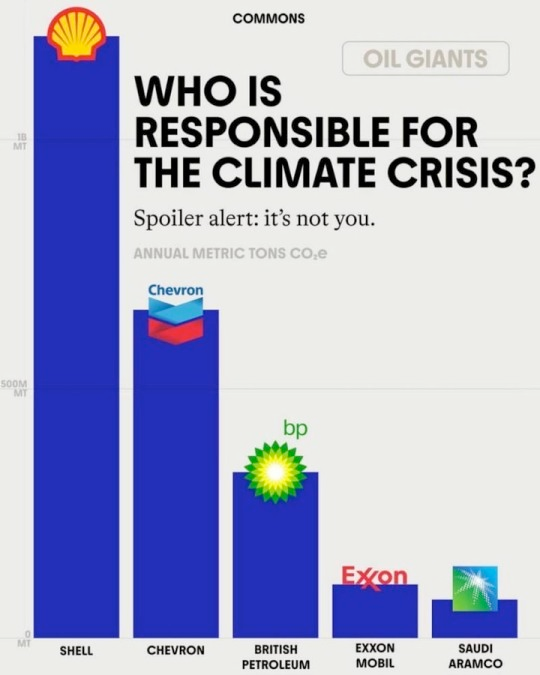
I’m not sure about the data sources for this image but from some quick research it looks like this includes scope 3 (end user emissions) for shell and chevron by not the others. The data realistically looks a bit more like this:
🇸🇦 Saudi Aramco: ~2.0 Billion metric tons (Estimated; excludes Scope 3 from official tracking) 🇬🇧 Shell: ~1.1 Billion metric tons 🇺🇸 ExxonMobil: ~813 Million metric tons 🇺🇸 Chevron: ~600 to 780 Million metric tons (Varies by accounting method) 🇬🇧 BP: ~400 Million metric tons
Context: For all these companies, Scope 3 makes up 85% to 95% of their total climate impact. This is why state-owned giants like Aramco and US majors like Exxon/Chevron focus their climate targets almost entirely on their own drilling operations (Scope 1 & 2) while excluding the footprint of the products they sell.
In any case this is pretty bad and we are probably gonners.
We ought to seize all the top companies.
They’re just holding companies. They don’t make anything. They don’t produce anything. They just bleed off a kick, like a mob boss, and use those gains to amass political power.
Seize them all and use the assets (and annual profits) to fund American society.
No thanks, BP and Saudi Aramco already prop up the US enough.
>>“Spoiler alert: it’s not you”
>>proceeds to display a chart of companies who sell a fuel we all use
If you can spot me $30,000 I’ll get an electric car today
But it is us, secondarily because we run our gas cars and such.
Not even secondarily, imo, but like thirdly and fourthly. A lot of people don’t have the option to not drive. I’d say it’s a sad privilege to have a reliable public transportation system.
Where does the money they get come from?
Oil extraction
You’re confused.
The money comes from you. I welcome you to no longer use a car and walk to the job. Poof, suddenly their profit falls. Multiply that by a society, and suddenly much of these firms can no longer exist.
The question has always been about how much humans are willing to sacrifice to save the earth, and the answer has pretty much always been “best I can do is blame a placeholder (some CEO/company, doesn’t matter which one, because it’s just demand from society and there will always be new companies as long as there is demand from you and me) and assume it’s 100% their fault”
Don’t get me wrong, this isn’t really an individual problem, it’s how society/humans work. We’d vote for someone who speaks against oil, but hang them as soon as the oil price goes above 5$
I don’t own a gasoline car you fool
I want the price of oil to be $2028 a gallon
The products you buy were made in factories powered by fossil fuels, shipped across oceans in fossil fuel powered ships, and arrive at the shop in fossil fuel powered trucks. The food you eat is fertilized with fossil fuels, and the industrial growing, processing, and packaging process puts carbon into the atmosphere. The streets you walk on are made from concrete, which releases carbon into the atmosphere from the chemical process used to synthesize it. And even if you live some magical life where you can avoid personally paying the cost of all of these things, the same is not true of everyone else, who needs to drive cars to work on asphalt highways, heat their homes with wood/propane/ng stoves, eats industrially produced food, and have all this economic activity protected via a fossil fuel powered military. And an increased price of carbon means that their lives cost more, which means they need higher wages, which means everything they produce that you might buy also gets more expensive.
I don’t disagree with you that gas prices should be higher. In fact, I think the only way to get from here to there is to appropriately price carbon. But to act like there is no potential for hardship among average people - that there arent legitimate challenges to weening off the carbon-heavy economy we are used to - is disingenuous at best
I know for a FACT that Shell bought up every patent it could on Hydrogen use in the 1960’s. My dad worked in England back then in the main office; way up in the tree and he witnessed this himself. FACT. Maybe I’m not completely clear: F A C T !!! He told me when I was a boy and I never forgot. (Was I clear? FACT!!!)
What do you have to be a TOTALLY ROTTEN COMPANY to even NOW not use those inventions and implement Hydrogen as a fuel so the world will be saved.
I truely HATE Shell with all my guts.
Green hydrogen only works when you have more energy than needed and you’re 100% renewable electricity. You could have done that with nuclear power in the 60s in theory. But solar in abundance is the only likely route it will work.
The point wasn’t that we should go all-in on hydrogen. The point was that they’ve been actively suppressing alternatives to oil for the better part of a century
Hydrogen will never be a viable fuel and will never save the world. It leaks like hell, has a low energy density so it needs to be either highly compressed or highly refrigerated to liquify it to be even usable for something that is moving, which needs a lot of energy and induces a lot of constraints.
Basically, everywhere where electricity is a meaningful solution, hydrogen is just outclassed. Which leaves heavy industries and maybe cargo ships. The rest must either electrify, or just go.
Y’know we could have had spaceships each since the 1930s, right?
Or even just running our cars on seed oils, like hempseed oil, or plant derived ethanol.
Or even just running our cars on water.
… If they’d stop killing inventors and stop abusing the patent system to secretize emancipatory technologies.
I believe they crush technologies, but most of the things you mentioned aren’t true. There were no spaceships possible in the 1930s. Why crush that technology when they could have conquered the world with it? It’s not possible to run cars on water. The thermodynamics just doesn’t make sense. We have cars that run on biofuel, but mass-converting vehicles to that would drive up costs of food. Ethanol for fuel already does that by using farmland that could grow food.
They left of china and India…