- cross-posted to:
- lemmyshitpost@lemmy.world
- cross-posted to:
- lemmyshitpost@lemmy.world
You must log in or register to comment.

“welp”
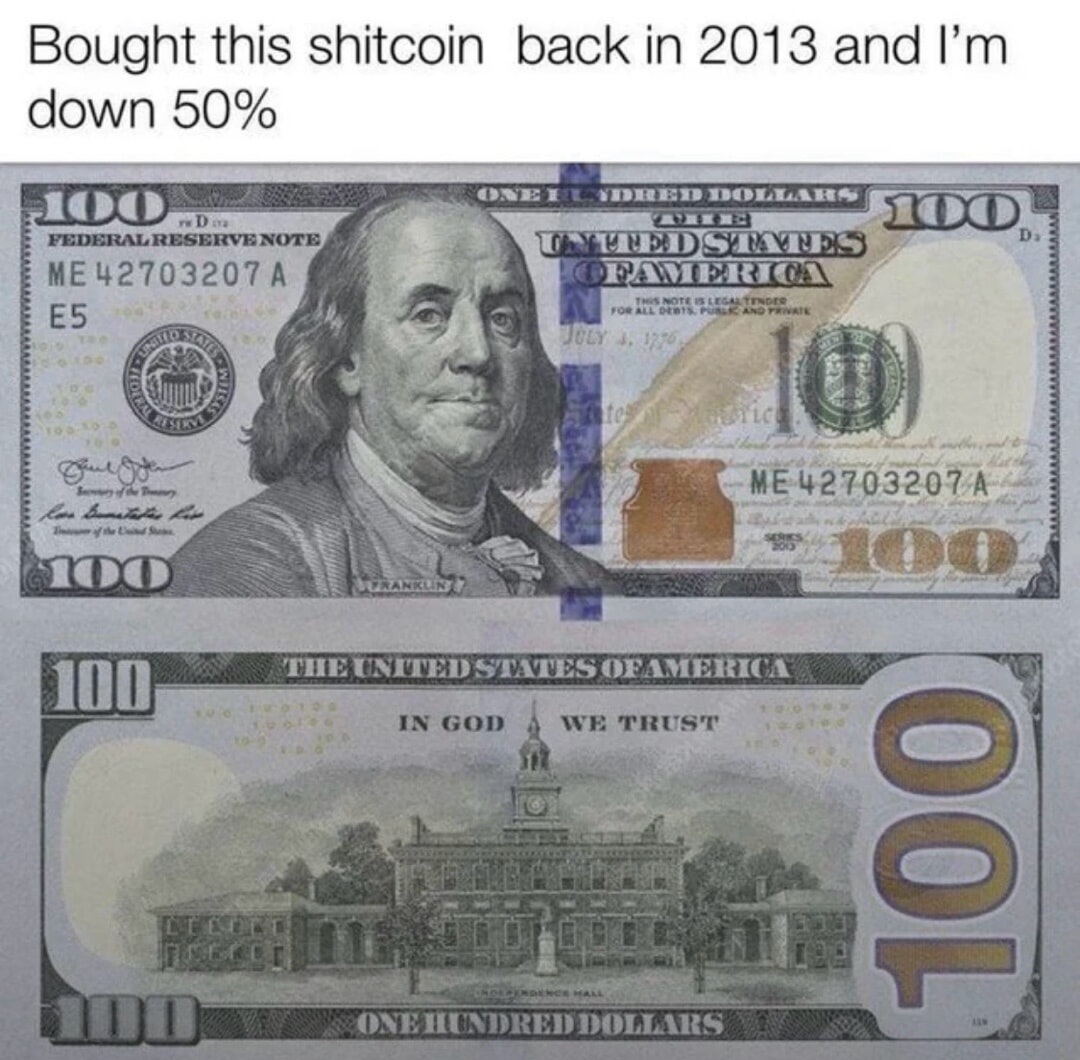
Benjamin Franklin smirked like that in his photo because he always knew.
Nah, he was thinking of ho-ors.
a) he was a ho-er
b) he slapped me and challenged me to a dual in New Jersey
w’hores
Hewers
Not long ago, I found a $100 bill at our local gas station.
I picked it up by the trash can, figuring it was probably a church fake.
It wasn’t a fake at all, it was a real $100
I make point to check by those pumps everytime I pass by that gas station…
You should leave a note. “Did you lose $100 here? Please do it again. Ha ha!”
I unlocked some sick alpha by exchanging those for drugs and then selling those drugs in smaller plastic bags
Fent is only like US$20. Don’t OD.
Fucking trash shit coin. I lost my ass on this too.
Down 50% already?
I’ve got a crisp $50 in my pocket. I’ll trade you for it.
That $50 is only worth $25 in goods or services.
I’m happy to pay you $25 for it!
Those $25 are only worth $12,50 in goods or services.
What’s with the comma? Don’t you know in usd it’s a . or decimal.
$12.50 in goods.
In europe it’s the opposite. We use the comma for this. So $100.000,45 is one hundred grand and 45 cents.
May I ask, how often are you paying with USD or a 100 dollar bill in Europe?
I know a guy
Not at all.
If you compare it with Gold - against which the USD moved in lockstep until the US left the Gold Standart - it’s a lot worse than just a 50% loss since 2013, more like a 65% of value.
The fall is probably the same in terms of real inflation (as actually felt by people in terms of how much less their money buys) - the official inflation figures understate inflation (probably because the mathematical calculation for GDP involves raw GDP being deflated by inflation, so the less the official inflation is the more politicians can harp about how much they made GDP “grow”) and this has been going on for decades, which is why a single blue collar salary that used to be enough for a good house, a car and the expenses for a family of 5 in the 60s, now can barelly pay the rent of small appartment in a major city.
More like the price of gold is artificially inflated far beyond any actual value.
which is why a single blue collar salary that used to be enough for a good house, a car and the expenses for a family of 5 in the 60s, now can barelly pay the rent of small appartment in a major city.
Except this isn’t remotely true. For American’s you had the 62% home ownership in 1960’s for much smaller homes (on average 700 sqft) vs 65% now for an average of 2000sqft. The average American family in 1960 owned 1 vehicle, they now own 2. They went on less vacations, moms typically had to work on top of taking care of the family (little to no daycare), oh and interest rates were much higher as well (on top of that pesky women couldn’t even own a home by themselves). Single person living was roughly 10% vs 30% now, oh and those hard working dads often didn’t live by a year past retirement. And if you were a minority? You absolutely were f’ed.
Yes, costs are higher now relative to income, but demands also are. Want cheap, you move out to rural areas, but risk you don’t have work. The same problem that has been endemic in the US since it’s inception.
Yes, costs are higher now relative to income, but demands also are.
There is a dangerous underlying logic to this line of reasoning. Treating all technological innovation as an added cost to be borne by the end consumer leads to one inescapable dead end. Yes, sometimes there are actual costs. If so, fine. However, this blanket notion of hedonic price adjustment increases wealth inequality with no end. It isn’t a sensible and we should be thankful our ancestors were not so foolish or we’d all be living in trees or caves right now.
Or perhaps consumerism should lay off. Wealth doesn’t happen when people don’t buy things they don’t need.
whoosh
62% home ownership in 1960’s for much smaller homes (on average 700 sqft) vs 65% now for an average of 2000sqft
62% -> 65% sounds reasonable.
700 sqft on average -> 2000 sqft on average is suspicious though. It’s possible stats got skewed by the top 1%, who are today richer than ever before, and own ridiculous amount of property. Median sqft perhaps would be more representative
Median square foot is close to the same. It’s cheaper to build larger than smaller in the US because of the space for expansion and developers aren’t being forced to pay for services needed when they expand suburban areas.
If you compare it with bitcoin it’s even worse. Both aren’t great comparisons, the US left the gold standard so long ago it’s not a meaningful comparison.
But that wouldn’t be a fair comparison. The prices of gold and dollars are stable. Bitcoin was invented in 2009 and is still in price discovery.
It’s almost like that’s my point.
Ah I thought you were implying bitcoin was stable my bad
Ah, aha, all good
Meme aside, is this based on inflation? Some sort of global market?
If it’s inflation it’s not accurate. 100 2026 dollars is equivalent to 70 2013 dollars (not $50).
Just trying to fact check the math. I’m fun at parties.
I think if you include cost of living and cost of purchasing property, the US dollar is easily 50% less effective now than in 2013.
April 2013 one BTC was 90 dollars, so it’s actually down a lot more than 50%
Don’t remind me I once had hundreds of Bitcoin worth $300 total and sold because that was a huge profit lol
“Erm, buddy, you know that’s not how they actually make milkshakes” type energy bud

deleted by creator
You’re drinking 3/4 of a LITER of milkshake?
The only stable meme coin is gold
I prefer Joules myself
Gold to usd lost 30% since 2013
I thought gold was immune to all this because there was a more less fixed amount
Not how economics works. The price of gold fluxuates wildly because demand for it fluxuates wildly, because people keep gambling on the value of gold.
It’s not called Fiat currency for no reason. There’s lots of rumors of a global switch to state backed crypto coins or purely digital currency. That way the normal people can’t hide any money, their money can be turned off unlike cash.
We already have mostly digital currency.
Money is created when a bank creates a loan, by starting with nothing and then splitting that nothing into a credit in one account (the borrower’s checking account, usually) and a debit in another (the borrower’s loan balance). From there, most transactions are digital where an ACH transfer or similar results in some numbers being subtracted from one account and added to another.
Almost all of this happens on computers, and even before computers it just happened literally on a paper ledger, with paper checks.
You might ask, “wait where does the bank get its money from to be able to allow money to be withdrawn or transferred to another bank?” If the bank doesn’t have the liquidity to do so, it can always borrow money from other banks or the government, with the last resort in the United States being the federal reserve banks, who by the way also print all the paper currency. So having that backstop is important for regular banks to have the power to create money, but the actual creation of money happens digitally to begin with, regardless of whether the bank later needs to distribute paper bills or borrow from the federal reserve.
Well only central banks can create it out of thin air. Normal banks lend other people’s money (fractional reserve banking)
Not exactly. The central banks acting as a lender of last resort encourage the commercial banks to create money in this way, but be assured that the actual creation occurs whether the bank needs to borrow money or not. The definition of money supply looks to the balances in checking accounts, and creating and disbursing a loan increases the balance in a checking account (while simultaneously increasing the negative balance in a loan account, but loan balances don’t shrink the money supply), and as that money is spent it increases balances in someone else’s checking account.
Not how it works. a bank can’t just magically issue loans in a vacuum without caring about liquidity, because the second a borrower spends that money, the bank has to cough up real central bank reserves to settle with another institution or go broke.
So the question becomes, does the money get created when it is put in a deposit account balance, or when it gets spent outside the bank for the first time?
The textbook answer is that the money is created as soon as the deposit balance is created, not when the account holder spends it down enough to where the bank needs to borrow to maintain liquidity. It’s how the Fed counts M1, for example.
The bank’s need to actually run a viable business, and central bank regulations, prevents it from going nuts with this, but that’s beside the point of what I’m saying: a bank doesn’t need the central bank’s permission or approval to create money by extending loans. In the aggregate, central bank policy affects the way all the different banks do this, but the end result is that the banks can create a shitload more money than there are reserves (and the reserves don’t need to be physical currency, either, since they can just be balances in accounts with other financial institutions).
That’s not how any of it works though.
It’s how all of it works. Money is just balances on double-entry bookkeeping, and the paper currency essentially is a piece of paper that the bearer of that paper is good for moving the balances in that ledger system.
And almost all of those ledgers are now digital.
By that logic any bank could grow arbitrarily large by just underwriting more loans. Then there’d be no competition between any of them and my job would be so much easier.
Yes, the limit to commercial bank lending is creditworthiness and default risk (because the bank is left holding the bag when a borrower doesn’t repay), and the cost of maintaining liquidity (the bank can borrow against the loans it owns, but it may cost a higher interest rate than they’d earn on the cash they’ve lent out). This paper lays it out pretty clearly, and is basically the near unanimous view among macroeconomists.
Or, in some regulatory environments, banks are required to maintain a minimum fractional reserve, which limits the total amount of loans it can lend out with its underlying assets.
But the money is created when the loans are created, and destroyed when the loans are repaid. The other stuff behind the scenes to give the system stability is important, but doesn’t actually create or destroy money.
Exactly. The bank can borrow, for which they need collateral, which sufficiently proves that what you’re saying is wrong.
They have to manage their balance sheet actively, and your original statement was in the lines of ‘it’s all made up and they have infinite equity supply’.
Read my original comment again. I explicitly talk about banks borrowing to maintain liquidity. It’s an important limit on their ability to create money, and nobody said anything about infinite money supply.
But it doesn’t change the fact that the act of money creation is caused by a bank creating a loan, and the money comes into being without a single physical act of manufacturing: it happens on a computer, and before computers it happened on paper.
So without claiming that money was unlimited, I did point out that money itself is overwhelningly digital in the modern age. And the limits don’t come from any physical constraints.
Good, holding currency and wealth is bad for society.
I seem to remember needing currency to buy goods and services needed to stay alive.
But you don’t need to hold on to it for decades.
The point of the post is that now the dollar has less value but the government didn’t do anything to ensure that you either get more dollars or the price of things don’t skyrocket every 6 months
That’s false on multiple levels.
For one, median real wages have been fairly stable and in fact have modestly increased in recent years, meaning wages did in fact increase alongside prices and you (or at least the median American) did “get more dollars.” This is no surprise - if there is inflation because money loses value, then the price of labour increases just as the price of goods and services does.
Secondly, the deliberate government policy is to aim for modest inflation of a few percent since the economic consensus is that this is beneficial for financial stability. So inflation is not a bug, it’s a feature. For the most part, monetary policy has been successful in achieving this goal in recent decades, aside from a brief inflation spike during Covid.
Finally, prices have not “skyrocketed” at all, not even during the Covid inflation spike, this is just hyperbole.
If you’re gonna lie try to make it believable dumbass