Mitigating actions are celebrated, while preventative measures are ignored, or even mocked as unnecessary.
The people designing and building large machinery and cars dont ever have to maintain them
The asphalt pavement of roads must be 4 inches thick to last forever. 3 inches lasts 5 years, 2 inches lasts one year, 1 inch is crumbling before you finish. You constantly see crumbling roads in the third world because of corruption, they don’t put as much pavement down as they charge for.
Now that’s a concrete fact
An asphalt fact, rather. Asphalt facts have lower modulus, so they are more adaptable to the point of the conversation.
The borders between countries in the Middle East including India/Pakistan were deliberately drawn to cause conflict. Of course when that conflict started to come back home everyone was shocked pikachu faced about it. I really don’t understand why people of those countries don’t just throw away the map and sort it out amongst themselves like adults, but I guess expecting world leaders of a majority of countries to act like adults is a bit much to ask most of the time.
kashmere, and northern india/bordering china. one wants the whole terrority the other wants the same, a pretense to expand later on.
You need to test your restore procedure all the way through & periodically to have confidence in your backups
Among many other reasons, the biggest reason for me that the US stock market cannot be trusted is because market makers combine 3 techniques to create fraud and push risk to others to dilute unwitting companies and investors: borrow stocks, selling a borrowed stock to buy later, strategically failing to deliver stock.
Borrowing stocks doesn’t create a clean paper trail, can be done repeatedly, and steals shareholder votes.
Selling a borrowed stock to buy later can strategically intend to fail from the start where they don’t even have to locate (not even acquire as you might assume) a share to borrow, effectively creating new shares out of thin air. Market makers in the US can legally do this, even for the benefit of their hedge fund counterparts (sometimes under the same company).
Fails for stock delivery are allowed, so they’re a strategy. Cash in lieu is not the same as share ownership. Cash is fungible, stocks are not, and this gap can create technically infinite risk.
Your infinite risk is my infinite gain 🍌
Nah, the stock markets were fixed in 2008!
They created dark pools.
But in seriousness this unrealistic playground should be completely separated from real economics and fucks everything up.
There’s no way to make a backdoor for encryption that keeps the encryption secure. Politicians and government flunkies can’t seem to wrap their pea brains around that concept.
Adding an extra lane to a congested road will always cause that road to be more congested, and will also increase traffic on nearby roads.
When China removed a highway, it reduced car traffic thought the entire city while not reducing the number of people travelling to and around the city.
The only solution to car traffic is viable alternatives to driving.
Tangential but nobody seems to know how to drive in traffic. Pick a lane and stay in it, leave extra following distance, and try to change speed as smoothly as possible. If everyone did these three things, traffic congestion would be significantly less severe.
Don’t forget zipper merging. I lived in an area where hundreds of hours spent commuting allowed me to observe the inability to merge was the primary driver of freeway congestion.
The main problem I’ve observed with zipper merging is nobody can seem to agree on what it is. People get aggressive when you try to use the available space on the road, and in discussions online it seems people think you’re trying to queue jump if you don’t merge as early as possible.
Probably not always. You build a 12 lane road entirely within a random small town, and it will stay empty and stupid. But, in the range of what actually might be built, yes, there’s pretty strong empirical evidence that cars fill any available space.
Which this actually isn’t a straight example of, exactly. Jevon’s paradox says more and better roads will mean more cars operating, not less. That happens, but in this case the increase is so great, that it leads to the same level of congestion on the roads all over again.
The wiki uses the example of coal. Better boilers and engines increased the use of coal, but it’s fair to say industrial Europe had better coal powered equipment afterwards, not the same or worse. (Although, to be fair, congestion is only one metric of traffic performance)
I agree, Jevon’s is not the perfect way to describe this affect. Is there a better way to classify this? It’s bugged me for a bit as I’ve had good debates about adding biking lanes and better sidewalks instead of just more lanes for cars. But Jevon’s is the best I could come up with.
No, it’s relevant enough, thanks for bringing it up.
You could say something about the elasticity of road usage being 1, but if you’re not a wonk that means nothing. Induced traffic is another technical term you might see around. Saying “research suggests another lane means an equal number of additional cars, eventually” is about what gets the best comprehension.
This is definitely not always true. They added a lane in my city a few years ago and my commute went from 45 minutes to 30 minutes.
IIRC the trend is observed over longer periods, where it feeds into people’s decisions about whether to have a car or second car, and how far to commute. And even then, congestion and travel time are two different things - an extra lane probably makes no difference, but a new route or higher speed limit will get you there faster regardless.
this logic asssumes more road == population growth
sure, and telescopes created all the stars in the sky.
The number of car-hours per person per year isn’t even close to fixed over the long run. The trend is basically that in the past, people might have carpooled, taken a bus or even hitchhiked, and usually lived close to their job. If the roads get better, they drive more.
so your idea is installing a system is pushing for classism and hoping to furthering socioeconomic downturn on the landscape of select neighbourhoods with select individuals with large populations that are struggling, paying the most taxes, yet expected to travel for lower wage jobs and you want to make their travel to work harder.
how bigotted.
WTF are you even saying, we’re talking about cars.
The longevity of concrete isn’t just tied to the cylinder break strength.
Also, concrete with certain aggregates end up creating silica gel, which is bad for concrete.
This is indeed a concrete technical fact!
Well, played, my friend, well played.
Got to make sure I’m providing what OP wants.
Which aggregates?
What are some other tests you can use to decide which concrete is best for you?
Aggregates with a lot of unstable silica like strained quartz can cause the creation of silica gel when exposed to cement. The aggregate supplier should be the one running tests to prove they don’t have reactive silica.
Other tests include air entrainment and the slump test. The concrete mix requirements should be chosen by the engineer or architect.
Good to know, thank you!
Hundreds of years of burning coal has spread mercury compounds all over the land, so that quite often when they build a new dam for hydroelectric power it’s dissolved into the water and ends up concentrated in fishes that people eat.
Man, humans have fundamentally and irreversibly fucked up this planet. We burn coal, so we have that problem you mentioned. I learned recently how chemical companies have done decades of a poor job just dumping chemical waste wherever they want or developing things that does more harm than good at the planet’s expense.
Enjoy it while it’s here I guess.
having to be careful about how much fish you eat due to mercury is one of the top dystopian things to me. People think about agriculture and grains with civilization but when you look at how important and common fish was to our diet for so long. Its crazy.
And they feed fish products to cows and chickens. The mercury should be there, too.
also its organic mecury, which is more toxic than the metallic form.
I dunno man, sounds fucking woke to me
its all big alchemy immortals trying to keep mercury’s benefits under wraps
I KNEW Qin Shi Huang was still around, fucking us from the past!
Inheritance.
Lol what
He’s obviously talking about the book series by Christopher Paolini.
Software dev.
The “magical formula” for stairs.
If this rule isn’t followed when building stairs, then it feels uncomfortable and more accidents will actually happen there.
In easy terms, it says: 2x riser + tread = average step lenght, usually 63cm.
I come from a family of carpenters, building all kinds of stairs for most of my life, and I’ve never heard of this. This is why I love construction; learn something new all the time. Thanks!
Oh man I hate it when stairs are not built to the proper ratio. It feels so weird.
I’m curious how this compares to eras before this formula was normalized and if this is universal or more so just a matter of keeping things the same so people get used to them.
I know of a few cases in religious buildings where stairs were designed to have a mystical effect. In Angkor Wat, for example, the stairs have a steep and tall tread pattern. Commoners weren’t used to them so they’d be exhausted, but the local monks were used to them so they could ascend and descend with ease.
Visit any old city in the UK (York and Edinburgh for example) and a lot of passages between streets have steps with uneven heights.
When you’re expecting it, its fine, you take extra care. But when its a modern building and they’ve fucked it up you really notice
When I did a tour of Edinburgh Castle, the guide said they’d do that deliberately to trip up invaders.
I guess this is why the old-as-balls apartment house I live in, in the middle of the old city, has stair steps go higher further up.
Okay, sure, and watch out for Nessie. /s
Did they point down at a cupboard and tell you it was a tiny dungeon for torturing people, as well? That’s a classic.
Same thing for castles/forts in Portugal.
What if the invaders have the same in their castles at home…? 😉
(No, I don’t believe it at all. They just built something without thinking too much)
You’ve got the same internet I do, friend.
https://usefulbs.com/blog/why-do-old-castle-stairs-often-have-steps-of-deliberately-uneven-heights
[it’s] a modern building and they’ve fucked it up you really notice
How about the stairs leading up from a subway stop?
My house is over 100 years old and all the damn stairs are different.
Yup. Can confirm from Canada. To be fair, they usually got them close to right here.
What part of the world? The house I grew up in is 110 years old and all the steps are even. Central Europe.
New England. When I was looking at houses I went in a few of these as that’s basically a lot of the market here, and most of them had at least one set of stairs I found myself uncomfortable on. Mine aren’t too bad, just narrow and short, but I’m short so it doesn’t bother me really. The attic is the weird one because it’s this set of spiral wooden stairs that leads into a really nice, large, fully finished attic. It could absolutely be another useful space…except…the stairs start out in a bedroom closet.
You have an effin secret lair and complain. Some people, I swear
Yeah. The novelty probably wears off, but from here that sounds neat.
Same here. My stairs seemed to be an afterthought meant to squeeze in where it shouldn’t, built by someone who shouldn’t even been allowed to hold a hammer. I have size 13 feet, they hang several inches over the step when I use them. I’ve went down those stairs faster than intended a few times now. The basement stairs were even worse, but they’ve been replaced now.
This is all so relatable lol… Oh well, have a spooky house with lots of quirks, so can’t really complain.
Ya old houses can be… interesting to say the least lol! The last person that owned this place died on the living room floor about 4 feet where I’m sitting right now. Bonus is I got new flooring out of the deal.
I’m actually slightly surprised it wasn’t the stairs that finished him off.
I mean, did the seller specifically tell you it wasn’t caused by the stairs? They might have just managed to drag themself to the living room before expiring!
Lol well the official cause I believe was a heart attack, but you never know for sure…
I guess in China the number is smaller because the average people are smaller. Otherwise it is universal. It has been found out, not made up arbitrarily.
In german and english, the comma in numbers is swapped. So the number 123.45 in german would be written as 123,45 while ironically, the thing that we used to separate thousands from hundreds is also swapped. So one-thousand-four-hundred would be written as 1,400 in english but as 1.400 in german …
By the way, it’s absolutely not just Germany that does it the other way:
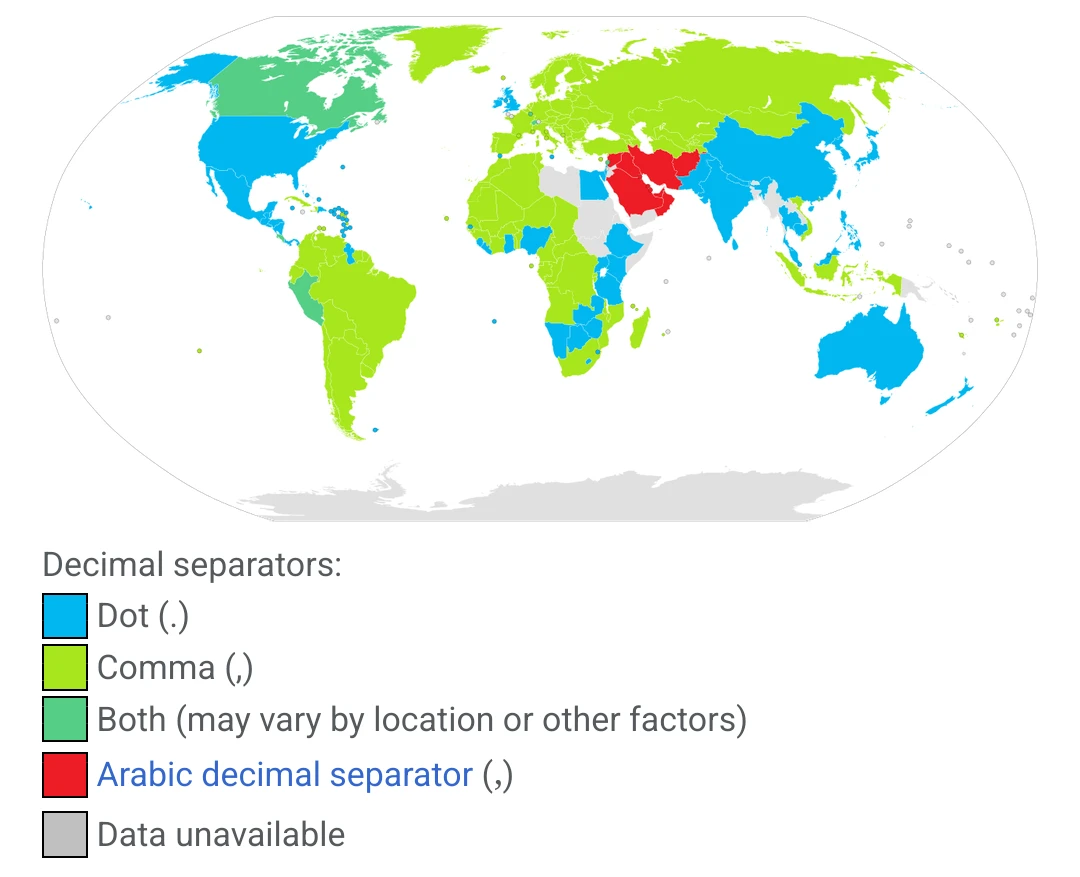
https://en.wikipedia.org/wiki/Decimal_separator#Conventions_worldwide
Unser Weg ist der richtige! 😜
There are many European mechanisms that make more sense to me, like aluminum being “alumINIUM”, as with many other elements.
But periods in the middle of numbers always felt wrong to me. We already have structures for sentences that pause, then eventually close a thought: “Billy played with Susie, and her dog. Cute!” Not “Billy played with Susie. and her dog, Cute!”
On top of that, you would pronounce 678 as six-hundred-seven-ty-eight in english … guess what it is in german:
Sechs-hundert-acht-und-sieb-zig (literally six-hundred-eight-and-seven-ty)
i’m actually trying to change this point specifically because it irks me … but i am sadly alone with it.
But French has a number problem four twenty ten nine times worse.
This is soo nineties!
It’s 1’400 in german.
oh interesting, this is the first time that i see this.
Ah yes, one foot four hundred inches. /s
And even more fun is that some German speaking countries do it like the US. Like Switzerland for example…
money is credit ( debt )