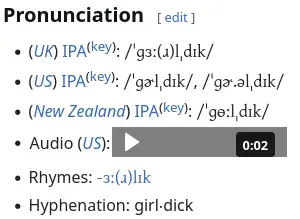
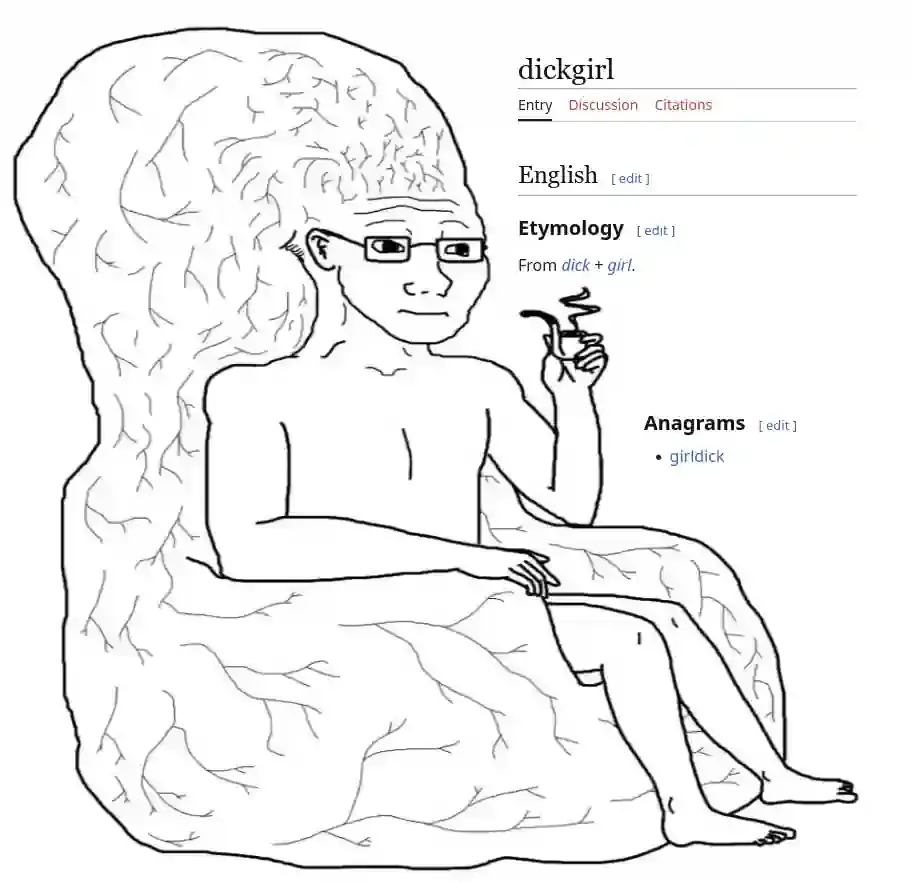
Just want to confirm that Wiktionary is amazing.
Edit: AMA if you’re interested in exploring or contributing to it.
Oh I know a great wikitionary entry too! https://en.wiktionary.org/wiki/sqrk
Is it a good replacement for a normal dictionary or urban dictionary or what is it best used for?
Wiktionary is a sister project of Wikipedia and is to something like the Oxford English Dictionary or Merriam-Webster what Wikipedia is to Britannica.
Re: Urban Dictionary: sort of, but the slang is more curated. The inclusion criteria on Wiktionary are pretty lax, and it’s way more descriptivist than prescriptivist. For example, we have the word “hitstun”, which is fighting game jargon you won’t find in a major dictionary.
A major aspect Wiktionary has that other major dictionaries don’t is that it’s an everything-to-English dictionary (or everything-to-whatever-language, e.g. fr.wiktionary.org is an everything-to-French dictionary). So as a very, very extreme example, this is the English Wiktionary entry for ‘no’, which we have entries for in 91 languages. We even keep track of languages like Akkadian, Klingon, Proto-Indo-European, American Sign Language (ASL), and so on. (In total, we have definitions from over 5100 languages.)
It’s also way more flexible than a standard dictionary. For example, the French entry for Sagittarius (“Sagittaire”) has an image of Sagittarius and a ‘See also’ table of every other Zodiac sign in French. We also, of course, often have links back to Wikipedia. Likewise, (like the Oxford English Dictionary) we keep track of etymology, so for example, you can learn that the word “slogan” comes from Scottish Gaelic for “battle cry”. We keep track of rhymes, anagrams, derived terms, etc. too. And definitions will (ideally) also have real quotations so you can see how they’re used in a sentence.
Probably the main lacking aspect right now is the thesaurus, which exists but is undercooked.
TL;DR: Yes, it can replace a normal dictionary and then some. I don’t think it can replace a normal thesaurus yet for most people.
very good that it’s descriptivist. The everything-to-whatever-language thing sounds interesting, I wonder if it could be used as a translator?
cool!
I wonder if it could be used as a translator?
It’s usually my first stop if I have a word in another language that I want to translate. It pairs well with creating a custom Firefox search engine for Wiktionary and then using a shortcut like
!wt.So for example, if I want to know what “rassurant” means, I can type
!wt rassurant, and it’ll take me to https://en.wiktionary.org/wiki/rassurant.Just to add, it’s a far better resource than my old Oxford Latin Dictionary (overpriced garbage today) for translations, and I really appreciate that they break down all Latin terms by declension (including a declension chart) or with verb principal parts (and their own conjugation charts).
Urban dictionary isn’t really trustworthy, you have to be prepared to get trolled.
For what it’s worth, “dickgirl” is lacking quotations/references on Wiktionary, so we’re failing to live up to attestation standards.
Without that, I don’t know if I’d be comfortable using “dickgirl” in an essay or a game of Boggle or putting it in a spelling bee for fear it isn’t a verifiable word.
Everybody: Do this guy a favor and do not add any source! It’s for the better for everyone involved
Do you have thought about Ethymonline in relation to Wiktionary?
I can say off the bat that Etymonline has a narrower focus of words than Wiktionary (there are fewer English words, and there aren’t etymologies for non-English words except incidentally). And that’s more than fine. Something I like about Etymonline is that, because of its narrower scope, it can potentially be more readable to link somebody to an etymology that isn’t crowded out by e.g. synonyms, related words, rhymes, etc.
Something Wiktionary recently got that I see as lacking in Etymonline is an etymology tree (see: Wiktionary’s ‘apraxia’ and Etymonline’s ‘apraxia’). The Etymonline entry for ‘milk’ (see below) seems to have one, but Wiktionary’s seems more consistent and traversible.
Something small that I actively dislike about Etymonline is that there’s no ‘References’ section at the bottom. They do inline citations (for example, in ‘milk’, they reference ‘Watkins’), but then you often have to actively take an aside to the principal sources page. I also don’t like that the content is under a proprietary license given it’s primarily regurgitating a handful of other authors’ work.
TL;DR: Etymonline is fine, but given it’s the work of non-academics as well, I think it largely can be/has been overtaken by Wiktionary. I’ll bring up ‘milk’ again as a counterexample, though, where I think Etymonline does it better. They (correctly) note that the “plant milk” meaning goes back to the 1200s, whereas this isn’t discussed whatsoever on Wiktionary – where a reasonable user might wonder when people started using “milk” for plant milk. I think overall, you’re likely to have a fine experience using either.
It also anagrams to:
gridlick
… do with this information as you will.
Don’t forget lickgrid!
Mmm, spicy outlet
Definitely saving this for later.