This is not a SFW instance. NSFW communities will be tagged, and efforts will be made to keep SFW communities clean, but proceed at your own comfort level.
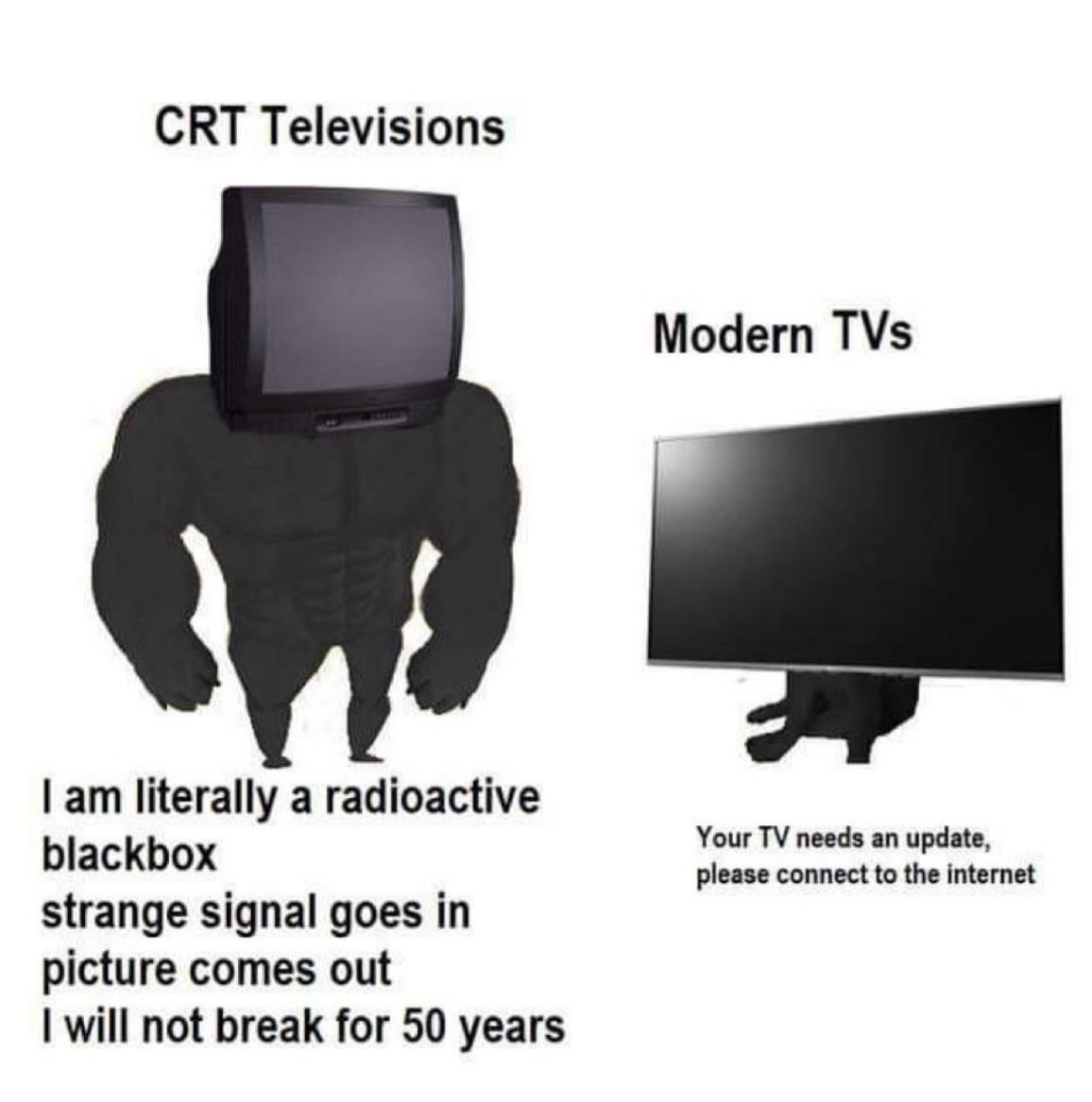
I have some doubts about them not breaking for 50 years.
Definitely.
Our repair shop back in the 80s had free minimalistic TVs you got during repairs.
I remember them standing at least once per year in our living room.
Also, despite all the repairing, my parents had to buy new sets thrice between late 70s and early nineties.
The “in the past stuff lasted forever” imho is a myth heavily fueled by survivorship bias.
Side note about survivorship bias (somewhat unrelated though):
People say “just because something is old doesn’t mean it’s good,” usually in the context of criticizing traditions, conventions, or established norms. Also things like ancient beliefs and classical philosophy.
But the thing is, although it’s true that being old or “ancient” doesn’t make something better than things that are new, withstanding the tests of time for hundreds or thousands of years does indicate that something is at least effective or worth preserving. Obviously things that get disproven or replaced by new innovations don’t fall into that category, so it’s not the same thing as romanticizing the past (which is of course problematic).
It’s not always the case of course, and I’m certainly not a traditionalist. But I find it an interesting example of how survivorship bias can actually be used to affirm a claim of worth or quality rather than negate it. It kinda flips the idea on its head.
The reason I thought of this is because I was reading dall’Agocchie’s descriptions of single-sword guard positions, and he basically says “the names of these guards come to us from previous generations, and they work, so there’s no need to change them.”
I think it’s kind of a long-winded way of saying “if it ain’t broke, don’t fix it.”
If anything, it’s merely a counterpoint to avant-gard philosophy. Like, why deconstruct the principles and techniques of an art form if it works as a structured approach to producing good art, or to learning art forms?
It applies to crafts as well. Wood carving has evolved over time as technology develops, but if you strip it down to the very basics, the principles and techniques are the same as they’ve always been. Use this tool for flat surface, this on for round surfaces, this one for angled surfaces, etc… Work with the grain. Sand from coarse grit to fine grit. These things don’t change, and trying to deconstruct them would just result in a messy sculpture.
It’s not that stuff lasted forever, it’s that things were repairable. That CRT could be repaired, or you could repair your truck. It sucked for sure but it was generally cheaper to repair something than to replace it. Then it became cheaper and easier to replace it than repair it because that one part cost more than buying a new whatever. Now the skills needed to repair things hasn’t been passed down and is becoming a lost skill like many others. For the better, perhaps. What’s good for the scorpion isn’t for the frog one may say.
It’s not just skills not being passed down, but also that as technology has moved on, things have got more complicated, and then the skills needed to figure out why something isn’t working, and what needs doing to fix it plus actually carry out the fix, have got more and more technical, to the point that anyone who could do a repair could also probably get a much better-paying career than repairing things.
That’s not an inherent problem, as a good service manual from the manufacturer could bypass the need to understand all the details of how a device works to identify a root cause, but it’s not in most companies’ interests to provide one that good when regulation doesn’t force them to, so for the most part, things need repairing without help from the manufacturer.
The “in the past stuff lasted forever” imho is a myth heavily fueled by survivorship bias.
Forever might be a bit strong, but recent built in obsolescence and enshittification would like a word. There was a time when longevity was a selling point, this is not that time. If you find that exception, embrace and share.
There was a time when longevity was a selling point
At least to some degree that might be because the special longevity features from former days are often the expected default by now.
Take e.g. cars. While galvanized bodies still where a huge, specifically advertised selling point for premium cars (I remember Audi stressing it), they (or similar approaches) have become the common baseline by now.
The condition of my 15 year old, cheap-ass, 24/7 outside, 200.000 km+ eastern European car would have blown the mind of anyone in the 80s.
And coming back to OPs example: We e.g. only got new LCD monitors at work because the management walked through the office and decided that the yellowy-bleached, 15-year-old monitors were not representative enough any more. From a technical standpoint they were still working totally fine.
Whereas I remember my CRT computer screens during the 90s and early 00s each severely degrade after 5-6 years with smudgy, unevenly lid, progressively darker getting images, or just deciding to stop working with a bang (like my beloved 17’’ did some day).
Or take e.g. the now standard LED lights compared to any lighting solution from just 20 years back.
built in obsolescence and enshittification
While this exists (especially when dealing with firmware-enabled devices), back in the days you just had real obsolescence instead.
Tech between roughly 1980 and 2010 was changing so rapidly, you were constantly upgrading or switching, especially for consumer electronics and IT, while we now have reached a plateau with much slower progression.
I am typing this on a 2015 entry level laptop, my E-Book-Reader was build in 2011 and my kids are totally happy playing 10 year old console games.
And regarding enshitification: If your product is shit from the start, you don’t even need that, see e.g. the car example from above…
Yes, things are not perfect by far yet, and some certainly even have regressed, and we should definitely strive to improve those things.
But I don’t see a point in trying and only looking at the gloomy side of things, downplaying everything that already has improved tremendously from 30 or 40 years ago.
Yeah, valid, enshittification as per Doctorow mostly applies to systems you can change on the fly ( e.g. firmware-enabled devices) and engineered obsolescence (and indeed the march of progress making things genuinely obsolete) is not new. It’s just that so many physical products are worse than they were (not Toyotas, taps that used to last 50+ years and are lucky for a couple of years now, washing machines) that the term expanded. Some MBAs decided making ‘good enough’ cheap crap creates a ‘revenue stream’ when people have to replace it.
Technology does indeed progress, and many times that’s a good thing (and not just a cheaper way to get a product sold. LED lights are great). 9 Billion people leads to a lot of good ideas, not a doomsayer, but I’d still like focus returned to longevity and quality in some way that advertisers can’t fuck up. One can dream, I get sick of having to constantly research products to see if I’m going to need to do it again in a short time.
Okay but that’s still better than the 4 years I got out of my most recent LG before it got the blue death that is not repairable. Not to mention that I have only ever had one CRT die on me in my life and still have 2 in the garage.
I have a 10 year old TV which is in the sweet spot and still going strong. If it ever breaks I’ll be upset because I don’t really want a 2026 overpriced piece of trash.
Definitely.
Our repair shop back in the 80s had free minimalistic TVs you got during repairs.
I remember them standing at least once per year in our living room.
Also, despite all the repairing, my parents had to buy new sets thrice between late 70s and early nineties.
The “in the past stuff lasted forever” imho is a myth heavily fueled by survivorship bias.
Side note about survivorship bias (somewhat unrelated though):
People say “just because something is old doesn’t mean it’s good,” usually in the context of criticizing traditions, conventions, or established norms. Also things like ancient beliefs and classical philosophy.
But the thing is, although it’s true that being old or “ancient” doesn’t make something better than things that are new, withstanding the tests of time for hundreds or thousands of years does indicate that something is at least effective or worth preserving. Obviously things that get disproven or replaced by new innovations don’t fall into that category, so it’s not the same thing as romanticizing the past (which is of course problematic).
It’s not always the case of course, and I’m certainly not a traditionalist. But I find it an interesting example of how survivorship bias can actually be used to affirm a claim of worth or quality rather than negate it. It kinda flips the idea on its head.
The reason I thought of this is because I was reading dall’Agocchie’s descriptions of single-sword guard positions, and he basically says “the names of these guards come to us from previous generations, and they work, so there’s no need to change them.”
I think it’s kind of a long-winded way of saying “if it ain’t broke, don’t fix it.”
If anything, it’s merely a counterpoint to avant-gard philosophy. Like, why deconstruct the principles and techniques of an art form if it works as a structured approach to producing good art, or to learning art forms?
It applies to crafts as well. Wood carving has evolved over time as technology develops, but if you strip it down to the very basics, the principles and techniques are the same as they’ve always been. Use this tool for flat surface, this on for round surfaces, this one for angled surfaces, etc… Work with the grain. Sand from coarse grit to fine grit. These things don’t change, and trying to deconstruct them would just result in a messy sculpture.
It’s not that stuff lasted forever, it’s that things were repairable. That CRT could be repaired, or you could repair your truck. It sucked for sure but it was generally cheaper to repair something than to replace it. Then it became cheaper and easier to replace it than repair it because that one part cost more than buying a new whatever. Now the skills needed to repair things hasn’t been passed down and is becoming a lost skill like many others. For the better, perhaps. What’s good for the scorpion isn’t for the frog one may say.
It’s not just skills not being passed down, but also that as technology has moved on, things have got more complicated, and then the skills needed to figure out why something isn’t working, and what needs doing to fix it plus actually carry out the fix, have got more and more technical, to the point that anyone who could do a repair could also probably get a much better-paying career than repairing things.
That’s not an inherent problem, as a good service manual from the manufacturer could bypass the need to understand all the details of how a device works to identify a root cause, but it’s not in most companies’ interests to provide one that good when regulation doesn’t force them to, so for the most part, things need repairing without help from the manufacturer.
Ah there’s the real issue, capitalism lol
You are certainly right, but that is not what OP’s meme was about…
Forever might be a bit strong, but recent built in obsolescence and enshittification would like a word. There was a time when longevity was a selling point, this is not that time. If you find that exception, embrace and share.
At least to some degree that might be because the special longevity features from former days are often the expected default by now.
Take e.g. cars. While galvanized bodies still where a huge, specifically advertised selling point for premium cars (I remember Audi stressing it), they (or similar approaches) have become the common baseline by now.
The condition of my 15 year old, cheap-ass, 24/7 outside, 200.000 km+ eastern European car would have blown the mind of anyone in the 80s.
And coming back to OPs example: We e.g. only got new LCD monitors at work because the management walked through the office and decided that the yellowy-bleached, 15-year-old monitors were not representative enough any more. From a technical standpoint they were still working totally fine.
Whereas I remember my CRT computer screens during the 90s and early 00s each severely degrade after 5-6 years with smudgy, unevenly lid, progressively darker getting images, or just deciding to stop working with a bang (like my beloved 17’’ did some day).
Or take e.g. the now standard LED lights compared to any lighting solution from just 20 years back.
While this exists (especially when dealing with firmware-enabled devices), back in the days you just had real obsolescence instead.
Tech between roughly 1980 and 2010 was changing so rapidly, you were constantly upgrading or switching, especially for consumer electronics and IT, while we now have reached a plateau with much slower progression.
I am typing this on a 2015 entry level laptop, my E-Book-Reader was build in 2011 and my kids are totally happy playing 10 year old console games.
And regarding enshitification: If your product is shit from the start, you don’t even need that, see e.g. the car example from above…
Yes, things are not perfect by far yet, and some certainly even have regressed, and we should definitely strive to improve those things.
But I don’t see a point in trying and only looking at the gloomy side of things, downplaying everything that already has improved tremendously from 30 or 40 years ago.
Yeah, valid, enshittification as per Doctorow mostly applies to systems you can change on the fly ( e.g. firmware-enabled devices) and engineered obsolescence (and indeed the march of progress making things genuinely obsolete) is not new. It’s just that so many physical products are worse than they were (not Toyotas, taps that used to last 50+ years and are lucky for a couple of years now, washing machines) that the term expanded. Some MBAs decided making ‘good enough’ cheap crap creates a ‘revenue stream’ when people have to replace it.
Technology does indeed progress, and many times that’s a good thing (and not just a cheaper way to get a product sold. LED lights are great). 9 Billion people leads to a lot of good ideas, not a doomsayer, but I’d still like focus returned to longevity and quality in some way that advertisers can’t fuck up. One can dream, I get sick of having to constantly research products to see if I’m going to need to do it again in a short time.
Okay but that’s still better than the 4 years I got out of my most recent LG before it got the blue death that is not repairable. Not to mention that I have only ever had one CRT die on me in my life and still have 2 in the garage.
Modern TVs are literally designed to fail faster so you have to replace it sooner.
https://youtu.be/hLUsopY-4eo
I have a 10 year old TV which is in the sweet spot and still going strong. If it ever breaks I’ll be upset because I don’t really want a 2026 overpriced piece of trash.