This is not a SFW instance. NSFW communities will be tagged, and efforts will be made to keep SFW communities clean, but proceed at your own comfort level.
The “in the past stuff lasted forever” imho is a myth heavily fueled by survivorship bias.
Forever might be a bit strong, but recent built in obsolescence and enshittification would like a word. There was a time when longevity was a selling point, this is not that time. If you find that exception, embrace and share.
There was a time when longevity was a selling point
At least to some degree that might be because the special longevity features from former days are often the expected default by now.
Take e.g. cars. While galvanized bodies still where a huge, specifically advertised selling point for premium cars (I remember Audi stressing it), they (or similar approaches) have become the common baseline by now.
The condition of my 15 year old, cheap-ass, 24/7 outside, 200.000 km+ eastern European car would have blown the mind of anyone in the 80s.
And coming back to OPs example: We e.g. only got new LCD monitors at work because the management walked through the office and decided that the yellowy-bleached, 15-year-old monitors were not representative enough any more. From a technical standpoint they were still working totally fine.
Whereas I remember my CRT computer screens during the 90s and early 00s each severely degrade after 5-6 years with smudgy, unevenly lid, progressively darker getting images, or just deciding to stop working with a bang (like my beloved 17’’ did some day).
Or take e.g. the now standard LED lights compared to any lighting solution from just 20 years back.
built in obsolescence and enshittification
While this exists (especially when dealing with firmware-enabled devices), back in the days you just had real obsolescence instead.
Tech between roughly 1980 and 2010 was changing so rapidly, you were constantly upgrading or switching, especially for consumer electronics and IT, while we now have reached a plateau with much slower progression.
I am typing this on a 2015 entry level laptop, my E-Book-Reader was build in 2011 and my kids are totally happy playing 10 year old console games.
And regarding enshitification: If your product is shit from the start, you don’t even need that, see e.g. the car example from above…
Yes, things are not perfect by far yet, and some certainly even have regressed, and we should definitely strive to improve those things.
But I don’t see a point in trying and only looking at the gloomy side of things, downplaying everything that already has improved tremendously from 30 or 40 years ago.
Yeah, valid, enshittification as per Doctorow mostly applies to systems you can change on the fly ( e.g. firmware-enabled devices) and engineered obsolescence (and indeed the march of progress making things genuinely obsolete) is not new. It’s just that so many physical products are worse than they were (not Toyotas, taps that used to last 50+ years and are lucky for a couple of years now, washing machines) that the term expanded. Some MBAs decided making ‘good enough’ cheap crap creates a ‘revenue stream’ when people have to replace it.
Technology does indeed progress, and many times that’s a good thing (and not just a cheaper way to get a product sold. LED lights are great). 9 Billion people leads to a lot of good ideas, not a doomsayer, but I’d still like focus returned to longevity and quality in some way that advertisers can’t fuck up. One can dream, I get sick of having to constantly research products to see if I’m going to need to do it again in a short time.
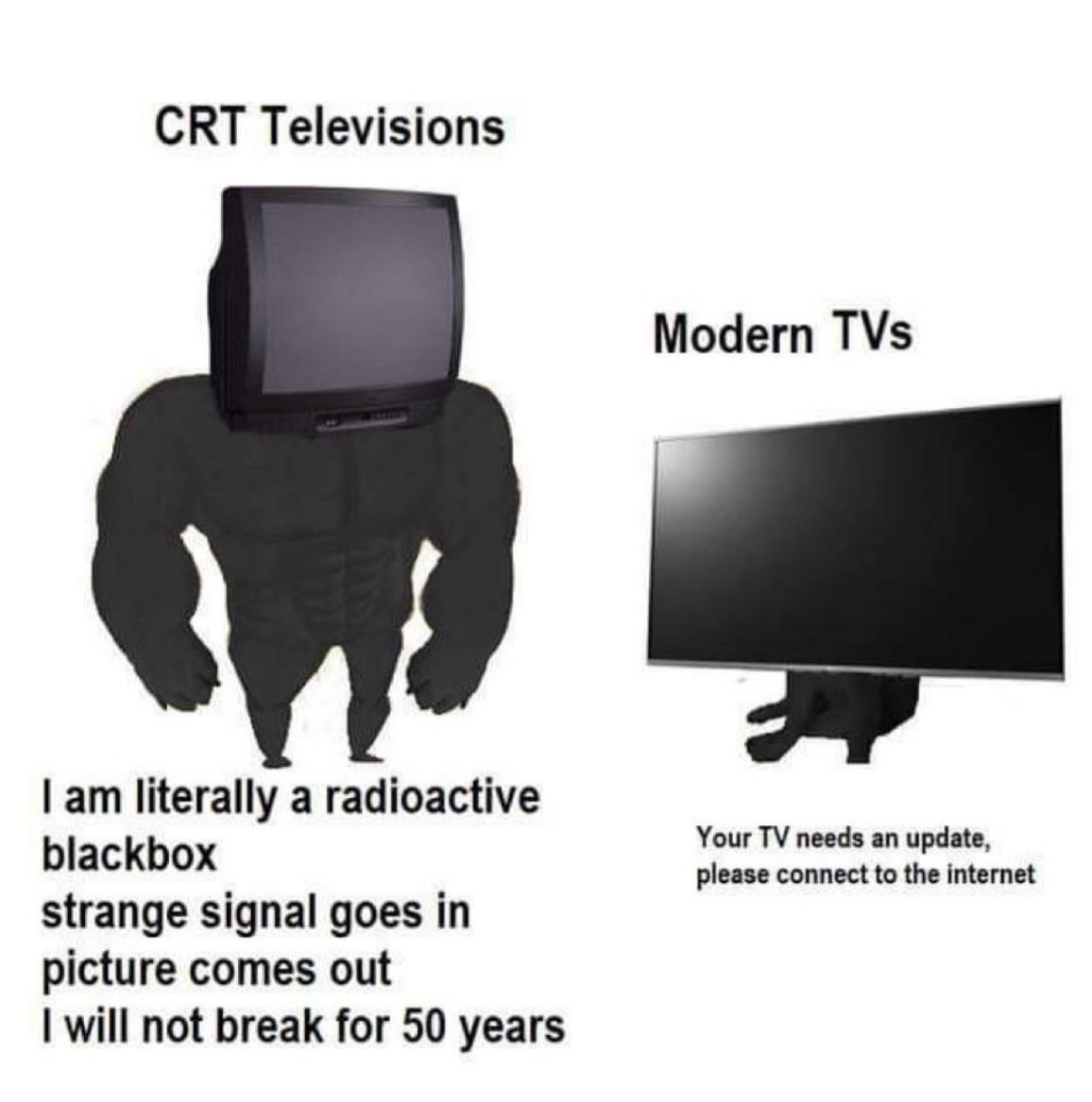
Forever might be a bit strong, but recent built in obsolescence and enshittification would like a word. There was a time when longevity was a selling point, this is not that time. If you find that exception, embrace and share.
At least to some degree that might be because the special longevity features from former days are often the expected default by now.
Take e.g. cars. While galvanized bodies still where a huge, specifically advertised selling point for premium cars (I remember Audi stressing it), they (or similar approaches) have become the common baseline by now.
The condition of my 15 year old, cheap-ass, 24/7 outside, 200.000 km+ eastern European car would have blown the mind of anyone in the 80s.
And coming back to OPs example: We e.g. only got new LCD monitors at work because the management walked through the office and decided that the yellowy-bleached, 15-year-old monitors were not representative enough any more. From a technical standpoint they were still working totally fine.
Whereas I remember my CRT computer screens during the 90s and early 00s each severely degrade after 5-6 years with smudgy, unevenly lid, progressively darker getting images, or just deciding to stop working with a bang (like my beloved 17’’ did some day).
Or take e.g. the now standard LED lights compared to any lighting solution from just 20 years back.
While this exists (especially when dealing with firmware-enabled devices), back in the days you just had real obsolescence instead.
Tech between roughly 1980 and 2010 was changing so rapidly, you were constantly upgrading or switching, especially for consumer electronics and IT, while we now have reached a plateau with much slower progression.
I am typing this on a 2015 entry level laptop, my E-Book-Reader was build in 2011 and my kids are totally happy playing 10 year old console games.
And regarding enshitification: If your product is shit from the start, you don’t even need that, see e.g. the car example from above…
Yes, things are not perfect by far yet, and some certainly even have regressed, and we should definitely strive to improve those things.
But I don’t see a point in trying and only looking at the gloomy side of things, downplaying everything that already has improved tremendously from 30 or 40 years ago.
Yeah, valid, enshittification as per Doctorow mostly applies to systems you can change on the fly ( e.g. firmware-enabled devices) and engineered obsolescence (and indeed the march of progress making things genuinely obsolete) is not new. It’s just that so many physical products are worse than they were (not Toyotas, taps that used to last 50+ years and are lucky for a couple of years now, washing machines) that the term expanded. Some MBAs decided making ‘good enough’ cheap crap creates a ‘revenue stream’ when people have to replace it.
Technology does indeed progress, and many times that’s a good thing (and not just a cheaper way to get a product sold. LED lights are great). 9 Billion people leads to a lot of good ideas, not a doomsayer, but I’d still like focus returned to longevity and quality in some way that advertisers can’t fuck up. One can dream, I get sick of having to constantly research products to see if I’m going to need to do it again in a short time.