This is not a SFW instance. NSFW communities will be tagged, and efforts will be made to keep SFW communities clean, but proceed at your own comfort level.
From what I know, it has to do with the word red covering the purple part of the spectrum long ago, and the “need” for the word purple came out later but purple things that were named red didn’t get renamed.
You can look at japanese right now and 青い covers both blue and green, with a relatively recent addition of 緑 to cover only green (thus possibly pushing 青い in the future to be only blue, who knows)
Similarly, the red fox is clearly orange, but English speakers were exposed to that species of fox before developing a word for that specific color. For bonus linguistical oddities, ‘orange’ was used for the fruit before it was used for the color.
And the fruit’s name is different from other countries’ names for it because “a naranj” was misheard as “an orange” and it stuck. Yellow-red wasn’t much adopted, though it did exist. Such is language, what a fun collective hallucination.
Well whys it called Shepherds Pie when it doesnt contain shepherds, or Cottage Pie when its nothing to do with cottages or cottagimg? How about that one…checkmate!!!
The Japanese part of this is evidenced by the fact that some traffic lights are blue rather than green. As far as I know, they are standardizing everything to green now to avoid any confusion, but some older lights are still blue because the words were the same for blue and green.
I already knew this about colors (it’s also why “redheads” have orange hair) but I recently dug more into how the musical spectrum and how tones are defined is very similar in it’s cultural variance. Another thing is how the cardinal directions are divided radially and how time is counted. Shit counting bases even, most of the imperial measurements are based on either base 12 or base 16 math.
Wild to think that something you grew up with as a fundamental fact of the world might actually be super culturally subjective.
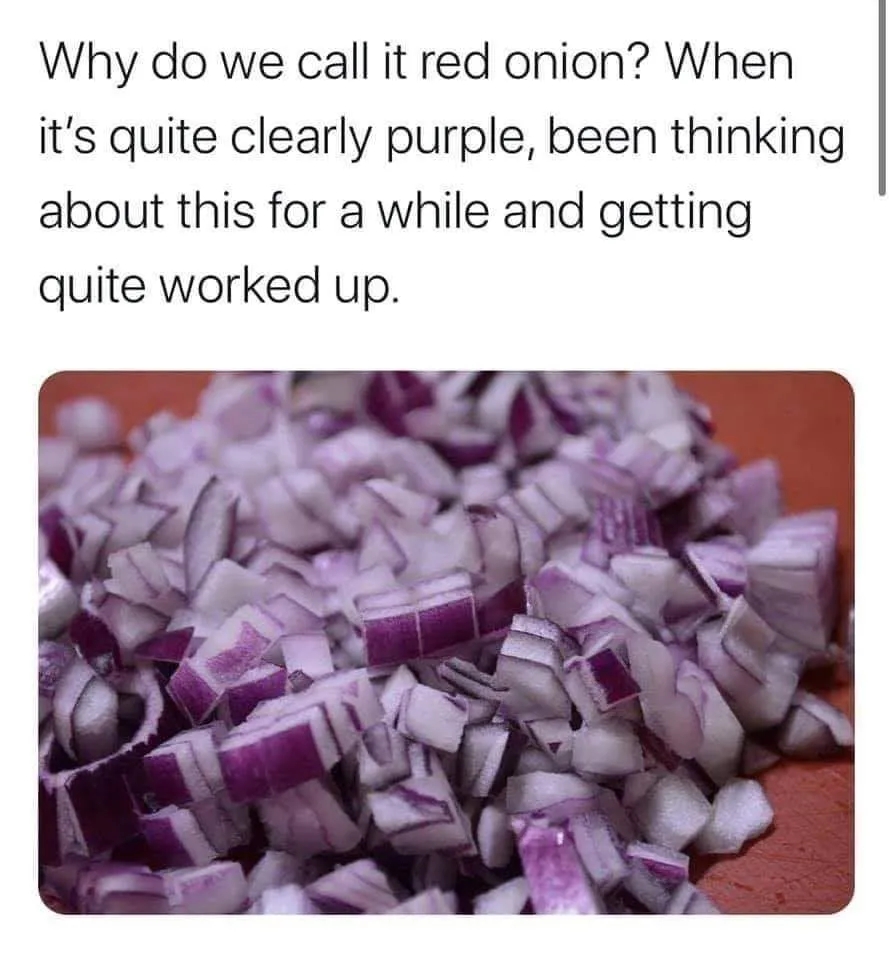
From what I know, it has to do with the word red covering the purple part of the spectrum long ago, and the “need” for the word purple came out later but purple things that were named red didn’t get renamed.
You can look at japanese right now and 青い covers both blue and green, with a relatively recent addition of 緑 to cover only green (thus possibly pushing 青い in the future to be only blue, who knows)
Similarly, the red fox is clearly orange, but English speakers were exposed to that species of fox before developing a word for that specific color. For bonus linguistical oddities, ‘orange’ was used for the fruit before it was used for the color.
Or the red squirrel, which is brown.
And red hair.
And the fruit’s name is different from other countries’ names for it because “a naranj” was misheard as “an orange” and it stuck. Yellow-red wasn’t much adopted, though it did exist. Such is language, what a fun collective hallucination.
Well whys it called Shepherds Pie when it doesnt contain shepherds, or Cottage Pie when its nothing to do with cottages or cottagimg? How about that one…checkmate!!!
And baby powder is never powdered babies!
I was similarly let down.
Oh shit! Shouldn’t have made my own. Although it is quite good sprinkled on my salad…
In Hungary, we have a dessert called madártej, or bird milk. It’s made out of cow milk.
Yes, the word for greenery/foliage, 青葉, translates to “blue leaves”
Also the green traffic light is called blue
Obligatory: https://youtu.be/gMqZR3pqMjg
The Japanese part of this is evidenced by the fact that some traffic lights are blue rather than green. As far as I know, they are standardizing everything to green now to avoid any confusion, but some older lights are still blue because the words were the same for blue and green.
I already knew this about colors (it’s also why “redheads” have orange hair) but I recently dug more into how the musical spectrum and how tones are defined is very similar in it’s cultural variance. Another thing is how the cardinal directions are divided radially and how time is counted. Shit counting bases even, most of the imperial measurements are based on either base 12 or base 16 math.
Wild to think that something you grew up with as a fundamental fact of the world might actually be super culturally subjective.