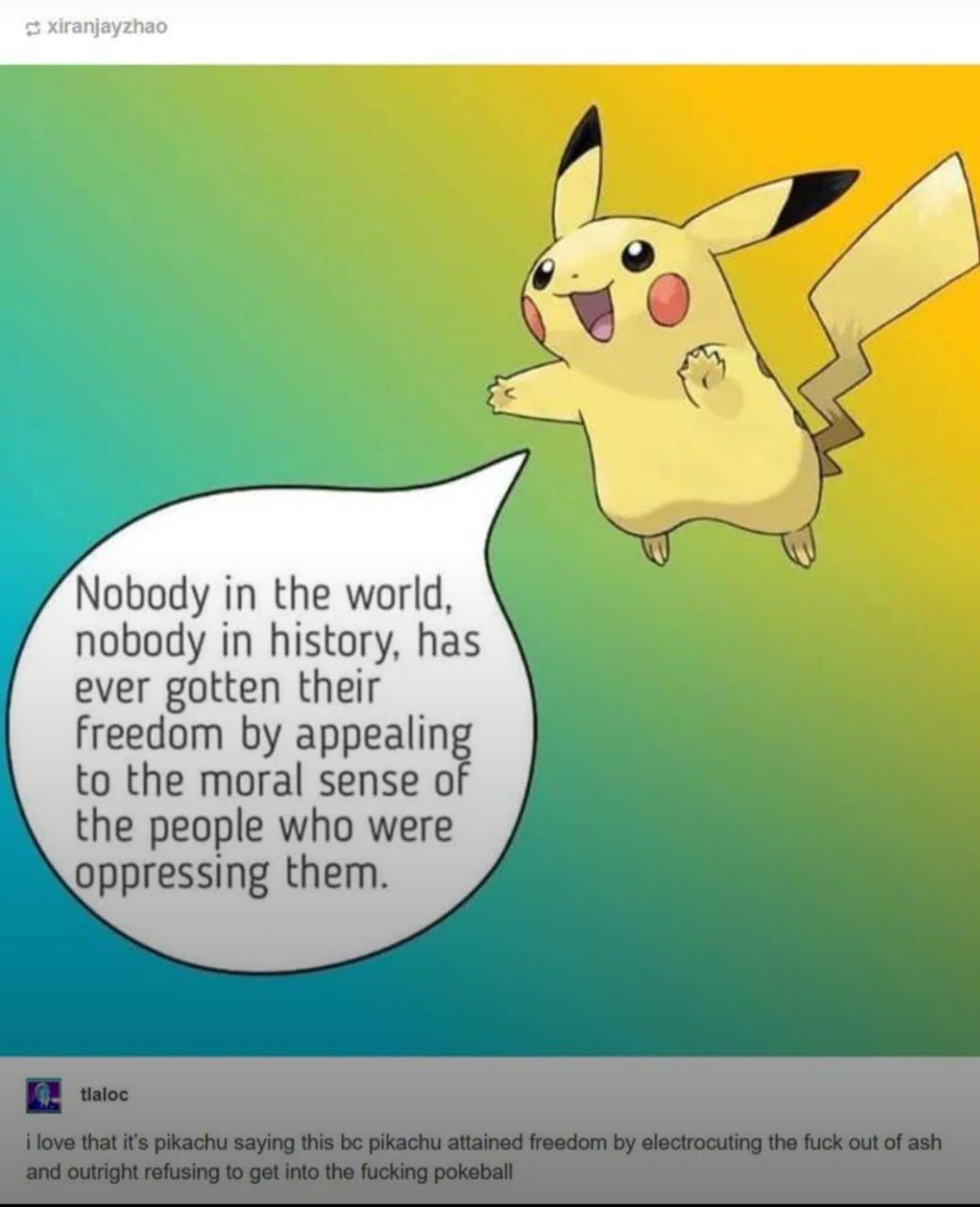
Dr. King’s policy was, if you are nonviolent, if you suffer, your opponent will see your suffering and will be moved to change his heart. That’s very good. He only made one fallacious assumption. In order for nonviolence to work, your opponent must have a conscience. The United States has none.
Stokely Carmichael
I wonder whether we have actual numbers to support this. And not just anectodal, or single individual events. But on a larger global scale, also investigating whether alternative measures have been taken and whether they suceeded. And then putting them into relation to each other, carefully considering potential limitations in the interpretability as well as implications, before forming conclusions regarding any recommendations of optimal action.
Or, put simply, is violence really the best way to deal with oppression?
This is also sharing some overlap with protesting methods. And I am not quite sure whether we have a definitive answer to that.
This isn’t really true. Most successful revolutions in the last hundred years have been largely non-violent. I mean look at the dissolution of the USSR, for instance. Or Hungary recently, although how much of a revolution that is is sort of up in the air. Or Spain. I think the numbers are something like once 3% of the population is in the streets you’re donezo.
I mean, also, like, India was directly and very much this.
That isn’t to cast aspersions on violent revolution, but it’s more of a narrative than reality, at least now.
Shelling your parliament with a tank isn’t violent?
I mean there was violence but who is calling that a “violent revolution?” Come on. I doubt there has ever been a revolution without a single instance of violence, but you are well aware that that’s not what we’re talking about, comma fucker.
Goal posts.
Sadly, this is true even for workforces, even though the cost of treating your labor pool well (giving them breaks, letting them chat with loved ones and surf the internet) is surpassed by the profit gained by increased productivity. (There are studies.)
Game developing companies still crunch, even though crunching decreases the likelihood that a deadline will be met.
A recent How Money Works video (this one on YouTube) came to the conclusion that the ownership class is just plain cruel and vindictive and is disgusted if their workforce gets even a modicum of class consciousness.
Every concession for labor, from the weekend to lunch breaks to bodily autonomy to living wages had to be attained by leveraging power against the ownership class.
So long as we have ownership class, we will be oppressed by them.
I agree with your points and don’t agree with crunch practices, and this is a bit of a nitpick, but what’s your source for crunching decreasing the liklihood of meeting a deadline?
I can easily imagine those things having correlation, as if you’re already on track for a deadline, why would you need to crunch?
I can’t really think of a complete reason for causation to go the other way though.
I remember news coming out about it in the early 2010s that a study showed that crunching reduces productivity drastically, to the point that even (only) two weeks of crunching will negate the additional work time. Curiously, some game companies at the time were crunching for a year or longer. I believe the statistic reported was that productivity commonly was reduced to 10% normal when crunching.
James Stephanie Sterling did a video about it, which is how the news came to me.
ETA: Typically, the problem is that game publishers will sometimes set impossible deadlines, or, if a game is on schedule to come out on time, the publisher will push the release date forward to an earlier release season. This was before the trend towards live service games, which was its own nightmare since the game would be released incomplete, but with a roadmap of expected features. Hence the development teams were perpetually behind and often were perpetually crunched. (/ETA)
Studies from the aughts (not necessarily related to game development) regarding the effect of micromanagement tools used on the workforce (e.g. mouse movement monitoring and keylogging) came earlier, noting that the time wasted by workers (under the label of time theft ) doing activities such as going to the bathroom, checking social media, talking to loved ones on the phone, getting coffee, etc. were more than offset by the increase in productivity when workers were allowed to do these things. (Slacking workers do exist, but they are starkly the exception. And large companies typically have a significantly greater number of bullshit jobs – workers tasked with busywork that doesn’t actually serve administration or the profit motive – than they have shirkers.)
Or voting