This is not a SFW instance. NSFW communities will be tagged, and efforts will be made to keep SFW communities clean, but proceed at your own comfort level.
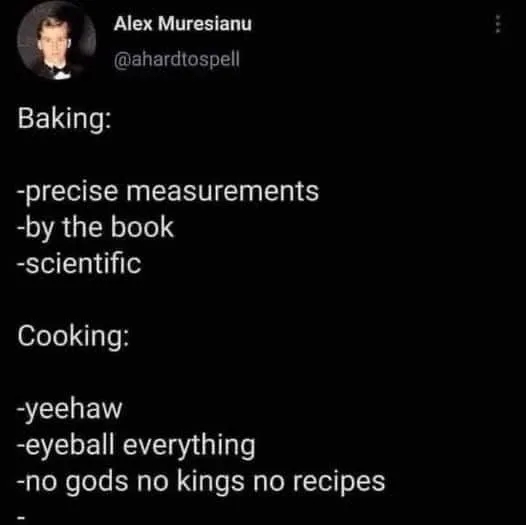
Most of these home bakers talking about how “precise” their baking is aren’t actually that precise. They:
measure ingredients by volume rather than weight
have home ovens that vary in temperature wildly
never consider ambient humidity/outdoor temp at all
Cooking and baking aren’t that different, there are hard and fast rules in both, but also if you’re good at one, you’re also good at the other, because they are the same thing. Can you follow a recipe that involves cooking meat in the oven? Then guess what? You can also bake a cake. I’m sorry to be the bearer of good news
They just haven’t practiced it. If you’re a good cook, you absolutely have capacity to be a good baker, because they’re only semantically different things. If we called it cooking a cake, no one would draw this distinction, and some other languages/cultures don’t.
If you can prepare, mix, and properly cook ingredients then you can prepare, mix, and properly bake ingredients.
I don’t always measure for baking - for bread and pastry I do weigh everything (ETA not because there is an ideal - there is still a range of amounts that will work - but because I want to know what the hydration % is) but for cakes I do them like cornbread, it’s more proportions - I know that for 3 eggs I need a certain amount of flour, I know how much baking powder and salt per cup of flour, and how much fat, milk or buttermilk or yogurt or ricotta, whatever - know it will work if I get it in the ballpark.
For cooking yep I am a yeehaw no recipe anarchist. Or more accurately, I read recipes for inspiration then don’t look at them while cooking, but I am old and have made so many mistakes over the years I know what I’m doing. It feels like intuition but is experience.
so you are saying i could put like twice the amount of eggs in the cake, and quarter the amount of flour in and it will still be an awesome cake? Like I can do when cooking?
What recipe where you’re cooking can you change ingredients by such extreme amounts? Pasta bolognese or lasagne with 2x as much meat and a quarter as much pasta would be all wrong. Do you put 2x as much oil in a sauce and expect it to go well? When you make a roux, don’t you have to like. Balance the amount of butter with the amount of flour?
When you cook rice, do you experiment with different amounts of water? Or do you just cook it until it’s cooked?
In general, though, yes, stylistic decisions like how much egg vs. flour is how you make different types of cake. There’s not one platonic ideal of cake because baking isn’t as precise as advertised.
What recipe where you’re cooking can you change ingredients by such extreme amounts?
some examples:
chilli has lots of leeway in the amount of chillis, beans and meat, and seasoning.
when I make potatoes with sauce and meat, I can add 50% potatoes and reduce meat by 50% and it’s still good (albeit less meat).
frenchfries with very little salt is good
generally my exact compositions depends of packages sizes and what is available, and how cheap I am. i.e I usually put full cans in it, and thus round to the next full can. And when I want to save money, I put half as much meat in it)
Pasta bolognese or lasagne with 2x as much meat and a quarter as much pasta would be all wrong
80% meat lasagna sounds awesome.
Balance the amount of butter with the amount of flour?
That is something that needs to balanced, but even then I am ±20% i guess.
When you cook rice, do you experiment with different amounts of water?
Rice is the one thing that needs exact measuring for water.
Or do you just cook it until it’s cooked?
I know someone who cooks rice like pasta, i.e. with lots of water, and in the end uses a sieve for the excess water. I may be crazy, but I am not that crazy.
I would argue that even measuring by weight isn’t all that important. Baking recipes are built as ratios. And as we all know, because we were awake in math class on that day, a ratio is simply a unit less form of measurement. And as long as we maintain the ratio we are good to go.
This is why you can bake a great loaf of bread with a scale, measuring cups and spoons, or the palm of your hand. Do you think Cavie Cave had a digital scale or a beautiful set of heavy stainless steel measuring cups in his cave 20,000 years ago?
I would argue that even measuring by weight isn’t all that important.
You would be wrong due to the physical properties of flour and how it compresses, but we generally agree that most people who are getting fine results with measuring however they want should just keep doing whatever they want.
Yeah, experience matters. But whether it’s learning to walk as an infant, baking bread, or having sexy sex, the more experience we have at doing something, the better we tend to get at it. As the old saying goes, “We tend to get good at those things we do often.”
If you’re concerned with maintaining ratios, volume isn’t going to be very precise when one of your ingredients is compressible (flour) and another isn’t (water). That said, the ratios used in baking are often less sensitive than people like to insist they are. Before we had recipes insisting you need to measure your flour down to the milligram, people learned how much flour to add by learning how wet/sticky/elastic the dough is supposed to feel when working it. Bakers learned by trial and error how wetter or drier doughs behave and how to get a preferred result, and then passed that knowledge on to their apprentices.
Volume is good enough. People lose sight of “just how good does good enough really need to be?” What you are talking about is a discussion of tolerances. I used to be a toolmaker. Perfection in accuracy and tolerances was part of my stock in trade. So many wasted hours spent telling customers that no, the tolerances do not need to be +.0005"/-.0000" or +.001mm/-.000mm for this or that it needs to be this accurate to function correctly. if you insist, I can do it your way, but you will be very unhappy.
When I bake my 2 loaves of bread at home, I use either cups and spoons or a digital scale depending on my mood. I honestly cannot tell you the difference in bread quality. Perhaps I’m just a bad baker and a worse connoisseur of bread - after all, I’m not Paul Hollywood. But I do know it’s still far, far better than store bought bread.
I have known 2 different people that owned and operated very successful family bakeries. They didn’t much care about weights of ingredients in the kitchen much beyond accounting costs per loaf to determine pricing. At 3AM ain’t nobody got time or the mood to scale everything. But yes, they did understand the dough itself allowing them to worry less about the exact measurement. We tend to get good at what we do.
Is baking as loosie goosie as cooking? Oh hell no! The tolerances must be respected. But you got more leeway than you, the home gamer, think you have. So worry less, and bake more!
At 3AM ain’t nobody got time or the mood to scale everything.
I mean, when I was a professional baker I did exactly that, and so did everyone I worked with. I think it’s more convenient and faster than measuring by volume, so it’s what I’d usually prefer to do at home or at work.
If you’re working with wood and measuring more specific than 1/16 inch - you’re doing something wrong. Wood can swell 1/8 inch for every foot with the season changes
Yeah, I just ask them for the traceable certifications for the accuracy of their measuring tools. I mean, I want to know you got that level accuracy. Not just have blind faith. I get a LOT of pissy responses and blank stares.
The worst thing to happen to woodworking is the availability cheap digital calipers, aka: Idiot sticks. They now think they a rocket surgeons.
As a former professional baker, nah.
Most of these home bakers talking about how “precise” their baking is aren’t actually that precise. They:
Cooking and baking aren’t that different, there are hard and fast rules in both, but also if you’re good at one, you’re also good at the other, because they are the same thing. Can you follow a recipe that involves cooking meat in the oven? Then guess what? You can also bake a cake. I’m sorry to be the bearer of good news
It never made sense why baking is put on this weird pedestal compared to “cooking”.
100%! This is what I’m saying. If you can cook, you can bake. Sorry/not sorry.
From what I’ve seen, bakers can usually cook. The reverse… eeeeh…
They just haven’t practiced it. If you’re a good cook, you absolutely have capacity to be a good baker, because they’re only semantically different things. If we called it cooking a cake, no one would draw this distinction, and some other languages/cultures don’t.
If you can prepare, mix, and properly cook ingredients then you can prepare, mix, and properly bake ingredients.
I don’t always measure for baking - for bread and pastry I do weigh everything (ETA not because there is an ideal - there is still a range of amounts that will work - but because I want to know what the hydration % is) but for cakes I do them like cornbread, it’s more proportions - I know that for 3 eggs I need a certain amount of flour, I know how much baking powder and salt per cup of flour, and how much fat, milk or buttermilk or yogurt or ricotta, whatever - know it will work if I get it in the ballpark.
For cooking yep I am a yeehaw no recipe anarchist. Or more accurately, I read recipes for inspiration then don’t look at them while cooking, but I am old and have made so many mistakes over the years I know what I’m doing. It feels like intuition but is experience.
Your last paragraph is just how my mom bakes. It’s entirely possible to bake without recipes once you have the experience, like you’re saying.
so you are saying i could put like twice the amount of eggs in the cake, and quarter the amount of flour in and it will still be an awesome cake? Like I can do when cooking?
What recipe where you’re cooking can you change ingredients by such extreme amounts? Pasta bolognese or lasagne with 2x as much meat and a quarter as much pasta would be all wrong. Do you put 2x as much oil in a sauce and expect it to go well? When you make a roux, don’t you have to like. Balance the amount of butter with the amount of flour?
When you cook rice, do you experiment with different amounts of water? Or do you just cook it until it’s cooked?
In general, though, yes, stylistic decisions like how much egg vs. flour is how you make different types of cake. There’s not one platonic ideal of cake because baking isn’t as precise as advertised.
some examples:
generally my exact compositions depends of packages sizes and what is available, and how cheap I am. i.e I usually put full cans in it, and thus round to the next full can. And when I want to save money, I put half as much meat in it)
80% meat lasagna sounds awesome.
That is something that needs to balanced, but even then I am ±20% i guess.
Rice is the one thing that needs exact measuring for water.
I know someone who cooks rice like pasta, i.e. with lots of water, and in the end uses a sieve for the excess water. I may be crazy, but I am not that crazy.
It would be something different but not bad. Clafouti is made like that, lots of egg not much flour. It’s lovely.
But if you know the recipe how would you miss by that much?
You wouldn’t put twice the salt and half the main ingredient in something you were cooking without expecting it to turn out very differently, right?
deleted by creator
Just be careful with egg whites. The sulfur taste will not go away with sugar
If your egg whites taste of sulfur, you dun goofed
I would argue that even measuring by weight isn’t all that important. Baking recipes are built as ratios. And as we all know, because we were awake in math class on that day, a ratio is simply a unit less form of measurement. And as long as we maintain the ratio we are good to go.
This is why you can bake a great loaf of bread with a scale, measuring cups and spoons, or the palm of your hand. Do you think Cavie Cave had a digital scale or a beautiful set of heavy stainless steel measuring cups in his cave 20,000 years ago?
You would be wrong due to the physical properties of flour and how it compresses, but we generally agree that most people who are getting fine results with measuring however they want should just keep doing whatever they want.
Again: How good does good enough need to be?
It’s also a lot about experience.
If you don’t know when a dough ball should be smooth/sticky then you’re going to have a bad time.
Maybe because I live in an area with very high humidity gradients - I always adding a pinch of flour, or a tbsp of water to get it just right
Yeah, experience matters. But whether it’s learning to walk as an infant, baking bread, or having sexy sex, the more experience we have at doing something, the better we tend to get at it. As the old saying goes, “We tend to get good at those things we do often.”
If you’re concerned with maintaining ratios, volume isn’t going to be very precise when one of your ingredients is compressible (flour) and another isn’t (water). That said, the ratios used in baking are often less sensitive than people like to insist they are. Before we had recipes insisting you need to measure your flour down to the milligram, people learned how much flour to add by learning how wet/sticky/elastic the dough is supposed to feel when working it. Bakers learned by trial and error how wetter or drier doughs behave and how to get a preferred result, and then passed that knowledge on to their apprentices.
Volume is good enough. People lose sight of “just how good does good enough really need to be?” What you are talking about is a discussion of tolerances. I used to be a toolmaker. Perfection in accuracy and tolerances was part of my stock in trade. So many wasted hours spent telling customers that no, the tolerances do not need to be +.0005"/-.0000" or +.001mm/-.000mm for this or that it needs to be this accurate to function correctly. if you insist, I can do it your way, but you will be very unhappy.
When I bake my 2 loaves of bread at home, I use either cups and spoons or a digital scale depending on my mood. I honestly cannot tell you the difference in bread quality. Perhaps I’m just a bad baker and a worse connoisseur of bread - after all, I’m not Paul Hollywood. But I do know it’s still far, far better than store bought bread.
I have known 2 different people that owned and operated very successful family bakeries. They didn’t much care about weights of ingredients in the kitchen much beyond accounting costs per loaf to determine pricing. At 3AM ain’t nobody got time or the mood to scale everything. But yes, they did understand the dough itself allowing them to worry less about the exact measurement. We tend to get good at what we do.
Is baking as loosie goosie as cooking? Oh hell no! The tolerances must be respected. But you got more leeway than you, the home gamer, think you have. So worry less, and bake more!
I mean, when I was a professional baker I did exactly that, and so did everyone I worked with. I think it’s more convenient and faster than measuring by volume, so it’s what I’d usually prefer to do at home or at work.
Yes absolutely.
You’ll see it in woodworking forums all the time.
If you’re working with wood and measuring more specific than 1/16 inch - you’re doing something wrong. Wood can swell 1/8 inch for every foot with the season changes
Yeah, I just ask them for the traceable certifications for the accuracy of their measuring tools. I mean, I want to know you got that level accuracy. Not just have blind faith. I get a LOT of pissy responses and blank stares.
The worst thing to happen to woodworking is the availability cheap digital calipers, aka: Idiot sticks. They now think they a rocket surgeons.
deleted by creator
Real and true