i.e do you prefer:
- technically grounded and plausible science elements (e.g The Martian)
or
- stuff so fantastical that it doesn’t even warrant trying to explain it (Dr Who, some Marvel/DC stuff, Star Wars)
Another way to look at this would be Sci-Fi versus Science Fantasy, perhaps.
- Old-School Sci-Fi like HG Wells centers around a core scientific idea and the consequences arising from that,
whereas
- Science Fantasy (more prevalent nowadays) only looks to science - or the impression of some science - to serve the fantasy devices it uses.
So which is better?
Both as long as they are not in the same setting.
The Martian is great Sci.
Dune is great Fi.
I wouldn’t want Dune to get all nitty and gritty about how Spice or space witch powers work scientifically and I wouldn’t want the Martian to have sand worms. Both are great for different stories, and as long as they are internally consistent they won’t break immersion.
Star Wars is Fi and shouldn’t have had an attempt to explain where the Force comes from, and any description of tech is just ‘ok sure, as long as we are consistent’ when it comes to hyper drives and Kyber crystals.
I love star wars, but don’t know even if it’s even nominally SF, which, hard or soft, should be exploring some ideas. Soft SF can explore psychology or sociology or religion in a futuristic setting. Dune, for instance, has plenty of thematic exploration of politics and economics and religion.
Star Wars, however, is just glorified set design. The elements of society and technology don’t interact in any meaningful way. Things are just sort of there because they look cool without any thought to the impact they would have. The ur-example of this is droids–which are just exist, though their social, religious, and economic ramifications would be enormous.
Star Wars is fantasy that happens to be set in space.
Now, it’s been a long time since I read the book, and I’ve never delved anywhere beyond the original novel, so treat this accordingly, but I think completely writing off the “science” of Dune is doing it a minor disservice. However, I’ll grant you that it isn’t “hard” sci-fi as that genre might typically be defined, either. Rather, the sciences that Herbert applied to his space opera were the social sciences, e.g. geography, sociology, history, and political science. I recall frequent digressions in the text talking about the ecology of Arrakis and how that has influenced interstellar politics, the most prominent example of this of course being the spice melange. Heck, the Liet-Kynes character was explicitly an Imperial Planetologist stationed there to learn about the Arrakis environment.
In fact, while checking my memory against the wiki article to make sure I wasn’t forgetting something, I saw this quote, which succinctly sums up my argument here: “the attention to ecology is hard, the anthropology and the psychic abilities are soft”.
All of which is to say, I agree with your main point: different stories require different approaches to scientific faithfulness. I liked all of the hard science of The Martian because, despite the fictional premise of an astronaut being stranded on Mars, I would largely expect an astronaut in that situation to think in terms of physics and biology and so on. I do not feel similarly about Han Solo. Right or wrong, I feel like authors with rigidly-held ideas about the value of hard vs soft science fiction tend to be insufferable pedants, and they write accordingly.
stars wars is somewhat vague how different races develop the “force” or where it came from other than your “mitochondria does it”, also they have “space witchs” using actual magic.
I like heavy sci, heavy fi and balanced sci-fi as long as its good storeytelling.
yes this, thats why old trek and stargate were good, not sgu 1st season though, thats why the original showrunners for stargate were hesitent to make another show/series, because of things like what amazon wanted , to turn into something like nutrek is what im guessing, good thing it never went through, otherwise it would be a disaster worst than sgu.
This is a long-running conflict.
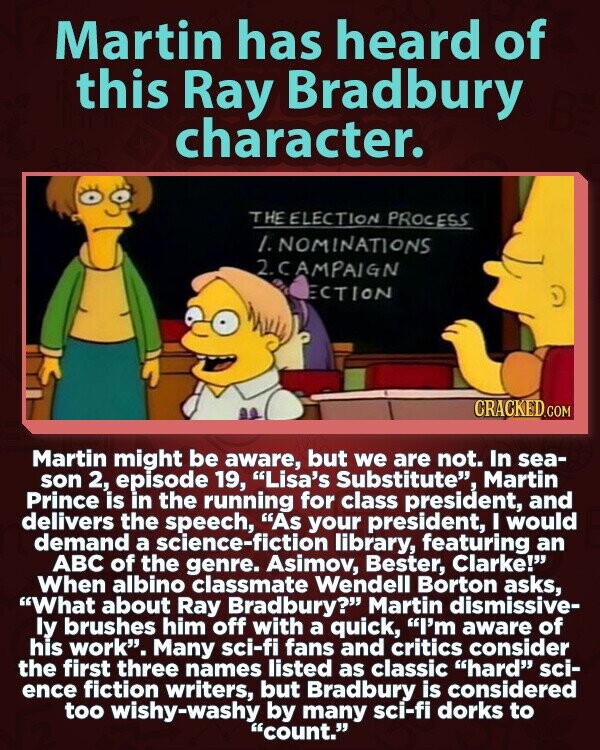
Woke up this morning thinking about Bradbury. The Martian Chronicles is kind of an Edda for Mars, and an obvious point of inspiration for the Big Man folklore in KSR’s Mars trilogy.
Honestly the only Bradbury novel I’ve read so far was Fahrenheit 451 (I loved it). That’s probably not sci fi, because tho it is set in the future, the futuristic elements which couldn’t exist today are spoke about in vague terms and it’s more a story of highlighting what’s wrong with our current society by extrapolating where it will go from here
Rock-hard science fiction for me.
Ah. An Arthur C. Clarke man of wit and discretion, I see.
🥴🥴🥴
I like both to be honest.
With that said, I actually lean more toward the Fi end of things, because when a book or movie gets something obviously wrong it’s really grating. Where as with technobabble it’s true in that universe, so who am I to contradict it. It’s easier to stay in the moment.
As a case in point, I actually turned Prometheus off at the point when it’s stated the ship traveled a billion miles… Or you know, out to Jupiter. The writers could have taken 10 seconds to educate themselves that as far as distances in space go, a billion miles isn’t even out of your own yard yet. Much less an interstellar distance. Given the reviews on the rest of the movie, I apparently didn’t miss much. Yes, I’m aware that Prometheus is solidly in the Fi end of the spectrum, but come on… Some one actually thought a billion miles was an interstellar distance? JFC education is really going down the tubes.
My kids and I still talk about the Prometheus school of running from things. “Oh look, a giant wheel of death is rolling towards me! Surely if I stay on the exact path it is following I will be safe! And I can certainly outrun the giant wheel of death, so why wouldn’t I?” Proceeds to get crushed by the giant wheel of death. This scene is representative of much of the film. Pretty pictures, lots of destruction, check your brain at the door.
Maybe it’s a European billion.
I like harder sci-fi. Very often it will explore “what if it’s like now, but this one thing is different?” You get to explore the human condition a bit more that way.
Softer sci-fi tends to be just fantasy that refuses to say the word “magic” out of pure marketing, and they end up being either the same old hero’s journey told and retold in current generation’s slang, or sloppily handled allegory.
It’s fine to like harder sci-fi, but don’t denigrate soft sci-fi just because you don’t like it. Soft scifi is no sloppier in allegory than hard sci-fi is. There are only 7 stories.
What I realized I like is the world building.
Only if it’s written organically.
I tried to read Lord of the Rings/A Song Of Fire and Ice and skipped parts where it was 20 pages about the lore. Granted, they are written in a compelling way. But I’m tired of it, especially in the hands of weaker writers. And sci Fi authors have a LOT of them.
Not really an answer to the question, but whatever The Expanse is. It’s right in the sweet spot.
It strikes me as very sciencey.
- The space travel, for instance, is “how could space travel actually work?” And even when they have a satisfying explanation for planet to planet travel, they need one for longer distances, so they introduce those wormhole gates? I haven’t read very far into it
- it tries to make space colonisation as realistic as possible, including the body horror
However it then surprises the reader by introducing
the alien plague
And therein lies the balance. Real science for where we know (or think we know) the boundaries of science, and completely theoretical fantasy for things we don’t know about (the existence of alien life and what shape it might take)
I think, personally, its less about how hard or soft the sci-fi is and more about how fleshed out the sci and the fi is. Im a big fan of science coming into contact with the unexplained, in an Event Horizon or Doom 3 type of way. The audio logs and background stories of Doom 3 are fantastic and really makes the world feel real and fleshed out.
I like hard-science, which is well researched and any future tech tracks a plausible path from current tech.
Always appreciate fiction with world-building that weaves strong cultural undertones, and believable nuances about the motivations, failings, and history of the fiction.
eg. Snowcrash, Permutation City, Blade Runner, Altered Carbon S1
If it is too technically grounded and plausible where the more fiction part is that they got their shit together and actually did it, like The Martian I see it more akin to the adventures genre.
Also the opposite, with Star Wars or Dune more closely related to fantasy, but in space.
I like science fiction that requires technologies that don’t exist that make the story possible, I don’t care if it not based in reality and it is not well explained how it supposed to work, I care more about what it does and how it shapes the lives of those around it.
My preference is for when the sci-fi setting is so fundamental to the story that the same story could not be retold in another setting. Like the basic story of star wars could be reframed as a cowboy epic with a few wizards or a scientist instead of jedi and it’d still work. Those kind of sci-fi books tend to not get filmed tho.
cowboy epic
Or Japanese samurai :)
I like hard science fiction. Things seem more real and possible when they are grounded on real science.
Star wars is more sci- drama/fantasy, than scifi, DISNEY just ruined the franchise. sg1 and trek is more like sci-tech, adding elements of all the other stuff.
i prefer them leaning into the sci-tech side, with element of good writing story telling. instead of tropes like with nutrek.
sci-fantasy books might be different from film.
stargate trys to develop the stories behind certain tech, how they work.
It’s never either-or. Sometimes, it is neither.
IMHO, a good Sci-Fi story has a well built world against which a story will play. I loved the ‘Parable’ series by Octavia Butler. The science level is basically the sameas ours (heck, it even plays ‘now’) and is not particularly important to the story itself. However, this series is one of the best dystopian Sci-Fi series I have ever read.