This is not a SFW instance. NSFW communities will be tagged, and efforts will be made to keep SFW communities clean, but proceed at your own comfort level.
Sure, that distinction has no difference if we’re talking about water.
But if you put a frozen chicken breast in the refrigerator, it will not be in liquid form the next day. It will simply be “not frozen” any longer.
to become free of the effect (such as stiffness, numbness, or hardness) of cold as a result of exposure to warmth
Or another example. You have a block of frozen cheese. You put it out on the counter for 24 hours. Would you say that cheese is now “melted” and ready to be put on nachos?
Are you thawing the chicken or thawing the juices? If you say that’s the same thing, then would you be satisfied if I served you a bowl of boiled chicken juice and called it chicken?
For example, I have those chicken packs from Costco that I bought months ago. They lay frozen in my freezer. When I thaw the chicken, I have to pour out all of the accompanying liquid before using the chicken.
I have been in kitchens my entire life. No-one will ever say any food, pasta sauce included, will be “melted” when temping to refrigerator or room temperature. Melt, in culinary terms, is reserved for things like cheese that is solid at room temperature and liquid when heated.
Saying I’ve spent most of my life in and around kitchens, the implication is professional kitchens/restaurants. And around professional chefs.
The distinction between thaw and melt, at least in culinary terms, is actually one of food safety. In a professional kitchen, melting is always going to involve the application of heat, where as thawing (or “temping” as it’s often said) is the slow and controlled bringing it to refrigerator or room temperature at which time it can be cooked. A thawed item may or may not be safe to eat, but something melted always will be. Take any course on food safety and the range and time food can and cannot be at certain temperatures, and it’s clear why there is a difference between these two terms.
As a way to illustrate why culinary terms are sometimes different than scientific ones. Take a tomato. Scientifically a fruit, right? But you wouldn’t put it in a fruit salad or fruit juice. It’s culinarily a vegetable, even though we know it’s technically a “fruit.”
Sure, and I’m sure in any competent kitchen they’d be called out. Nothing is defined by what is said once out of one hundred times, it’s defined by what’s said 99.
Solids are frozen already. Gallium melts in your hand, taking it from the freezer to the counter would do nothing. Thawing is specific to solids that contain liquids.
Nevermind that; the real issue is that using hot water to thaw food is dangerous advice because the outside will get warm enough to spoil while the center is still frozen. You’re supposed to use cold water to do it, and that water should either be running from a tap or switched out frequently as it warms.
Or you could just not be a dumbass and cook the food after it thaws instead of leaving it out. I promise you, you are not going to get sick because the outside of your food thawed slightly faster than the inside. You people act like you all have OCD and are hyper-obsessed with bacteria/germs to the point of psychosis.
Thaw your damn food in hot water, in cold water, in the fridge. It doesn’t matter as long as you aren’t leaving it sitting out for 6+ hours.
Me neither, but yeah, I’m making the same assumption.
So like, a bag of chicken frozen into a block… Thawing it in hot water WILL make it thaw faster, but it will also make the bacteria grow faster. Don’t do that.
Are you referencing that comment that mirrors mine? “CIA bot” or something. Don’t know what that is, what they’re trying to say, or why it’s being upvoted. It’s not mine.
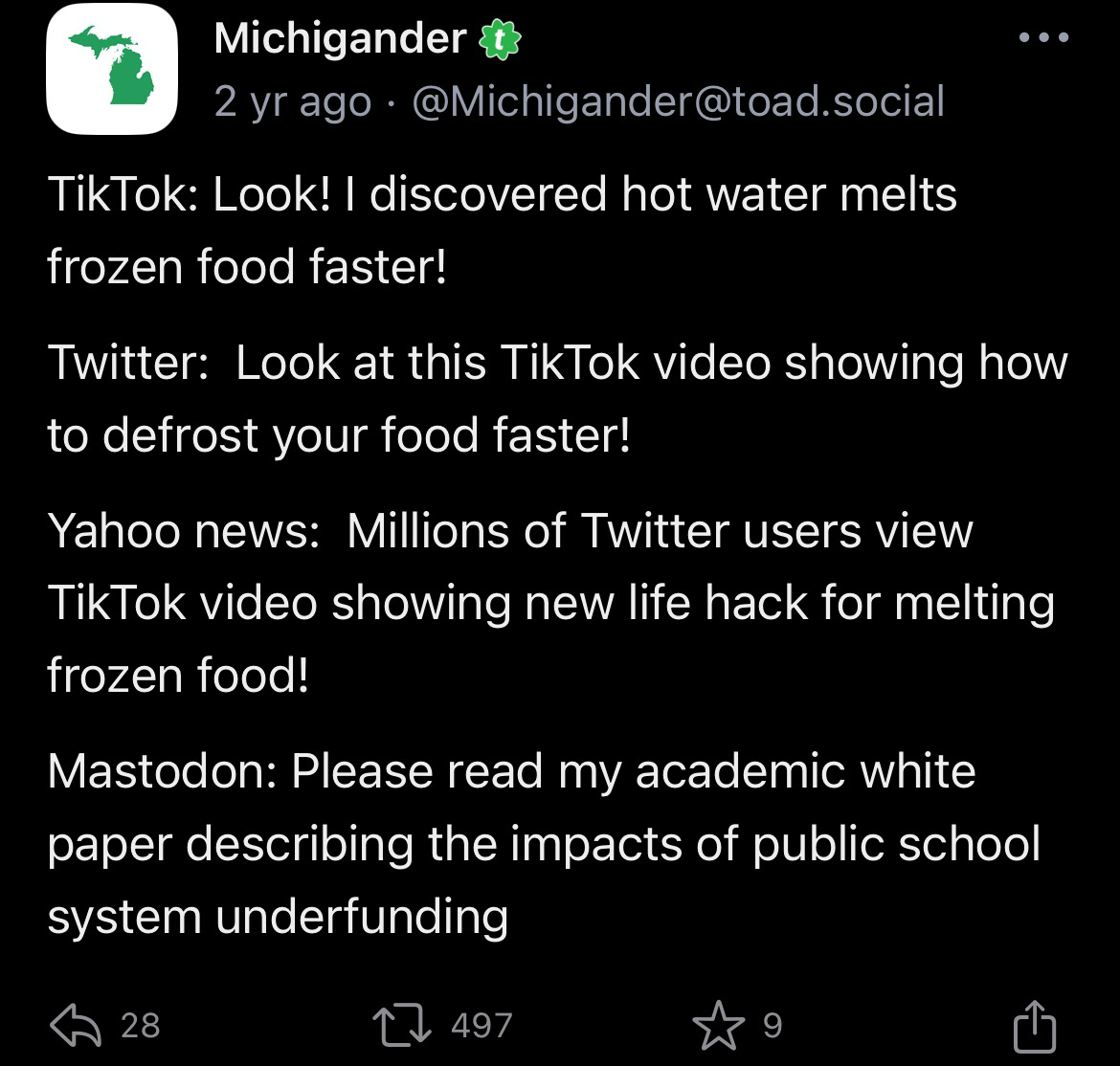
I feel like the subtle burn in this is the implication that the undereducated don’t know the difference between melting and thawing.
I
feellike the subtle burn in this is the implication that the undereducated don’t know the difference between melting and thawing.I don’t get it
I like the subtle burn, was just a play on the comment
???
Sure, that distinction has no difference if we’re talking about water.
But if you put a frozen chicken breast in the refrigerator, it will not be in liquid form the next day. It will simply be “not frozen” any longer.
Or another example. You have a block of frozen cheese. You put it out on the counter for 24 hours. Would you say that cheese is now “melted” and ready to be put on nachos?
But if you put your cheese on the counter, it’s still yours.
You need someone else’s cheese for nacho cheese.
Eh. Considering that chicken contains water and other juices that freeze when frozen… it’s both. 🤷♂️
Are you thawing the chicken or thawing the juices? If you say that’s the same thing, then would you be satisfied if I served you a bowl of boiled chicken juice and called it chicken?
Are you being deliberately obtuse?
Chicken thaws, juices/water melt. Chicken contains water/juice.
For example, I have those chicken packs from Costco that I bought months ago. They lay frozen in my freezer. When I thaw the chicken, I have to pour out all of the accompanying liquid before using the chicken.
Things can be more than one thing at a time.
Sure but in this case the meme isn’t specific, they could be talking about pasta sauce.
I have been in kitchens my entire life. No-one will ever say any food, pasta sauce included, will be “melted” when temping to refrigerator or room temperature. Melt, in culinary terms, is reserved for things like cheese that is solid at room temperature and liquid when heated.
Most people have kitchens
Too many people taking things literally.
Saying I’ve spent most of my life in and around kitchens, the implication is professional kitchens/restaurants. And around professional chefs.
The distinction between thaw and melt, at least in culinary terms, is actually one of food safety. In a professional kitchen, melting is always going to involve the application of heat, where as thawing (or “temping” as it’s often said) is the slow and controlled bringing it to refrigerator or room temperature at which time it can be cooked. A thawed item may or may not be safe to eat, but something melted always will be. Take any course on food safety and the range and time food can and cannot be at certain temperatures, and it’s clear why there is a difference between these two terms.
As a way to illustrate why culinary terms are sometimes different than scientific ones. Take a tomato. Scientifically a fruit, right? But you wouldn’t put it in a fruit salad or fruit juice. It’s culinarily a vegetable, even though we know it’s technically a “fruit.”
This thread is very Lemmy.
Tis a silly place. I think about 95% of the comments where people are disagreeing could be summed up as:
It’s always like the most pedantic, semantic, shallow bullshit that people are writing insanely long comments about.
Just because you’ve never experienced it doesn’t mean it’s never happened.
Sure, and I’m sure in any competent kitchen they’d be called out. Nothing is defined by what is said once out of one hundred times, it’s defined by what’s said 99.
You said no one will ever say it, I’m saying I’ve heard it. Any competent kitchen would honestly not stop to correct because they’re too fucking busy.
No-one is ever too busy to bust on FNG.
Thawing doesn’t imply changing from a solid to a liquid. It means changing from a frozen solid to a room temperature solid.
Solids are frozen already. Gallium melts in your hand, taking it from the freezer to the counter would do nothing. Thawing is specific to solids that contain liquids.
Gallium will also kill you if you eat it, and in the context of this meme, we’re talking about culinary items and culinary terms.
We’re not in a chemistry lab, we’re in a kitchen. Solids thaw to solids.
That’s what I said…
Where?
If you aren’t going to read the comments you’re replying to I’m not going to help you.
Oh I read it. It’s just not what you said.
Your source is wrong; thawing is mostly used on foodstuffs, which rarely is a liquid.
My source is the dictionary…
And you’re telling me you’ve never heard of permafrost thawing? Or the weatherperson talking about the spring thaw?
Your dictionary’s definition of thawing is still erronous, frozen to liquid is just one case of multiple.
Who do you think I am? You will need to take your beef up with Noah Webster or the Merriam brothers.
Cool, so those all-knowing guys made an error. Relatable, if you have to explain a 100’000 words.
Nevermind that; the real issue is that using hot water to thaw food is dangerous advice because the outside will get warm enough to spoil while the center is still frozen. You’re supposed to use cold water to do it, and that water should either be running from a tap or switched out frequently as it warms.
Or you could just not be a dumbass and cook the food after it thaws instead of leaving it out. I promise you, you are not going to get sick because the outside of your food thawed slightly faster than the inside. You people act like you all have OCD and are hyper-obsessed with bacteria/germs to the point of psychosis.
Thaw your damn food in hot water, in cold water, in the fridge. It doesn’t matter as long as you aren’t leaving it sitting out for 6+ hours.
I would say it’s the centerpiece of the punchline.
But what do I know? I’m a bear and I eat the heads off of fish.
… Isn’t the centerpiece the fact that you SHOULDN’T thaw food in hot water, because of bacteria?
I don’t use TikTok and wasn’t sure if this was real so I just assumed we were talking about submerging packaged frozen food in warm water.
Me neither, but yeah, I’m making the same assumption.
So like, a bag of chicken frozen into a block… Thawing it in hot water WILL make it thaw faster, but it will also make the bacteria grow faster. Don’t do that.
How come you can put frozen meat in a crockpot but not thaw it in frozen water?
https://www.allrecipes.com/dont-cook-frozen-meat-in-the-slow-cooker-11811052
Huh. I didn’t know that, thank you for sharing. I’ve used many recipes that call for throwing all the frozen ingredients directly in
Two accounts, huh?
Are you referencing that comment that mirrors mine? “CIA bot” or something. Don’t know what that is, what they’re trying to say, or why it’s being upvoted. It’s not mine.
Oh yea, that was weird.