• 0 Posts
  • 29 Comments
Joined 2 years ago
cake
Cake day: September 6th, 2024

help-circle

  • The thing with collapsing empires is that it’s not really a choice. You can print all the money you want, your economy only has so much productive potential. The core problem empires encounter is they build their economies and political system based on growth. Rome for example built a slave empire and military machine off the spoils of war. They used the proceeds from one war to fund the next. The slaves captured in one conquest provided the surplus disposable labor to grow the economy to fund further conquest. And its political system was never properly designed to govern such a large area with any degree of stability. The wealth of empire allowed the political instability to be bandaged for a time. But nothing can grow forever. And when an empire fundamentally built and sustained by growth reaches the limits of its growth? It doesn’t just stabilize and level off. Growth was the only thing keeping the whole house of cards stable. Once growth stops, collapse begins.

    The problem with collapse is that it works in just the opposite form of imperial expansion. As the economy falters, military spending has to decline. A larger share of the budget could go to the military, but that has to be funded by taxes, spending cuts, or more inflation. These just add to the political instability and shrink the economy further. The needs for the military can be reduced by withdrawing troops from distant theaters, but then those areas become more vulnerable to enemies. As collapse continues, you have to give up territories or lose them to rebellion or conquest. You can neglect your periphery, not invest in it, and lightly defend it, but that just makes those regions likely to rebel. As you lose territories, your economic potential shrinks even further. This collapse snowballs until the whole system disappears entirely, or the empire collapses down to its heartland. That core territory, the one that originally expanded outward to conquer a vast empire, can then stabilize and remain as normal nation.

    The US has been on a continuous expansion phase since its founding. Up until WW2 or so that meant actual territorial expansion. After WW2, the expansion has been in the form of an expanding trade empire and an ever-expanding overseas military presence. And up until the last generation or so, that growth served to paper over a lot of the internal contradictions and instability inside the US. The US was pretty unique in its founding in that it was founded through a revolution, but only a political revolution, not an economic one. The leaders of the American Revolution were American merchants and Southern nobles that wanted to kick the king out, seize political control, but keep the existing economic system the same. Contrast this to the French Revolution and most subsequent ones that featured extensive political and economic issues.

    The US’s political system has a lot of bugs that cannot be easily patched. The presidency had built-in dictatorial potential from the start. The Constitution is designed to be deliberately difficult to amend. The Supreme Court is poorly designed. There’s no proportional representation, the House and Senate both favor land over population, and on and on. We’ve been trying to patch the system as best we can with amendments and reform laws. But the political system is clearly in decline. The original concept of checks and balances is completely broken. Congress has completely lost the power to declare war. The Supreme Court has become openly corrupt. And the oligarchs have completely subjugated the government to serve their narrow self-interest.

    Personally, I don’t see how this ever recovers. The Rubicon has been crossed to many times. It’s clear that when the president violates the law or a court ruling, there’s no real enforcement mechanism to stop them. The Founders fundamentally did not design or Constitution’s structure with political parties in mind.

    Our system’s failures were present from the beginning, but growth can paper over a lot of failures. In the 19th century, giving away free land out West was a social pressure release valve. People who got tired of living under the low pay and high rents of the industrial cities back East could vote with their feet and go start a farm out West. In the 20th century, the automobile suburbs and the post war boom created a middle class that served to stabilize national politics. In the 90s and the era of globalization and the expanding US trade empire allowed cheap goods to flood into the country, buoying the lifestyles of that same middle class. (Those fortunate enough to not be in the Rust belt.) And rising home prices over the last 40 years have served to further reinforce that politically stabilizing middle class.

    But it can’t go on forever. The US trade empire has hit its limits. Rising home prices helped the older generations, but in turn they made housing prices unaffordable for people starting out. And as a result the birth rate has tanked. For the first time in American history, subsequent generations are poorer than their parents. Real standards of living for most of the population are declining.

    This is what collapse looks like. An empire built on growth is only stable while it’s growing. You cannot just stop growth at some point, level off, and stabilize. When growth hits its inevitable limits, the growth process starts working in reverse. The same snowballing process that enabled the empire to grow starts rolling backwards.

    This is collapse. Every empire that has ever existed has gone through this expansion and collapse cycle. The US will be no exception. And this is only looking at it from the classic imperial political and economic lens. We haven’t even touched on environmental deterioration and the effects of a collapsing climate.


  • Instead of using a car wrap, what about just setting up a big TV on a pole, pointed directly at a camera, set to continuously generate and display images of vehicles with random license plates? In that case you wouldn’t be actually displaying alternate plate numbers on any vehicle. You would just be fuzzing the camera with images of fake cars.

    The entire legal justification for flock cameras is that it’s legal to record anything that’s in public. But it’s also perfectly legal to display images of cars on a TV.

    Hell, you could probably do this as a protest, holding up a TV on a pole while standing on a public sidewalk. (Might need to make it a cart of some sort.)


  • The problem is…then what? Are you going to walk from your front door to the flock camera, all in full black clothing and face coverings? You’re going to have to walk past any closed-circuit security and Ring doorbell cameras. Police can follow you through multiple cameras and maybe even see you walking through your front door.

    Are you going to drive a few blocks from the camera, park, and then walk to it? They can search vehicle position records for any vehicles that came and left within a certain distance from the cameras within a certain time period. If they can trace you walking to your car, they can find you. Even if you left your phone at home and use an old vehicle without spytech in it, there will still be video of your vehicle in the area.

    Flock cameras are probably the single most capable cameras police departments have regular access to. But they have access to countless tools of surveillance. I think the only way you could reliably damage a flock camera and get away with it is if a Flock camera is near some nature area or other natural feature. For example, if there’s a forest area a short distance from where the camera is, or a stretch of tree-covered river or creek you could duck into to break the camera track.

    In order to destroy a flock camera and get away with it, you would need to have access to some large area that is not under surveillance. This allows you to walk into the area while in plain clothes, change into concealed clothing while in the area, and the reverse on the return trip.

    Destroying a flock camera while keeping your face covered is trivial. The hard part is getting to the camera and getting back home without leaving a trail to your identity. And unless there’s a big nature area nearby you can disappear into, I think that would be a challenge.

    Notably, this is actually the technique Luigi used. He ducked into a wooded park to change clothes and escape the surveillance net. With enough resources they were still able to catch him. But someone destroying a flock camera won’t justify as much resources to hunt them down as what Luigi did.


  • Note/Dislaimer: the information here is purely hypothetical and educational, discussing the limits of Air Power as a means of severing enemy transportation links. The Golden Gate Bridge is used as a familiar example when discussing the vulnerability of suspension bridges. But the author of this post has zero desire or intention to damage the infrastructure of the US or any other country. Nothing in this post should be taken as a threat or warning of any kind.

    Your instincts are correct. The forces are very different. If one of the main cables on a suspension bridge is severed, the entire bridge deck will come down. You would be able to reuse the towers, foundations, and maybe some of the vertical cables supported by the main cable that wasn’t hit, but repairing such damage would be similar in difficulty to rebuilding the bridge from scratch. Demolition and restoring that bridge deck probably represents about 50% of the work of building a whole new bridge from scratch.

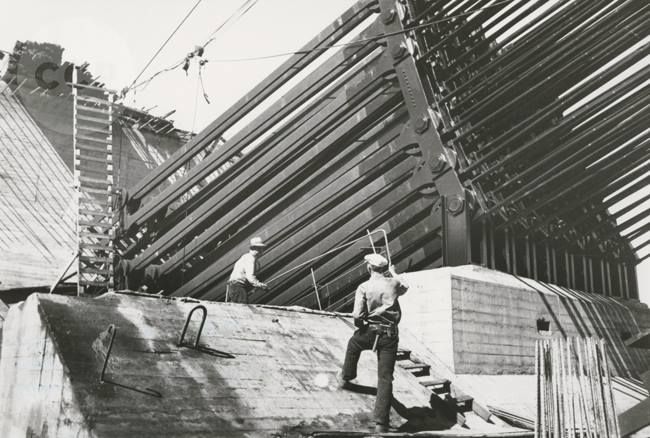
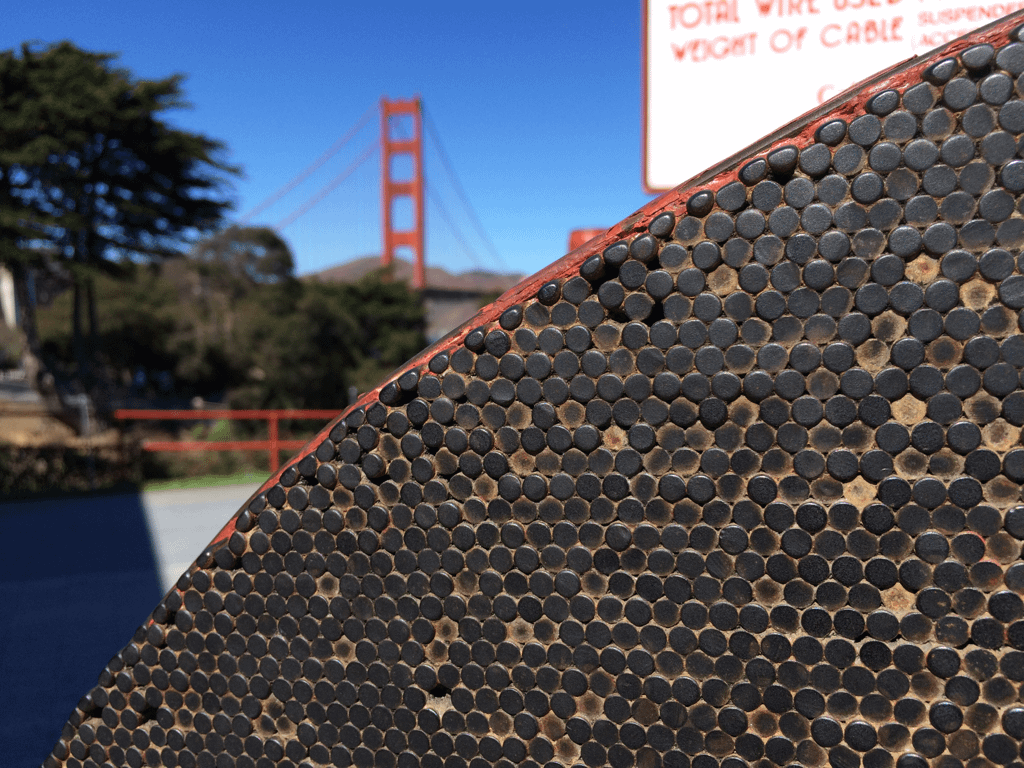
    However, actually severing one of the main cables is lot more difficult than you might think. They’re not a giant rod of solid steel; they’re thousands of individual pencil-sized wires bundled together. At the anchorages, these individual wires spread out and embed themselves into a giant block of concrete. Here are the Golden Gate Bridge’s anchorages under construction.

    Those steel elements are only a portion of the total, and after they were built, the entire volume was filled with concrete. The Golden Gate Bridge’s anchorages are giant hunks of heavily reinforced concrete. Imagine a cube of super-reinforced concrete 12 stories to a side. That’s the scale of what we’re talking about.

    You can absolutely forget about destroying one of the anchorages directly. They would be trivial to hit. They’re giant hunks of concrete. But anything short of an atomic bomb would have trouble doing significant damage to them. While bunker-buster bombs exist, those are made to punch a hole through many feet of concrete and then explode in the air below the concrete. They’re not designed to turn a massive 30 meter cube of solid concrete into gravel. It takes a minimum amount of energy to pulverize something that large. And that amount of explosives just can’t be delivered by a plane or missile. And even if a bomb takes out a chunk of an anchorage, you’ve only managed to sever a few dozen of the thousands of wires holding up the bridge. Destroying the anchorages themselves would be even more impractical than destroying regular bridge piers.

    So that leaves the cables themselves. You mentioned severing them at the anchorages, but it actually doesn’t matter where they’re severed. Imagine hanging a rope between two walls in the room you’re in now. It doesn’t matter where you cut that rope; anything hanging from that rope is going to fall. However, the best point to target would be right where the cables hang from the supporting towers. That is where the tensile forces in the cables are at their maximum.

    I’m no expert in military ordnance. I have no doubt the Air Force has studied the problem extensively, but I really don’t know how effective bombs are at taking out suspension bridge cables. I don’t know exactly how precise the US Air Force is nowadays with their precision bombing, but I’ll take it for a given that they have the ability to reliably get a direct hit on one a 1-meter wide bridge cable. Unlike in Vietnam, I’ll assume we can actually hit the thing reliably.

    You’re talking about a cable that is made of thousands of individual wires. The Golden Gate Bridge’s main cables are a meter thick. They look like this.

    This isn’t the type of target most military bombs are designed to destroy. Broadly speaking, there are two main types of bombs. There are area weapons and penetrators. The area bombs subject a large area of ground to heat, shock wave, and high speed debris. Some bombs are designed to say, kill every unarmored person and any lightly armored vehicle within a hundred meter radius. These area weapons would be completely useless on bridge cables. Even with a direct hit, most of the explosive force would bounce off the cable and into the air. You’ll probably sever a few of the surface wires, but the vast majority of the cable’s capacity will remain intact. And those things are built with a factor of safety. The Golden Gate Bridge was built with a factor of safety of about 2.5. Which means in theory you could cut through more than half of both of each main cable’s cross-sectional area, at the point of maximum cable tension, and the thing would still stand.

    That leaves the penetrators. Bunker buster bombs have already been mentioned. But what I’m thinking of are the shaped charge weapons designed to punch through things like tank armor. These weapons work by using an explosion to create a pencil-sized jet of superheated molten metal. This instantly drills a small hole through the armor of a tank. This is effective at destroying tanks, as that superheated stream of metal enters the tank cabin, rapidly expands, ricochets off the walls, and pastes everyone inside. And the resulting rapidly expanding gases can blow the turret right off some tanks.

    But where my knowledge fails is how effective these shaped charges would be against a meter-thick bundle of steel wires. A shaped charge would certainly be capable of punching a hole, but if you want to sever the cable, you need to sever the entire cross section. A shaped charge may not have enough energy for that, or the stream of vaporized metal might just pass right through the cable, in one side and right out the other. I won’t say it’s impossible, especially if you designed a bomb specifically for targets like this. But whether a shaped charge that is designed to puncture tank armor can sever a big suspension bridge cable? I’m sure the Air Force knows, but that’s beyond my expertise. I’m sure it’s been thoroughly studied, and I’m sure those studies are classified to all hell and back. It’s possible there may be information on this publicly available, but I feel dicey enough posting about severing suspension bridge cables on a public forum like this. Even if such info is publicly available, I would rather not have some angry men in black suits show up on my front porch asking why I’ve been reading numerous papers on how to effectively sever the cables of giant suspension bridges. I don’t need that in my life right now. 😅

    On the plus side, this actually makes big suspension bridges very resilient to terrorist attacks. A specialized shaped charge missile built by Lockheed Martin specifically to sever large suspension bridge cables could do the job. But you can’t destroy the Golden Gate Bridge by setting off a home-made truck bomb on it a al Oklahoma City. You would blow a hole in the bridge deck, kill a lot of people, maybe sever some of the support cables, and maybe damage some of the outer layers of the main cables. But if you set of a truck bomb right next one of the main cables, again most of the explosive force would just bounce off. A meter thick steel element is pretty damn resilient. I’m not aware of any incidents of a major long-span suspension bridge being taken down by terrorist bombs like this.


  • A land bridge wouldn’t really help with the finances. There’s already a few roads that go all the way up to Alaska. Most things going from the lower 48 to Alaska still are shipped by sea or air.

    It’s not the fact that Alaska isn’t contiguous with the US that is the problem. The problem is that Alaska is very far from the US’s core population and economic centers, and Alaska itself has little population, and most of its land has extremely low economic value. Adding more low-productivity territory between Alaska and the US won’t change that equation. (Vancouver is definitely not a low-productivity territory, though capturing it by force would be a nightmare.)

    Think of it this way. A country has economic engines and economic sinks. The engines provide the tax revenue to cover everything else. The engines are your major industrial cities, your big population centers, agricultural areas like the Mississippi Valley, etc. The engines are what provide the core material needs of the society. The sinks are territories you annex not to serve as economic engines, but because they provide non-economic value. Maybe they provide a place to station troops or naval forces, making it harder for an adversary to invade your core engines. Maybe they provide a vital strategic resource like oil. You can always trade for these resources, but owning the land they’re under means you can’t be cut off from these resources by a trade embargo. Maybe you annex a territory simply to prevent it from becoming a lawless failed state that would cause trouble to spill over your border.

    You take on sinks because they increase the safety and stability of your core regions. Alaska does not pay for itself, not even close. It’s valuable to the US because it serves as a valuable place to station troops, and because its oil and other resources cannot be cut off through a trade embargo. And we’re better off having it rather than letting Russia having a foothold on the continent. If anyone proposed cutting off Alaska today, I would call them an idiot. Having Alaska is the US purchasing an insurance policy against future disruptions. But like any insurance policy, on average it costs you more than it pays out.

    But in the scenario we were considering, the US simply can’t afford to maintain these “nice to have” territories anymore. It’s like when you lose your job and have to cut back on expenses, sometimes insurance is something that has to get cut.


  • Something can be necessary and useful while still be an unprofitable money sink. I pay for water from my city’s utility. It’s a useful resource, but it’s still a money sink. I don’t earn any profit from the water I get from the city. In fact, it all goes down the drain in one form or another, and I have to pay even more money for the city to take the used water off my property! I absolutely need it; I couldn’t live in the home I do if the water was cut off. But it’s not a profit center for my household finances. Just because something is necessary and useful does not mean it is profitable.


  • Exactly. Give me a couple days and a big enough angle grinder and I can take the Golden Gate Bridge down. (Assuming I have no regard for my own safety.) But the big steel cables holding the bridge up can be cut just like any other steel. Of course, I don’t actually want to take down the Golden Gate Bridge. But even if I did, it wouldn’t be having the right tools that would prevent me from doing it. It would be the fact that if I tried it, I would probably be beaten to death by a crowd of angry people before the police could even arrive. You show up with a giant cut off disk and start going to town on the cables supporting a bridge holding up thousands of cars? You probably won’t even live long enough to see those terrorism charges.

    That’s the problem with taking bridges out from the air. You can’t get up close and use the proper tools. You have bombs, missiles, and that’s it.


  • Yes. But we’re talking about a scenario where the US is collapsing like every other empire before it has. Rome would have liked to keep hold of England, but they just couldn’t afford it anymore. Alaska is a nice thing to have strategically, but it’s not a core engine of the US economy or one of it’s major population centers. It doesn’t pay for itself. When empires decline, these far flung “nice to have” territories are the first to go.


  • That’s pretty easy to fix. The bottom image just has a hole in the bridge deck. Clean up the hole, epoxy in some new rebar, build some forms, pour new concrete, and you’re done.

    The top image is worse, but it’s still not as bad as it seems. Look closely at that bridge. That looks to be a bridge made of precast concrete. Look how the whole fallen span seems to have come down in one big piece. It’s a very clean break.

    When I say precast, I mean literally that. The beams for that bridge are not poured on site. They’re made in a factory and trucked in. A precast concrete plant could have a whole yard full of beams just sitting there, ready to go. How you build such a bridge:

    1. Construct bridge piers by either casting in place or driving precast piles into the ground.
    2. Either cast the pier top caps in place or use precast caps carried in and placed by crane.
    3. Hoist precast beams and place them spanning the top caps.
    4. Once beams are in place, construct formwork and cast a bridge deck on top of the precast beams.

    In a bridge like this, often the only part that is poured in place is the bridge deck. To fix the bottom bridge, you would remove any debris, clean up the edges, drop in some new beams, build some forms, and cast a new bridge deck.

    And what I’m describing is just typical precast concrete bridges. I’m describing what you can do even when you haven’t optimized your whole bridge construction sector for easy repairability. But Iran has been preparing for a US attack for a generation. The reason the US’s decapitation strike failed to cause a regime collapse was because Iran isn’t some tin pot dictatorship lead by one brutal despot. It’s an advanced nation that’s built its governmental system from the ground up with survivability in mind. There was an elaborate continuity of government plan in place, and as the US and Israel assassinated Iranian leadership, the conveyor belt just moved folks up to replace those killed. It’s a modern day governmental version of the ancient Immortals. Iran’s even granted a lot of their military forces a high degree of autonomy. There are a whole bunch of missile crews hiding in underground bases with standing orders to launch at pre-chosen targets if they don’t receive word from leadership after a certain amount of time. In short, Iran has gone to great lengths to make its government and military highly resilient to attack.

    And if they did this for their government, why not their infrastructure? You can design bridges with quick repairability in mind. For example, you can standardize sizes as much as possible. Instead of custom designing everything, design your precast bridges to use only a small number of different beam sizes and standardized length. You tell your bridge engineers:

    • All bridge spans must be in 2 meter increments, 4m, 6m, 8m, 10m, 12m, etc.
    • All bridges must be built from one of six beam cross-sections. Do not design custom sections.
    • All bridges must be designed to use the minimum strength of concrete any of our batch plants produce.
    • All bridge decks must be designed to use the lowest grade of rebar commonly available.
    • The distance between bridge beams must be in one of a few allowable dimensions to allow the use of pre-made drop-in formwork. * All bridges must be constructed with precast piers, pier caps, and beams with bridge decks cast in place using drop-in metal formwork.
    • All bridge piers must be designed with twice the usual factor of safety, ridiculously overbuilding them to make them extremely resistant to bomb damage.

    I have no idea what Iran is doing. But I do have a background in structural engineering. I’ve taken a literal course called “bridge design.” If you asked me to design a nation’s bridges to be extremely repairable, this is how I would do it. The piers are the hard part to replace, so you make those far, far stronger than they need to be. That way if a bomb blows off a chunk of a bridge pier, there’s still plenty of capacity left. Everything else? You standardize the hell out of it and then mass produce and stockpile replacement parts. If you only allow six beam sections and 6 beam lengths, that means there will only be 36 types of beams used across all of your bridges. You can then produce and stockpile huge numbers of these beams, allowing extremely rapid repair after an attack.

    We typically don’t build bridges to this level of standardization. The problem with using few standard sizes is that you inevitably end up over-designing your bridge. You can’t design the perfect custom cross-section to carry your loads with the absolute minimum amount of material possible. So your bridges end up heavier and more expensive than they could otherwise be. But if you’re willing to pay a bit more for a much, much more resilient transportation system, standardization can accomplish this.

    Again, no idea if Iran is actually doing this. But considering the lengths they’ve gone to make their whole regime resilient to attack, it wouldn’t be unreasonable to assume they’ve applied the same philosophy to their physical infrastructure. You don’t try to build an indestructible bridge. You just make your bridges easy to repair instead. If you do it right, repairing a bridge will be far cheaper than dropping a bomb on one.


  • It’s not as difficult as you might think. Or, more precisely, it’s a lot more difficult to destroy a bridge than you might expect. Look at how much trouble Ukraine has had trying to keep the Kerch Strait bridge out of commission. Or look at the hundreds of bombing runs the US did in Vietnam to try and knock out one stupid bridge.

    It’s easy enough to temporarily shut a bridge down. Bombing its road deck is pretty easy. The deck is usually exposed to the sky, so bombs can be dropped right on it from above. And the deck is thin enough to be fairly vulnerable to bombing.

    The problem is that bombing a bridge deck doesn’t actually destroy the bridge. At best you create a hole in the bridge deck a meter or two across. That can shut a bridge down temporarily, but it doesn’t actually damage the bridge’s structure. To repair the deck you do something like:

    1. Clean up the hole. Remove any loose concrete chunks with a hammer, cut off any exposed rebar with an angle grinder.
    2. Drill holes at regular intervals through the edge of the hole.
    3. Run new rebar spanning the hole. Epoxy rebar into old bridge deck.
    4. Attach some plywood to the bottom side of the bridge deck to server as as mold.
    5. Pour new concrete and let cure.

    This can be done in a day or two. And on a multi-lane-bridge, traffic can continue to flow around the bomb site at reduced capacity.

    If you actually want to destroy a bridge, you can’t just hit a random spot on the bridge deck. If it’s a big truss bridge, a direct hit on a key truss member could cause the entire bridge to collapse. But those are very precise targets to hit. And if it’s just a bridge deck sitting on beams sitting on piers, the only way to destroy the bridge will be to knock out the support piers.

    The problem with destroying them is that bridge piers are both hard to hit and extremely resilient. They’re protected from above by the bridge deck, so to hit them you’ll have to glide a bomb in horizontally. And even if you manage to hit them, they’re utterly massive. They have to support the entire weight of the bridge above. Plus they’re often directly in a river’s channel. This means they’re built to survive the forces of water current and ice collision if the bridge is in a temperate climate. Plus they’re built extra thick to resist the corrosive effects of the river water. Now, if you do actually manage to knock out a support pier, replacing it will be a nightmare. But that’s a very difficult thing to do.

    It’s actually a lot more difficult to destroy a bridge than people realize. Knocking a hole in a bridge deck is easy. But bridge decks are easily and quickly repairable.


  • The decline of the Roman empire was a wild thing for the people actually living on the ground. Imagine you’re living in Alaska. You were born there and have never considered yourself anything but American. Your home is, as far as you’re concerned, completely inseparable from America and as American as any other part of the country.

    One day you see an emergency press conference on the TV. It’s a press conference by governor. They’re announcing that they just received word from Washington. The message said:

    “We’re sorry we have to do this. But the federal government just can no longer maintain our presence in Alaska. The country just can’t afford it anymore. The national finances are exhausted and the nation must consolidate down to focus on its core territories. You will no longer be federally taxed, all federal troops will be withdrawn from the state, no federal dollars will be spent on the state, and Alaska will no longer receive representation in Congress. Existing US citizens in Alaska will retain their citizenship, but new children born in Alaska will be subject to the same citizenship rules as those born to American expatriates living overseas. We are granting Alaska full independence. We wish you the best. Good luck. But you are on your own.”

    Imagine what it would be like to be a resident of Alaska and to hear that message. How do you even respond to that? Do you stay in the US, leave Alaska, and move to the lower 48? Do you try to stick it out in the newly independent Alaskan nation? Can Alaska even survive as an independent nation?

    In the modern world, we’re not used to national governments just packing up and leaving a state or province. Governments work so hard to suppress even the possibility of revolt that the idea of one just abandoning a state or territory is a strange concept. But historically this does happen with declining empires. It really wouldn’t even be that crazy of a move for a declining US. Alaska is a part of the US, but it isn’t a core territory. The lower 48 is really the core of the United States. Territories beyond this are mostly money sinks useful for either resource extraction or power projection. Nice things to have, but not the US’s core population and economic centers. I can foresee future scenarios where the US eventually just walks away from places like Alaska, Hawaii, Puerto Rico, and other territories not contiguous with the US mainland. No empire lasts forever, and collapse tends to move from the periphery inward. On the ground in the periphery, this looks like the national government just announcing you’re no longer part of the country.


  • Yeah the hate is weird. I’m not the biggest stream watcher, but I can respect the medium. Streamers are just doing the modern version of what AM talk radio personalities like Rush Limbaugh did. Not in terms of content or politics, but in terms of format. Limbaugh ran multi-hour long shows reacting to news and headlines. His listeners primarily listened passively, letting the radio run in the background of daily life. He would take calls and engage with his audience directly. Streaming is just modern talk radio.