do you ever get a new shiny thing and it looks like it works very nice and coherently and then you dig a bit deeper and realize that it is just a bunch of semi-broken shit held together by glue and duct tape? that’s the state of android, that is nicely obscured on pixels by google customizations
- 1 Post
- 11 Comments
- GrapheneOSRuinedMyPixel@sh.itjust.worksOPtolinuxmemes@lemmy.world•taught my machines to talk and this is how they repay meEnglish5·22 hours ago
- GrapheneOSRuinedMyPixel@sh.itjust.worksOPtolinuxmemes@lemmy.world•taught my machines to talk and this is how they repay meEnglish3·22 hours ago
haha, no, depending on your use case zfs is mostly set and forget, you just have to get a set of sane defaults, which, at least for me, is way easier and saner than stuff like btrfs. Arch wiki is a good source for that.
scrub is a command that reads data from disks and verifies checksums, it can automatically heal the corrupt data if some redundancy is available. 0 bytes repaired means nothing was repaired, 5 errors mean that there are 5 instances where the recalculated checksums of data did not match the expected values that were calculated when initially written. Normally the command would output ‘scrub repaired 0B with 0 errors’, that’s how you know that the pool is healthy.
shprutzling the cache vdevs sideways is generally required only for obscure optimizations, I’ve never seen a case where a wrong setting would lead to data loss.
The gotchas come from a single thing: the stupid CDDL licence, which is not compatible with GPL. That means that zfs is not included in linux kernel and most of the normal linux userspace filesystem stuff do not work with zfs.
Also, keep in mind that zfs is generally almost impossible to fuck up, what I’ve done here is a result of extreme dedication and like 8 years of experience.
- GrapheneOSRuinedMyPixel@sh.itjust.worksOPtolinuxmemes@lemmy.world•taught my machines to talk and this is how they repay meEnglish2·1 day ago
I’ve seen a calculation somewhere for drive speed, size and scrub frequency where optimal number of extra drives was calculated. On fast storage and with weekly scrubs one extra drive should be mostly fine.
My philosophy is any raid is not really a data contingency solution - it just saves some time when the drive fails.
- GrapheneOSRuinedMyPixel@sh.itjust.worksOPtolinuxmemes@lemmy.world•taught my machines to talk and this is how they repay meEnglish8·1 day ago
that’s no fun. also, it turned out that this is not a disk error, the zfs metadata got corrupted and now I get a panic when trying to mount this.
- GrapheneOSRuinedMyPixel@sh.itjust.worksOPtolinuxmemes@lemmy.world•taught my machines to talk and this is how they repay meEnglish1·1 day ago
This is raidz1. Three 4TB NVME drives. I’ve built this machine as the primary server for services like immich as a fun project that enables me to say that my photo service runs faster than all the commercial stuff and is on ARM64. The downside is that the SoC is not supported by upstream very well so vendor patches had to be applied and there was some instability between that and my shitty electricity supply.
- GrapheneOSRuinedMyPixel@sh.itjust.worksOPtolinuxmemes@lemmy.world•taught my machines to talk and this is how they repay meEnglish1·1 day ago
I feel very sorry for you. I have the same problem (panic on mount) with this one, but at least it works when mounting read-only. I’ve been moving data with zfs send the entire day
- GrapheneOSRuinedMyPixel@sh.itjust.worksOPtolinuxmemes@lemmy.world•taught my machines to talk and this is how they repay meEnglish19·2 days ago
my achievement here is that this is a proper raidz setup with multiple disks and ecc ram
- GrapheneOSRuinedMyPixel@sh.itjust.workstoLemmy Shitpost@lemmy.world•Yes, I use Debian stable. How'd you know?English3·7 days ago
I was using a mix of debian servers, arch thinkpads and macos macbooks at the point where I moved everything to NixOS (macbooks did not survive this transition and were donated due to never working properly because of t2 issues).
Nix is extremely hard. I mean, don’t get me wrong, initial setup is easy, adding and updating packages is the easiest experience between all package managers out there, nixpkgs is overpowered as it has almost all the software that exists since there are no conflicting dependencies in nix. Getting something that is not in nixpkgs to run is impossible for a beginner (nixpkgs has steam-run to partially solve this, but results may vary). Getting to the point where a tornado may pass through your home and destroy all the hardware inside, and the whole recovery process from that point is about 20 minutes of your time, including the trip to the store for new hardware, requires significant effort, both time and mental, that most of us don’t have. But the entire point is that it is possible with Nix!
If Debian is like owning a 90s Corolla, NixOS is like owning a factory that can make any car you like. You can choose to get a 90s Corolla, you can choose to get a newer Corolla, you can skip corollas entirely and make something new and fast. When the new and fast thing breaks, you can make a new car or go back to the Corolla. The Corolla comes completely ready to use by you from the production line. If you need to adjust the mirrors, you just make a new car with the correct mirrors setup. All the cars you make after that will come with the mirrors setup how you like them, because that is now a part of the manufacturing instructions the factory has.
The only caveat is that factory gets updates every 6 months and then your car building pipeline may break when you get the update. In three years I’ve been using nixos fixing those took about 5 minutes and usually boiled down to stuff like ‘previously we had a list of car colors, passed as a string, now the factory expects to get a hex color code’.
Judging by the commit history, I moved most of my machines to NixOS after about 6 months building my config, then, 8 months later I rebuilt the entire thing from scratch when I understood nix enough to make everything truly modular.
I really doubt that once you’ve embraced NixOS you’d be tempted to use anything else or try LFS. NixOS is beautiful. NixOS just works (after 6 months of setup).
also, machines wipe themselves at each boot! service state data is distributed via zfs send! zfs that actually works!
- GrapheneOSRuinedMyPixel@sh.itjust.workstomemes@lemmy.world•Today’s kids don’t have to worry about turning off your PC before you can unplug your mouse or keyboardEnglish1·3 months ago
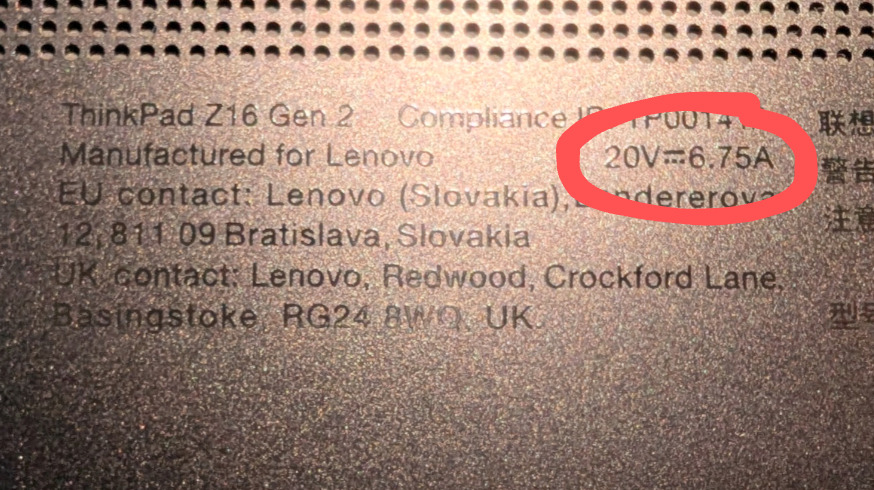
I have a fucking thinkpad that does not follow the USB PD spec!
The thing has only type-c ports, the thing is relatively recent (2023), the thing accepts 140W via type-c, I never bothered to check the actual specs and assumed PD 3.1
Turned out that no, this is not PD, this works only via proprietary power brick that outputs 20v@6.75A, that I didn’t get as I already have a bajilion of PD 3.0/3.1 power supplies at home.
back of the device

the problem here does not originate in zfs, this is a hardware failure due to a poorly supported SoC (vendor says PCIe works ‘normally’ since kernel 7.1, this system ran 6.19) and bad electricity supply