• 0 Posts
  • 19 Comments
Joined 3 years ago
cake
Cake day: June 13th, 2023

help-circle
  • That’s a big part of why so many communities are full of bots and slop now. The bigger subreddits were already bad for that, but before I left Reddit (during the API protest), I at least was able to find quality discussions and posts in a bunch of smaller, more niche subreddits.

    Lemmy doesn’t have nearly as many of those kinds of communities, so I found myself visiting Reddit a few times after the API stuff. I was disappointed to learn that many of the communities I had frequented were nothing like I remembered, and many of them had completely different mod teams. Whether it’s the mods or just the people who cared enough to frequently post and comment, a lot of the good people on Reddit left during the API fiasco. Although I enjoy Lemmy far more than I did Reddit (due to the higher concentration of meaningful conversations), it sucks to see how much has been lost at Reddit


  • When my mum was a child, when she wet the bed, she had her nose rubbed in it, like a dog.

    Her step dad used to get her half siblings to restrain her arms as one of them beat her up.

    When still a child herself, she was made responsible for the wellbeing of multiple of her very young siblings, necessitating her teaching her younger brother to help her shoplift food if they wanted to eat anything before their evening meal.

    The thing is with my mum is that the good times were very good, and on average, she was still pretty decent — and that’s with awful things like the emotional abusive dragging down that average. As much as I still feel hurt over what she put me through, I also feel a like of sympathy for her. She tried to be better than what she had, and whilst she did succeed in that, that says as much about the extremely low bad as it does about the good she achieved as a parent.


  • My mum wanted kids because she was pretty heavily parentified when she was still a child herself, and was often put in the impossible situations like “I need to figure out how to feed my toddler younger brother who I am responsible for”, which led to her having to teach him help her shoplift by hiding food when he was sitting in the shopping trolley at the supermarket. She wanted the opportunity to be the parent that she wished she could’ve had.

    That’s certainly a more noble goal than simply wanting to continue one’s family line, but there’s still a deep immaturity to it in hindsight. Her childhood left her pretty thoroughly fucked up, and you can’t move on from that kind of trauma just by deciding to be better. Healing requires a lot of support, time and effort. Although she did infinitely better than her parents did, her baggage ended up bringing a lot of toxicity to my teenage years, and our relationship was permanently harmed by that. Some of her most toxic traits were as a result of overcorrecting after deciding that she wanted to be nothing like her parents had been.


  • She got drunk and was crying about her regret about not aborting me. She came from a larger family and wanted more kids than she ended up having, but my dad’s personal limit was 2-3 kids — and kid number three was only to try for a daughter if kid number 2 ended up being another boy. Me being a girl meant that she could only have two kids, and the fact that I was pretty fucked up means that she felt like she’d “wasted” a kid on me, so to speak

    I don’t blame my mum for having these thoughts, as awful as they may be. At the time, I had not long since been diagnosed with autism, and my mental health was pretty awful too, which must’ve been a lot of stress for a parent to handle. What I do blame her for is being deeply depressed and having her teenage daughter be her primary (and basically only) emotional outlet.

    Whilst I am theoretically open to having a relationship with her in future, if she ever got sober (though that seems unlikely I’d learn of her being sober, as I went No Contact with her years ago), I’ll never be able to forget how much she hurt me. She wasn’t the root cause of my mental health problems, but she certainly made them a hell of a lot worse. And given that she never remembered the stuff she said when she was this drunk, I’ll never get the closure of a genuine apology.

    What’s especially tragic about my mum is that she’s actually pretty well adjusted, considering the awful childhood she had. The main thing she wanted from life was to be a mum, and to do a better job than her own mum had. I do think she achieved that, and there are so many things that I feel appreciative of her for. Unfortunately, no amount of good can make up for the hurt that she caused when she’d get drunk and pile her grief onto me. Most of the time her drunken tears were far less hurtful, but it’s still a heavy burden to put on an already struggling teenager.

    It’s a shame, because I think she could’ve been an incredible parent if she’d been able to get therapy in the few years after she moved out but before she fell pregnant.


  • Most importantly, love requires both partners to be emotionally vulnerable, right? So then under gender roles, men can’t love women, only objectify them? Wouldn’t this make society one giant trauma factory where men are traumatized into detached sociopathy and women are traumatized into servitude?

    Yup, basically

    So what the hell are conservatives doing in relationships? Are they all loveless relationships

    I think that whilst there are some conservative men who “cheat” and allow themselves moments of escaping from their gender roles, there are a lot of miserable people. Like, have you ever noticed how conservative media is just constant ragebait, and makes people just get angry at how shit the world is, then it will make them feel scared and powerless, but then because they don’t have the emotional capacity to explore those emotions, they channel it more into rage. I think that you’re right on the money when you describe claiming power under the patriarchy as being a “Faustian bargain”.

    Although you probably feel like you’re socially delayed because you’re not just now working through all this stuff, speaking as someone who’s 29, I have known plenty of people who didn’t reach this realisation until they were a fair bit older than you, so from my perspective, you’re probably ahead of your peers. Some people may seem like they don’t need to work on this stuff, but often it’s just that it’s less easy to detect until it really becomes an issue later in life. What you discuss is why I vehemently consider it to be an aspect of my duty as a feminist to work to understand how the patriarchy harms men, and restricts masculinity in general.

    If you want to explore this more, a book that I would hugely recommend is “The Will to Change: Men, Masculinity and Love” by bell hooks. It’s an incredible book, and I think we’d live in a far healthier world if every man read this book. It’s old enough that you can find it for free on Archive.org


  • “He had a way to connect people that I just can’t, but I’ll try anyway.”

    Yeah, I feel you. I lost my best friend to COVID back in 2021. He was a charismatic whirlwind of a man, who seemed to exude an aura of safety and welcomingness. I’m a pretty loud person myself, so I would’ve never seen myself in the “sidekick” niche, but alongside a big personality such as him, it was a role I was happy to fill.

    When he died, I had a moment of going “well damn. I thought I was going to be the inevitably doomed sidekick to his hero story. Does this mean I need to try ‘be the hero’? How the hell do I do that?”. The world needs energy like his now more than ever, so it feels like it’s my duty to learn from him and help fill the niche that he left behind. It’s a tricky job though, because I’ll never be able to be like him. I have made some progress in learning how to emulate the impact he had on the world but in a “me” way. If nothing else, trying to do this helps me feel closer to him, and helps me to grieve his absence.

    It sounds like you’re facing a similar challenge. I wish you luck on that quest, and again, I’m sorry for your loss


  • Okay, so there’s two main reasons why alcohol withdrawal is so brutal (much of what I’m about to say also applies for benzos too)

    1.) Alcohol primarily increases the actions of a neurotransmitter called GABA, which is sometimes referred to as “the off switch of the brain” because of its role as the key inhibitory neurotransmitter. If you’ve ever heard people say that alcohol is a depressant, this is what this means (although people often use that to mean it will make you emotionally depressed, but that’s not what the phrase means — it means that it’s a central nervous system depressant. Certainly alcohol (and alcohol withdrawal) can affect mental health, but as a biochemist, that’s far out of my wheelhouse; I do know that the effect is not a simple one of “alcohol makes you sad”).

    Chronic alcohol dependence means that the brain has to upregulate a bunch of systems, in order to compensate for the neuronal inhibition caused by extra GABA activity. It’s basically the same phenomenon as how if you regularly drink caffeine, it will stop being effective due to compensatory upregulation of the system involved — except when you stop drinking caffeinated drinks, you’re mainly feeling the impact of that one upregulated system. It feels awful, but it won’t kill you. However, GABA has such a far reaching impact across the entire central nervous system that when you stop drinking, your entire brain is running at an increased level of excitation — which is what can lead to things like anxiety, tremors and seizures.

    2.) Another reason why alcohol withdrawal has such a big impact is because alcohol doesn’t just affect GABA, but many other neurotransmitters. It’s what my neuroscientist friend referred to as “a dirty drug” (n.b. there’s no value judgement in this statement, it’s just just referring to it being less specific than other drugs). Dopamine, serotonin, glutamate and norepinephrine (and others) are also affected by alcohol consumption, and as with GABA, chronic alcohol dependence causes these systems to adjust their level of activity to compensate for the alcohol. When a person stops drinking alcohol, it’s basically all of these compensatory mechanisms being suddenly revealed.

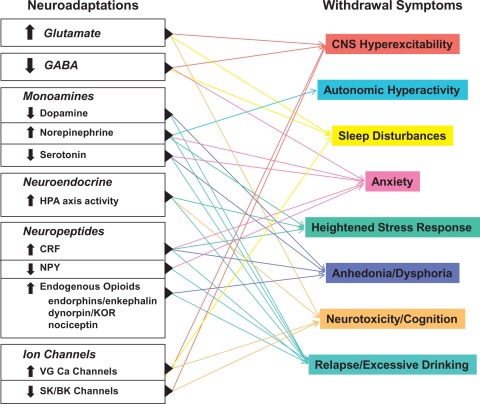
    Below is a diagram that shows how chronic alcohol dependence affects neurotransmitters (an up arrow to the left of a neurotransmitter means that it is upregulated due to alcohol (i.e. systems involved become more active), and the symptoms on the left are the result of the changes to those systems, only revealed during alcohol withdrawal. I don’t expect you to be able to follow the specifics of this image, given that even in the textbook I got this from[1], the main point of this image seems to be to go “There’s a heckton going on and everything is so interconnected that it’s super difficult to figure out exactly how alcohol withdrawal causes these symptoms”


    [1]: citation for the image: Howard C. Becker, Patrick J. Mulholland, Chapter 9 - Neurochemical mechanisms of alcohol withdrawal, Editor(s): Edith V. Sullivan, Adolf Pfefferbaum, Handbook of Clinical Neurology, Elsevier, Volume 125, 2014, https://doi.org/10.1016/B978-0-444-62619-6.00009-4. (https://www.sciencedirect.com/science/article/pii/B9780444626196000094)


    1. 1 ↩︎


  • “would be”, “was” — am I to take this to mean that your brother is no longer with us? If so, I am sorry for your loss.

    If I have intuited this correctly, then I hope that some day, you can be the “truck guy” for other people. The truck is optional honestly — just as long you carry with you the spirit of helpfulness and trust in reciprocal community support.