As much as we love to hate on bad old M$, Visual Basic had a rather feature complete IDE for 1991, including syntax highlighting. At minimum by the 5.0 release (1997) it also had function syntax hints and certainly built in documentation. You could even customize the editor window colors.
Of course it had absolutely no code repository or version control capability whatsoever. It was designed with a one dude, one computer, one project paradigm in mind for sure.
Yes, and the form controls included do not support mouse wheel inputs either unless you manually capture the events in your own code using the Windows API. This includes e.g. multiline text boxes in within VBA applications even as late as in Office 2016 which is monumentally irritating.
But VB itself was certainly among the first modern IDEs. It wasn’t the first IDE in general, though. I think that was probably Turbo Pascal back in the DOS days which had its editor, compiler, and debugger (such as it was) all in one lump.
I started professional programming with VB3 in 1995. Just in terms of the ability to create Windows applications, it was light years beyond anything else – even if it didn’t even have custom classes at that point. Maybe Delphi was close.
You could get a “hello world” app up and running in like 40 seconds. It’s how I got into programming as a kid. In modern frameworks there’s a massive bootstrap barrier that beginners don’t get through.
I started using VB to create a music composition app that used MIDI functions to generate the notes. This was very easy to do, but when I started writing my own software synthesis routines, Visual Basic was much too slow to be viable. So I started learning C. I thought creating a Windows application in C would be generally just as simple and easy as visual basic but holy shit was that ever wrong. I ended up doing the computationally-intensive stuff in C and compiling it into a DLL that I accessed from a VB front end. Really the best of both worlds.
Constantly switching between Visual Basic and C was quite the mindfuck, though. Thank god C# came along eventually.

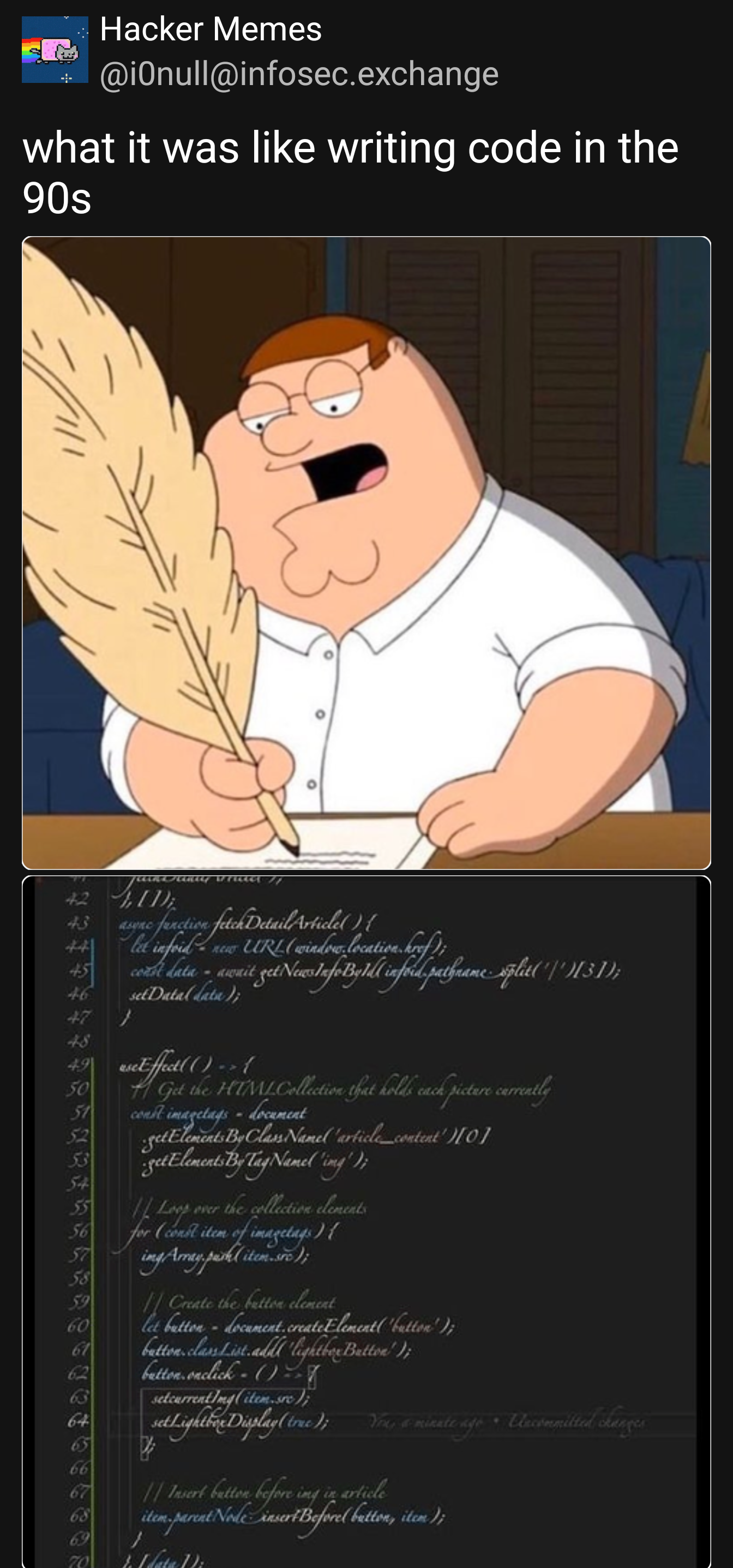
As much as we love to hate on bad old M$, Visual Basic had a rather feature complete IDE for 1991, including syntax highlighting. At minimum by the 5.0 release (1997) it also had function syntax hints and certainly built in documentation. You could even customize the editor window colors.
Of course it had absolutely no code repository or version control capability whatsoever. It was designed with a one dude, one computer, one project paradigm in mind for sure.
Even with SP6 installed, you need to manually patch in scrollwheel support.
Yes, and the form controls included do not support mouse wheel inputs either unless you manually capture the events in your own code using the Windows API. This includes e.g. multiline text boxes in within VBA applications even as late as in Office 2016 which is monumentally irritating.
But VB itself was certainly among the first modern IDEs. It wasn’t the first IDE in general, though. I think that was probably Turbo Pascal back in the DOS days which had its editor, compiler, and debugger (such as it was) all in one lump.
I started professional programming with VB3 in 1995. Just in terms of the ability to create Windows applications, it was light years beyond anything else – even if it didn’t even have custom classes at that point. Maybe Delphi was close.
You could get a “hello world” app up and running in like 40 seconds. It’s how I got into programming as a kid. In modern frameworks there’s a massive bootstrap barrier that beginners don’t get through.
I started using VB to create a music composition app that used MIDI functions to generate the notes. This was very easy to do, but when I started writing my own software synthesis routines, Visual Basic was much too slow to be viable. So I started learning C. I thought creating a Windows application in C would be generally just as simple and easy as visual basic but holy shit was that ever wrong. I ended up doing the computationally-intensive stuff in C and compiling it into a DLL that I accessed from a VB front end. Really the best of both worlds.
Constantly switching between Visual Basic and C was quite the mindfuck, though. Thank god C# came along eventually.