This is not a SFW instance. NSFW communities will be tagged, and efforts will be made to keep SFW communities clean, but proceed at your own comfort level.
There’s always so much to unpack in these discussions. The Marxist theory of the state is the historic mechanism of class rule. Both anarchists and communists believe this, that the ruling class of capitalism uses the state in order to oppress and exploit the masses.
Both left tendencies are revolutionary, both left tendencies want to seize production for the workers, both left tendencies understand that state power must be seized, and the capitalist state must be destroyed.
The difference seems to be, that Marxist communists believe in establishing a workers state to suppress the existing bourgeois elements, where anarchists more want to transition away from the state as a form of geographic organization.
Lenin’s theory was that the worker state would not need all the functions of the bourgeois state, and would be able to phase out those functions. But Lenin’s theory was also dependent on an international worker revolution. When the revolution in Germany failed, when Russia was invaded by capitalists and the remaining Tsarist forces allied with the invaders, it forced a crisis in Russia. From there, it was just crisis after crisis. Lenin originally said “all power to the Soviets (worker councils)” but when the civil war completely destroyed what little industrial capacity Russia had, then there were no factories in which to organize for. Without a place to work, there’s no workers and hence no worker organization.
Lenin and the Bolsheviks did make mistakes, but the conditions were extremely fraught. In the process of smashing the state, there were many functions of state that were necessary in order to prevent the reactionaries and foreign capitalists from seizing state power for themselves. This led to rehiring the old tsarist state bureaucrats back into the roles that they had prior to the revolution, and this happened on a mass scale. But this wasn’t by design, it was an accident, a quirk of necessity brought on by years and years of war. When the civil war was over, Lenin was sick, and the bureaucracy rallied around Stalin who had been working to replace the “old Bolsheviks” who had taken up roles of state functionaries, with people who were loyal to him. Stalin didn’t create the bureaucracy, so much as the bureaucracy elevated him. Without worker councils the bureaucracy was the only power left in Russia.
Trotsky and Lenin’s theory of permanent revolution never left the page, and Trotsky was able to wield it as a resistance to Stalinist bureaucracy, but conditions under Trotsky wouldn’t have been much different. He would have faced the same challenges, and I don’t have to tell a comm of anarchists about the utter tragedy that he oversaw at Kronstadt. But still, anarchist historian Paul Averich, critical of Lenin at every turn, still hesitates to lay responsibility for it at the feet of Lenin. But after that, the disastrous NEP.
Stalin developed the theory of socialism in one country, which established the “socialist state.” But even without the theory, the contradictions of global capitalist statehood were still forced on the country of Russia.
I still think the theory laid out in State and Revolution is sound. I think there needs to be some way of organizing against foreign invasion and internal sabotage. I don’t think Russia or even China are particularly good examples, but also, both cases were barely industrialized peasant societies when they defeated their weak domestic capitalist class.
I think if mass worker revolution happened in a highly industrialized then the possibility of a just and democratic worker state would be more possible than what happened in Russia. I consider myself a communist, but if I was in country presided over by a Stalinist bureaucracy, I’d be killed in the purges, along with the rest of you. I believe that you keep fighting for liberation until all are free and all are equal and in harmony with nature, that it is the fight for those things that moves humanity forward. And maybe I’m just not familiar enough with Anarchist theory, but the contradictions that reify into the state form do not go away just because the state is mired in contradictions. As long as there classes there will be the need to organize geographically.
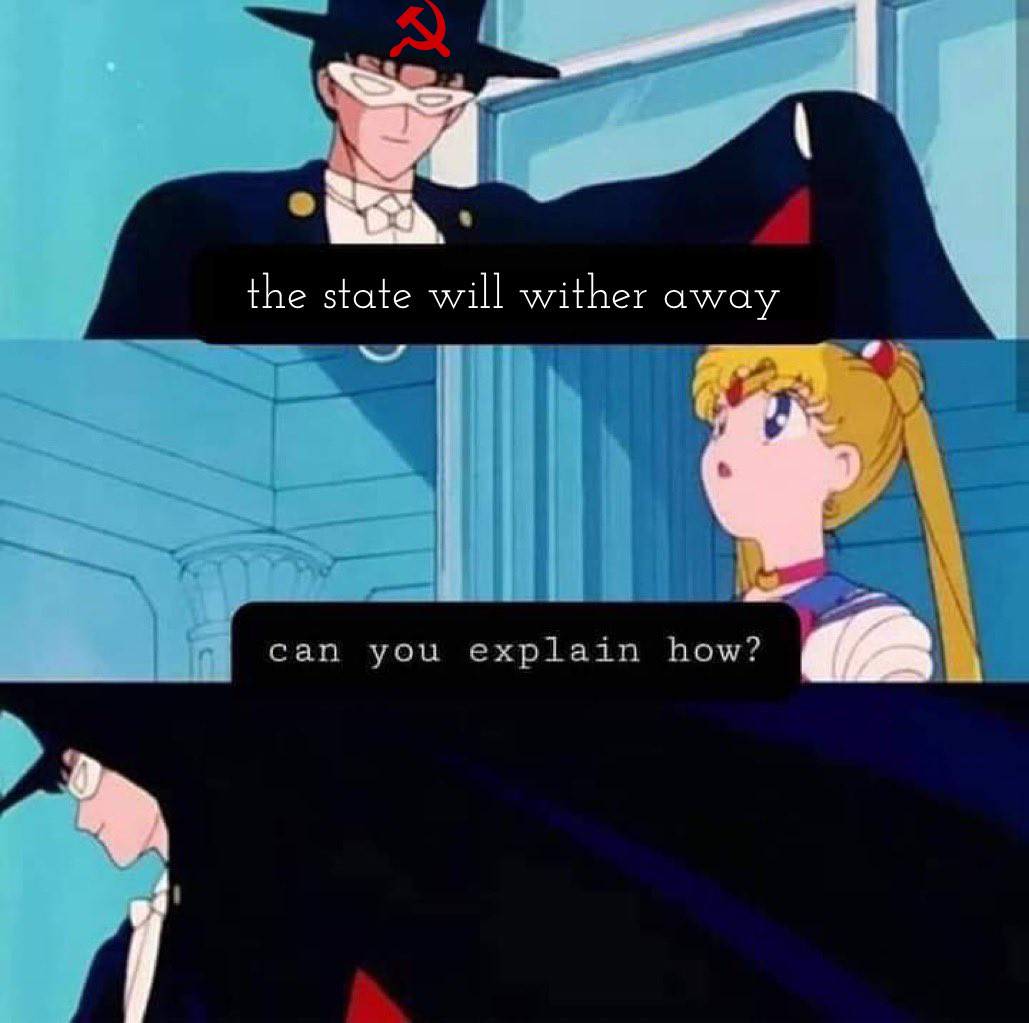
I believe that no revolution will be possible until there’s real worker control and democracy. And if the conditions actually get there, like on a global scale, then chances are I will want something more decentralized and consent driven for all people. But as long as there are classes there is the need to suppress one or the other, and the only way to do that is some kind of central organization that oversees those relations within a particular geographic area. As the bourgeois class is dismantled, so is the necessity for the worker state to dismantle it. This is how the state withers away. The fact that it did not, could not happen in Russia doesn’t mean it is wrong, in theory. It just means the time of global revolution is still in the future.
This is not meant as a “gotcha” to anarchists, I just think the theory is explained, and isn’t hard to understand. And there’s lots of valid historical concerns about it. But with the most good faith intention, if a country found themselves in a revolutionary situation, and faced these very real problems, what alternative would there be bit central organization of one form or another? In my opinion, the problems of authoritarianism can be mitigated through direct participation and political education. If such an organization could take up the functions of state, then I think it would be more successful than either 20th century state socialism or decentralized anarchism.
There’s always so much to unpack in these discussions. The Marxist theory of the state is the historic mechanism of class rule. Both anarchists and communists believe this, that the ruling class of capitalism uses the state in order to oppress and exploit the masses.
Both left tendencies are revolutionary, both left tendencies want to seize production for the workers, both left tendencies understand that state power must be seized, and the capitalist state must be destroyed.
The difference seems to be, that Marxist communists believe in establishing a workers state to suppress the existing bourgeois elements, where anarchists more want to transition away from the state as a form of geographic organization.
Lenin’s theory was that the worker state would not need all the functions of the bourgeois state, and would be able to phase out those functions. But Lenin’s theory was also dependent on an international worker revolution. When the revolution in Germany failed, when Russia was invaded by capitalists and the remaining Tsarist forces allied with the invaders, it forced a crisis in Russia. From there, it was just crisis after crisis. Lenin originally said “all power to the Soviets (worker councils)” but when the civil war completely destroyed what little industrial capacity Russia had, then there were no factories in which to organize for. Without a place to work, there’s no workers and hence no worker organization.
Lenin and the Bolsheviks did make mistakes, but the conditions were extremely fraught. In the process of smashing the state, there were many functions of state that were necessary in order to prevent the reactionaries and foreign capitalists from seizing state power for themselves. This led to rehiring the old tsarist state bureaucrats back into the roles that they had prior to the revolution, and this happened on a mass scale. But this wasn’t by design, it was an accident, a quirk of necessity brought on by years and years of war. When the civil war was over, Lenin was sick, and the bureaucracy rallied around Stalin who had been working to replace the “old Bolsheviks” who had taken up roles of state functionaries, with people who were loyal to him. Stalin didn’t create the bureaucracy, so much as the bureaucracy elevated him. Without worker councils the bureaucracy was the only power left in Russia.
Trotsky and Lenin’s theory of permanent revolution never left the page, and Trotsky was able to wield it as a resistance to Stalinist bureaucracy, but conditions under Trotsky wouldn’t have been much different. He would have faced the same challenges, and I don’t have to tell a comm of anarchists about the utter tragedy that he oversaw at Kronstadt. But still, anarchist historian Paul Averich, critical of Lenin at every turn, still hesitates to lay responsibility for it at the feet of Lenin. But after that, the disastrous NEP.
Stalin developed the theory of socialism in one country, which established the “socialist state.” But even without the theory, the contradictions of global capitalist statehood were still forced on the country of Russia.
I still think the theory laid out in State and Revolution is sound. I think there needs to be some way of organizing against foreign invasion and internal sabotage. I don’t think Russia or even China are particularly good examples, but also, both cases were barely industrialized peasant societies when they defeated their weak domestic capitalist class.
I think if mass worker revolution happened in a highly industrialized then the possibility of a just and democratic worker state would be more possible than what happened in Russia. I consider myself a communist, but if I was in country presided over by a Stalinist bureaucracy, I’d be killed in the purges, along with the rest of you. I believe that you keep fighting for liberation until all are free and all are equal and in harmony with nature, that it is the fight for those things that moves humanity forward. And maybe I’m just not familiar enough with Anarchist theory, but the contradictions that reify into the state form do not go away just because the state is mired in contradictions. As long as there classes there will be the need to organize geographically.
I believe that no revolution will be possible until there’s real worker control and democracy. And if the conditions actually get there, like on a global scale, then chances are I will want something more decentralized and consent driven for all people. But as long as there are classes there is the need to suppress one or the other, and the only way to do that is some kind of central organization that oversees those relations within a particular geographic area. As the bourgeois class is dismantled, so is the necessity for the worker state to dismantle it. This is how the state withers away. The fact that it did not, could not happen in Russia doesn’t mean it is wrong, in theory. It just means the time of global revolution is still in the future.
This is not meant as a “gotcha” to anarchists, I just think the theory is explained, and isn’t hard to understand. And there’s lots of valid historical concerns about it. But with the most good faith intention, if a country found themselves in a revolutionary situation, and faced these very real problems, what alternative would there be bit central organization of one form or another? In my opinion, the problems of authoritarianism can be mitigated through direct participation and political education. If such an organization could take up the functions of state, then I think it would be more successful than either 20th century state socialism or decentralized anarchism.
I found this a really thoughtful post. Gonna chew on this for a while. Thanks.
No problem. Hmu if you have any questions