This is not a SFW instance. NSFW communities will be tagged, and efforts will be made to keep SFW communities clean, but proceed at your own comfort level.
Elephant Racing
colloquialism for one lorry (semi truck) overtaking another.
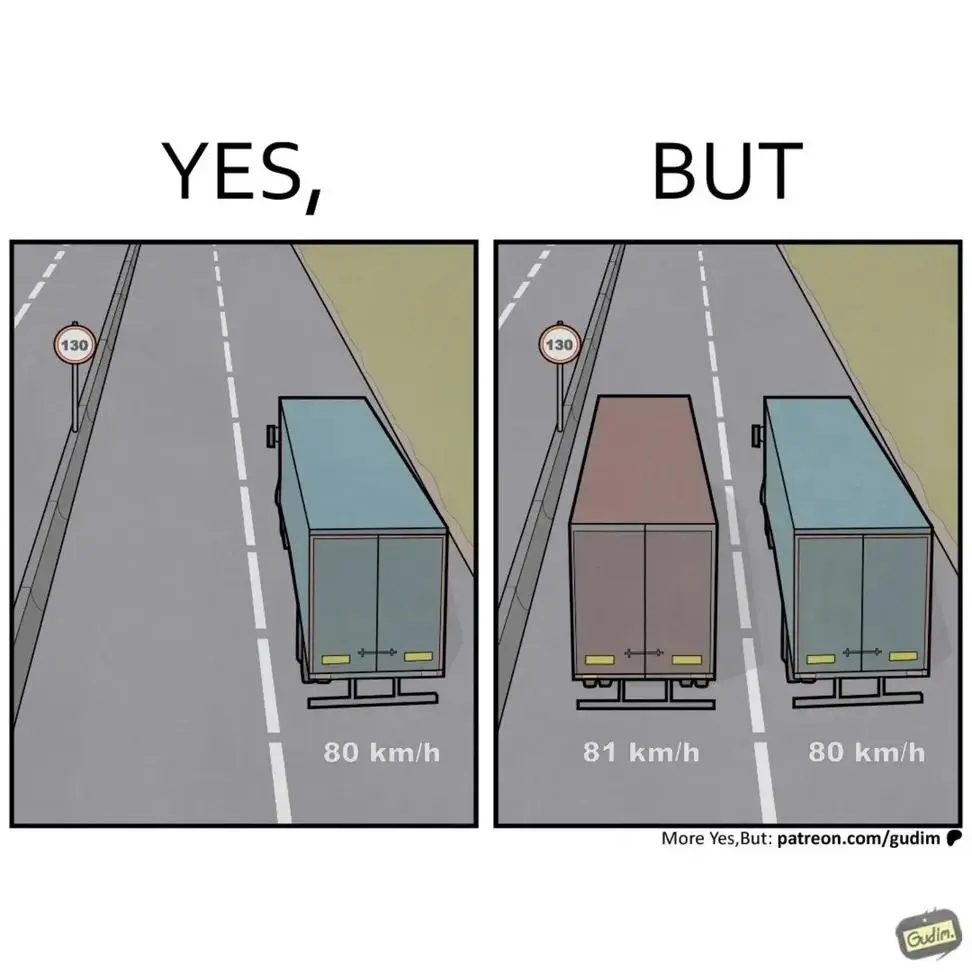
Elephant racing is a colloquial term for a situation where one lorry (semi truck) overtakes another on a multi-lane road (usually a highway) with a small speed difference.
Quantitative Analysis
The overtaking process usually takes several minutes due to the small speed difference. This difference is often due to the legal allowance being the speed limit plus 6 km/h tolerance, but the speed in the overtaking lorry is instead set to 10 km/h above the limit. Even if the faster vehicle ends up closer than the prescribed 50 m following distance for trucks above 50 km/h, overtaking at speeds below 10 km/h isn’t permitted. With a difference of 4 km/h, an elephant race takes at least half a minute if the passing lorry is already very close and returns to its lane immediately after.
Taking into account lane changing as well as the distance before the overtaking process, a typical overtaking manoeuvre will take 3 minutes and extend over 4 kilometers at a speed difference of 2 km/h. Sometimes these attempts fail and are aborted, especially when increased air resistance or gradient changes negate the excess speed.
The time saved is very small, even over a day. For a distance of 500 km at a constant speed of exactly 80 km/h, it takes 6 hours and 15 minutes. If the route is clear throughout and is driven at a constant speed of 82 km/h, it will still take 6 hours and 6 minutes, not even 10 minutes less. These 10 minutes of time savings contrast with the significantly higher time losses for the many affected car drivers on two-lane highways.
For our German-challenged friends:
Elephant Racing
colloquialism for one lorry (semi truck) overtaking another.
Elephant racing is a colloquial term for a situation where one lorry (semi truck) overtakes another on a multi-lane road (usually a highway) with a small speed difference.
Quantitative Analysis
The overtaking process usually takes several minutes due to the small speed difference. This difference is often due to the legal allowance being the speed limit plus 6 km/h tolerance, but the speed in the overtaking lorry is instead set to 10 km/h above the limit. Even if the faster vehicle ends up closer than the prescribed 50 m following distance for trucks above 50 km/h, overtaking at speeds below 10 km/h isn’t permitted. With a difference of 4 km/h, an elephant race takes at least half a minute if the passing lorry is already very close and returns to its lane immediately after.
Taking into account lane changing as well as the distance before the overtaking process, a typical overtaking manoeuvre will take 3 minutes and extend over 4 kilometers at a speed difference of 2 km/h. Sometimes these attempts fail and are aborted, especially when increased air resistance or gradient changes negate the excess speed.
The time saved is very small, even over a day. For a distance of 500 km at a constant speed of exactly 80 km/h, it takes 6 hours and 15 minutes. If the route is clear throughout and is driven at a constant speed of 82 km/h, it will still take 6 hours and 6 minutes, not even 10 minutes less. These 10 minutes of time savings contrast with the significantly higher time losses for the many affected car drivers on two-lane highways.