This is not a SFW instance. NSFW communities will be tagged, and efforts will be made to keep SFW communities clean, but proceed at your own comfort level.
The problem is, it obviously (collective bargaining etc. alone breaks the theory already) doesn’t work. Like any economic theory, it’s a theory that assumes too many things and ignore a great deal of other things. If a job stays more or less unchanged for a hundred years and there’s still demand for it, why exactly do you need constant pressure on those specific wages?
Also, you can have growing and shrinking wages without a national bank targeting an inflation rate. Having heard some FED people speak (powell etc.) makes it even more clear that there’s a bunch of out of touch assholes at the levers of this shit.
I largely agree, but there is a need for some mechanism to reallocate labor.
The problem arises when the relative value of things shifts. If you are doing X making $50K per year, but technological developments have made X less valuable (i.e. greater automation making it more efficient per-worker, or simple falling demand), then one of two things has to happen to maintain the correct labor allocation to X:
The wage decreases in absolute terms, $50K becomes 40 or 30 or whatever the new equilibrium price-point is given the circumstances.
All other wages and prices increase relative to the $50K such that the value of the wage given to the worker is the same as if 1 had occurred. This is the inflation case.
Any other outcome means there is an imbalance: a worker would be providing a service worth less than X and being rewarded a value of X. This would be a signal to add more workers doing X … the opposite of what is needed when X is becoming less valuable. There is no future - in a market economy - where a worker simply continues to earn what they did before in value terms. This would mean ignoring the demand signals in the market and ascribing a resource allocation by fiat - which if we are doing that we shouldn’t be discussing market dynamics in the first place.
Markets exist for price discovery and resource allocation. Labor is a resource and has a price, and like any other resource that price changes. This has many consequences, both good and bad, for the humans comprising the dispassionate word ‘labor’.
Also, like many other things priced by the market, there are distortions from the ideal case. Roles are valued higher or lower than they ‘should be’ based on social prestige, or perceived difficulty, or visible utility to those already affluent, or whether it is done in a field or an office.
People are well aware of all of all this, in a broad sense. There is always anxiety in modern life around stability and continuance of employment and pay (doubly so with all the AI talk).
These forces also affect firms - when they operate in areas that are becoming less valuable, inflation smoothes their transition out of the market … rather than simply collapsing and displacing all of their employees at once.
The target is arbitrary, just the larger the steady inflation is the faster the reorganization occurs.
There are other possible systems - we built all of this and can decide to do something else entirely at any point… as long as the harvest is collected, the power plants are serviced, the pharmaceuticals are produced, etc. This is just what we’ve landed on the compromise where the masses don’t revolt, the elites don’t (completely) dominate, and all the necessary work still gets done.
I don’t know if non-inflationary policy would be better or worse - it would certainly be strange to expect negative raises each year - but it perhaps would be more honest.
I fully share your frustration, and thank you for the discussion!
Laying people off just needs to be less of a bigger deal, instead of dropping wages 2% a year, they should just lay off the 2% least efficient workers each year. but that requires a stronger social safety net because people talk about layoffs like they’re sending people to their deaths, which is kinda true because without a steady income in this country youre reduced to surviving the elements.
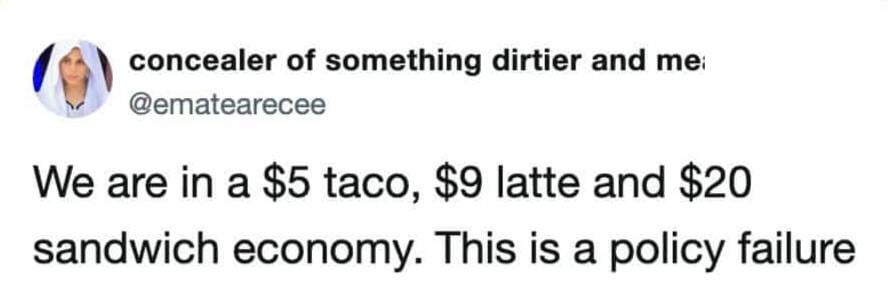
The problem is, it obviously (collective bargaining etc. alone breaks the theory already) doesn’t work. Like any economic theory, it’s a theory that assumes too many things and ignore a great deal of other things. If a job stays more or less unchanged for a hundred years and there’s still demand for it, why exactly do you need constant pressure on those specific wages?
Also, you can have growing and shrinking wages without a national bank targeting an inflation rate. Having heard some FED people speak (powell etc.) makes it even more clear that there’s a bunch of out of touch assholes at the levers of this shit.
I largely agree, but there is a need for some mechanism to reallocate labor.
The problem arises when the relative value of things shifts. If you are doing X making $50K per year, but technological developments have made X less valuable (i.e. greater automation making it more efficient per-worker, or simple falling demand), then one of two things has to happen to maintain the correct labor allocation to X:
The wage decreases in absolute terms, $50K becomes 40 or 30 or whatever the new equilibrium price-point is given the circumstances.
All other wages and prices increase relative to the $50K such that the value of the wage given to the worker is the same as if 1 had occurred. This is the inflation case.
Any other outcome means there is an imbalance: a worker would be providing a service worth less than X and being rewarded a value of X. This would be a signal to add more workers doing X … the opposite of what is needed when X is becoming less valuable. There is no future - in a market economy - where a worker simply continues to earn what they did before in value terms. This would mean ignoring the demand signals in the market and ascribing a resource allocation by fiat - which if we are doing that we shouldn’t be discussing market dynamics in the first place.
Markets exist for price discovery and resource allocation. Labor is a resource and has a price, and like any other resource that price changes. This has many consequences, both good and bad, for the humans comprising the dispassionate word ‘labor’.
Also, like many other things priced by the market, there are distortions from the ideal case. Roles are valued higher or lower than they ‘should be’ based on social prestige, or perceived difficulty, or visible utility to those already affluent, or whether it is done in a field or an office.
People are well aware of all of all this, in a broad sense. There is always anxiety in modern life around stability and continuance of employment and pay (doubly so with all the AI talk).
These forces also affect firms - when they operate in areas that are becoming less valuable, inflation smoothes their transition out of the market … rather than simply collapsing and displacing all of their employees at once.
I can see that, my point being that the 2 percent target is merely fighting symptoms and imo doing more harm than good.
And still, price discovery happens without a 2 percent target aswell.
My issue is, it’s been decades and society in general just accepts this kinds of economic policy. This is ridiculous, and i am attacking that.
BTW, i am not trying to pick a fight, i am just frustrated
The target is arbitrary, just the larger the steady inflation is the faster the reorganization occurs.
There are other possible systems - we built all of this and can decide to do something else entirely at any point… as long as the harvest is collected, the power plants are serviced, the pharmaceuticals are produced, etc. This is just what we’ve landed on the compromise where the masses don’t revolt, the elites don’t (completely) dominate, and all the necessary work still gets done.
I don’t know if non-inflationary policy would be better or worse - it would certainly be strange to expect negative raises each year - but it perhaps would be more honest.
I fully share your frustration, and thank you for the discussion!
Laying people off just needs to be less of a bigger deal, instead of dropping wages 2% a year, they should just lay off the 2% least efficient workers each year. but that requires a stronger social safety net because people talk about layoffs like they’re sending people to their deaths, which is kinda true because without a steady income in this country youre reduced to surviving the elements.