This is not a SFW instance. NSFW communities will be tagged, and efforts will be made to keep SFW communities clean, but proceed at your own comfort level.
Does anyone else find the fetishization of mediation on TNG is kind of unrealistic at best and paternalistic at worst?
Just kind of gives the vibe of people that refuse to understand that populations are more than happy to fuck over other populations as a matter of conscious policy to maintain their own advantage.
These are the people that think, “All these people squabbling amongst themselves are stupid. We just need to get their leaders in a room and lock the door until they come to an agreement,” as if there is always an even trade that a powerful population, that holds all the cards, can amicably make with an weak population that holds no cards because access to the deck has been denied them.
That all these social problems are not struggles to be fought and won, but puzzles to be solved by superior intellects.
Hm. Maybe it’s time to make a list of diplomacy episodes for me to ree-watch.
I watched so much TNG it’s one of those shows that just sort of sits in my head and I don´t feel the need to watch it again because it quite alive in there, but it’s lives in the perspective of a man 20 years younger than I am.
Funny. I was a child when it was on air but I come from a conservative family that discounted the show as liberal nonsense (but still enjoyed it anyways… go figure). With my current perspective, TNG helps me cultivate optimism and belief in a better future in which diplomacy trumps violence.
But hey, maybe starships were a metaphor for nuclear weapons and you have to talk things out when every group of people has access to a doomsday weapon. Remember: peace… through superior firepower.
Yes, you’ve kind of highlighted my key philosophical and political with problem, of which TNG is the most egregious example.
The arc of history does NOT bend toward justice. Believing so lulls us into complacency and laziness. Eventually, if we just wait long enough, we will achieve utopia by default, no need to do much about it.
Of course, if TNG inspires you believe such a thing as possible, and thereby motivates you to WORK towards it, great! But I find more often it acts as a sedative.
The West Wing might be a good comparison for someone looking at how fictional narratives act as a social nepenthe. Like, yes, a good portion of those fans saw the discrepancy between the show and reality and worked to change it, but how many people were just happy to have the show? How many people saw the West Wing and didn’t notice that it is absolutely not how America’s politics operate and left every episode feeling happy that right always prevails.
And the whole aversion to violence is completely ahistorical fantasy, as far as I can tell, but very convenient for a class of people who have achieved everything they need materially but would like to maintain a sense of moral superiority while maintaining the status quo that they benefit from (see: New York Times editorial page).
Personally, I don’t believe in progress. I think it’s a myth. Technology is a glittering lure trapping us in a future that will never come, and that lure shines brightest in TNG. I believe societies rise and fall and there are mechanisms underneath it all that we can effectively do nothing about (including getting swept up in them). I don´t think humanity is groping towards perfection, but will continue to rise and fall until a catastrophe we foresaw and failed to prevent paves the way for the Age of Polydactyl Cats.
But I do love Star Trek because it is ABOUT this shit in a way many shows are not, even if I don’t agree with their take; and often they’ll at least RAISE objections to their own premise, sometimes answered, sometimes not. And, of course, weĺl always have DS9.
Yeah, it would be a bummer if the Enterprise just left behind systems in permanent war or genocide every third episode, or if a show had to turn into a seventeen-parter to get all the nuance right.
The one thing about Star Trek that I’ve always had to sort of ignore in order to enjoy it is that they’re supposed to be living in a post-scarcity society where nobody uses money, but they still have people that do the absolute shit miserable jobs that nobody wants to do today.
Voyager touched on this when they had sentient holograms in perpetual servitude cleaning, Picard touched on it in the creation of “Freecloud” and DS9 touched on it with all the ferengi stuff…
But it’s never explained why people like Joseph Sisco are running restaurants for free, why Picard ‘owns’ Chateau Picard, etc…
Nor is it explained why when Nog goes to Sisco’s restaurant he is using his transporter credits…free?
There’s a lot in-universe that is unexplained and comes down to naive idealism, but that doesn’t mean that we as a society can’t strive towards it.
Someone smarter than I once said “practice doesn’t make perfect, but practice does make better.”
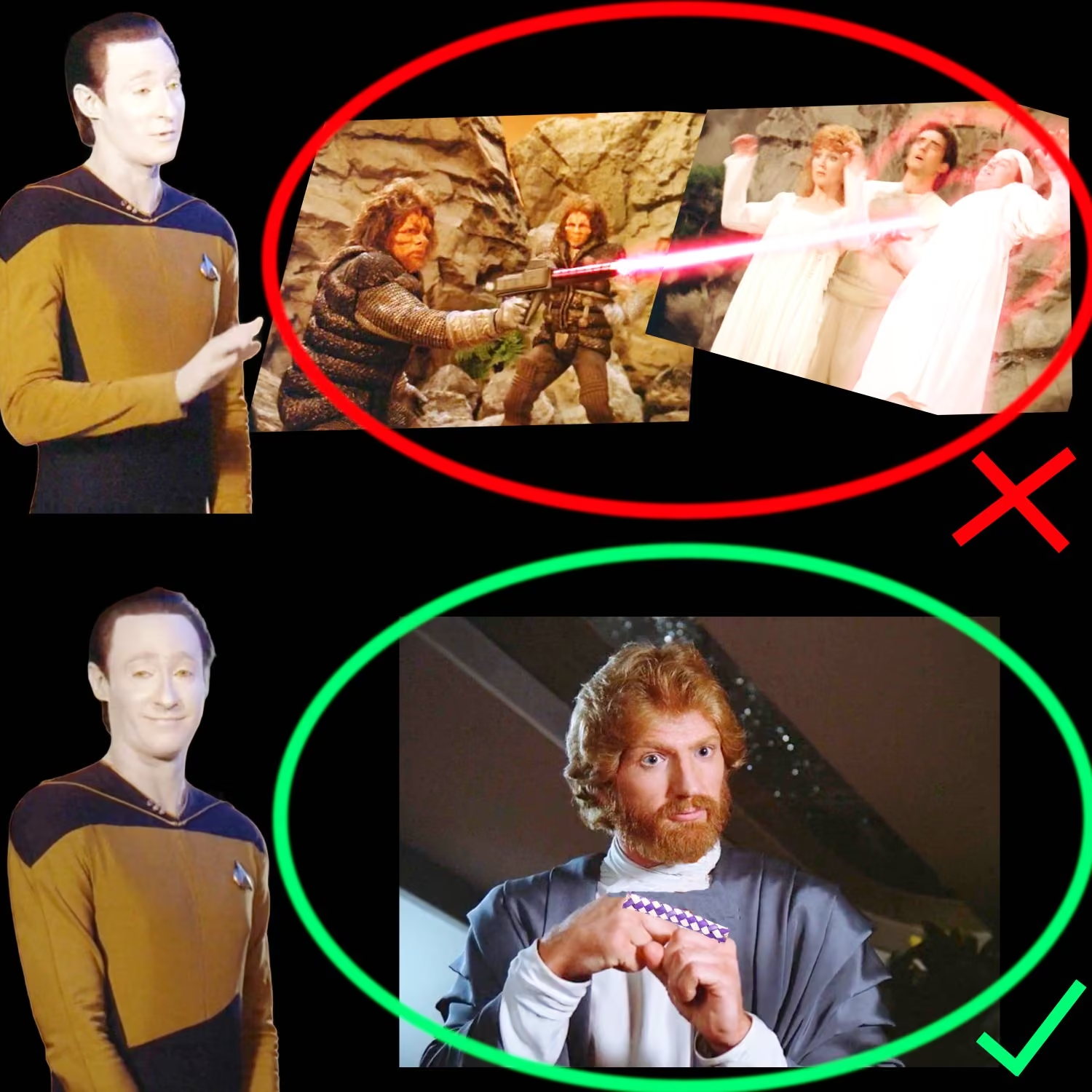
Does anyone else find the fetishization of mediation on TNG is kind of unrealistic at best and paternalistic at worst?
Just kind of gives the vibe of people that refuse to understand that populations are more than happy to fuck over other populations as a matter of conscious policy to maintain their own advantage.
These are the people that think, “All these people squabbling amongst themselves are stupid. We just need to get their leaders in a room and lock the door until they come to an agreement,” as if there is always an even trade that a powerful population, that holds all the cards, can amicably make with an weak population that holds no cards because access to the deck has been denied them.
That all these social problems are not struggles to be fought and won, but puzzles to be solved by superior intellects.
Edit: Contribute to my TNG Negotiation watchlist here: https://sh.itjust.works/post/65181549
I think you’re feeling pessimistic, which is valid. But diplomacy works. And when it cannot work… the show also depicts xenocide.
Hm. Maybe it’s time to make a list of diplomacy episodes for me to ree-watch.
I watched so much TNG it’s one of those shows that just sort of sits in my head and I don´t feel the need to watch it again because it quite alive in there, but it’s lives in the perspective of a man 20 years younger than I am.
Funny. I was a child when it was on air but I come from a conservative family that discounted the show as liberal nonsense (but still enjoyed it anyways… go figure). With my current perspective, TNG helps me cultivate optimism and belief in a better future in which diplomacy trumps violence.
But hey, maybe starships were a metaphor for nuclear weapons and you have to talk things out when every group of people has access to a doomsday weapon. Remember: peace… through superior firepower.
Yes, you’ve kind of highlighted my key philosophical and political with problem, of which TNG is the most egregious example.
The arc of history does NOT bend toward justice. Believing so lulls us into complacency and laziness. Eventually, if we just wait long enough, we will achieve utopia by default, no need to do much about it.
Of course, if TNG inspires you believe such a thing as possible, and thereby motivates you to WORK towards it, great! But I find more often it acts as a sedative.
The West Wing might be a good comparison for someone looking at how fictional narratives act as a social nepenthe. Like, yes, a good portion of those fans saw the discrepancy between the show and reality and worked to change it, but how many people were just happy to have the show? How many people saw the West Wing and didn’t notice that it is absolutely not how America’s politics operate and left every episode feeling happy that right always prevails.
And the whole aversion to violence is completely ahistorical fantasy, as far as I can tell, but very convenient for a class of people who have achieved everything they need materially but would like to maintain a sense of moral superiority while maintaining the status quo that they benefit from (see: New York Times editorial page).
Personally, I don’t believe in progress. I think it’s a myth. Technology is a glittering lure trapping us in a future that will never come, and that lure shines brightest in TNG. I believe societies rise and fall and there are mechanisms underneath it all that we can effectively do nothing about (including getting swept up in them). I don´t think humanity is groping towards perfection, but will continue to rise and fall until a catastrophe we foresaw and failed to prevent paves the way for the Age of Polydactyl Cats.
But I do love Star Trek because it is ABOUT this shit in a way many shows are not, even if I don’t agree with their take; and often they’ll at least RAISE objections to their own premise, sometimes answered, sometimes not. And, of course, weĺl always have DS9.
I enjoy watching TNG as an idealized, utopic society. If every conflict was realistic and messy, it would lose a lot of its identity and charm for me
Yeah, it would be a bummer if the Enterprise just left behind systems in permanent war or genocide every third episode, or if a show had to turn into a seventeen-parter to get all the nuance right.
A LOT of TNG always came across as naive oversimplification, to the point I found it hard to watch even when it was new.
The one thing about Star Trek that I’ve always had to sort of ignore in order to enjoy it is that they’re supposed to be living in a post-scarcity society where nobody uses money, but they still have people that do the absolute shit miserable jobs that nobody wants to do today.
Voyager touched on this when they had sentient holograms in perpetual servitude cleaning, Picard touched on it in the creation of “Freecloud” and DS9 touched on it with all the ferengi stuff…
But it’s never explained why people like Joseph Sisco are running restaurants for free, why Picard ‘owns’ Chateau Picard, etc…
Nor is it explained why when Nog goes to Sisco’s restaurant he is using his transporter credits…free?
There’s a lot in-universe that is unexplained and comes down to naive idealism, but that doesn’t mean that we as a society can’t strive towards it.
Someone smarter than I once said “practice doesn’t make perfect, but practice does make better.”