This is not a SFW instance. NSFW communities will be tagged, and efforts will be made to keep SFW communities clean, but proceed at your own comfort level.
We usually think in linguistic concepts even when reading a book, one of the most difficult things to do with a student when they are learning drawing is teaching them to really see instead of thinking of linguistic traits. I have aphantasia and it is difficult for me to recall visual traits so instead i focus on visual recipes, or construction while drawing. It is difficult for me to recall faces for example but if i reduce a face to geometric shapes and proportions and do a lot of trial and error so i can approximate a face I’ve seen.
So when reading is not that I am seeing things, but i am making a conceptual map, an abstraction. Kinda like how dreams are like stories we tell ourselves to the point they might seem like intangible images. Sometimes I feel my brain relate stuff i read to things i’ve already seen, or builds some conceptual bridge between known concepts to unknown ones.
But reading is also a practice on itself different than hearing. Language has aesthetics, rhythm character. I feel i learn more about the aesthetic beauty of language by reading it on the page than hearing it on an audio book because it forces me to build that bridge between my horizon of understanding and the authors’.
This is especially true for authors that have an entirely different background than me because to understand them i need to read slower and research. Something that audio books doesn’t allow with it’s predisposed presentation.
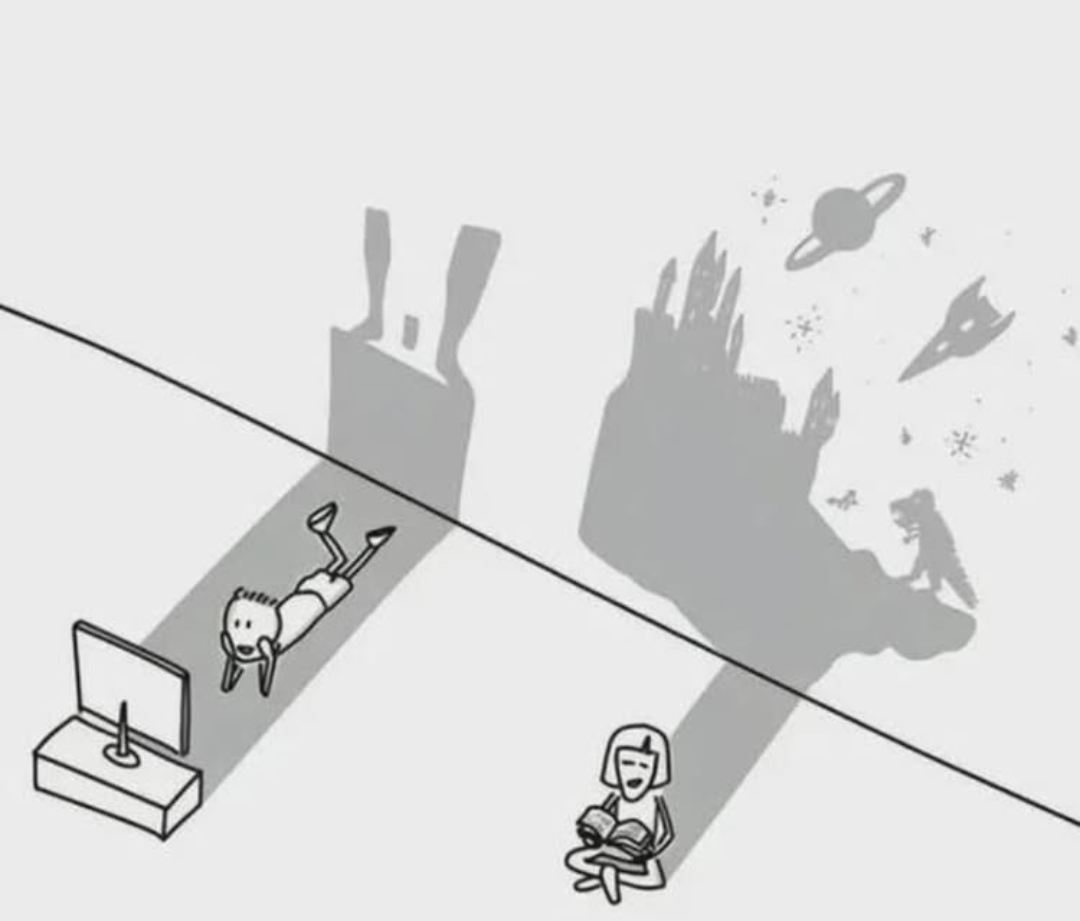
We usually think in linguistic concepts even when reading a book, one of the most difficult things to do with a student when they are learning drawing is teaching them to really see instead of thinking of linguistic traits. I have aphantasia and it is difficult for me to recall visual traits so instead i focus on visual recipes, or construction while drawing. It is difficult for me to recall faces for example but if i reduce a face to geometric shapes and proportions and do a lot of trial and error so i can approximate a face I’ve seen.
So when reading is not that I am seeing things, but i am making a conceptual map, an abstraction. Kinda like how dreams are like stories we tell ourselves to the point they might seem like intangible images. Sometimes I feel my brain relate stuff i read to things i’ve already seen, or builds some conceptual bridge between known concepts to unknown ones.
But reading is also a practice on itself different than hearing. Language has aesthetics, rhythm character. I feel i learn more about the aesthetic beauty of language by reading it on the page than hearing it on an audio book because it forces me to build that bridge between my horizon of understanding and the authors’.
This is especially true for authors that have an entirely different background than me because to understand them i need to read slower and research. Something that audio books doesn’t allow with it’s predisposed presentation.