This is not a SFW instance. NSFW communities will be tagged, and efforts will be made to keep SFW communities clean, but proceed at your own comfort level.
For anyone who missed out on learning food safety guidelines at some point, which I don’t blame anyone for -
Don’t thaw your food in hot or even warm water. Even if you don’t accidentally cook your food before you meant to, allowing the outer layer of the food to spend time in the temperature danger zone while the inner parts thaw will allow bacteria to start causing trouble. Now, if your frozen thing is small or thin enough to completely thaw in like 5 minutes, you’re probably fine using warmer water, but in general, try to keep everything under 40°F(4°C) until you’re actually ready to cook it.
Also, I’ve found that things just thaw faster in cold water. My theory is the large temperature differential creates a sort of cold barrier, like the Leidenfrost effect. Or maybe the outside cooks enough to slow the heat transfer.
But moving cold water is the trick for a fast thaw.
Moving water is the key. If the water is stationary, the liquid nearest the food cools, thus reducing the thawing effect, and convection alone isn’t enough to bring in fresh water to that region. Either hold the item to be defrosted under a running tap, which is rather wasteful, or put it in a bowl of water and stir it.
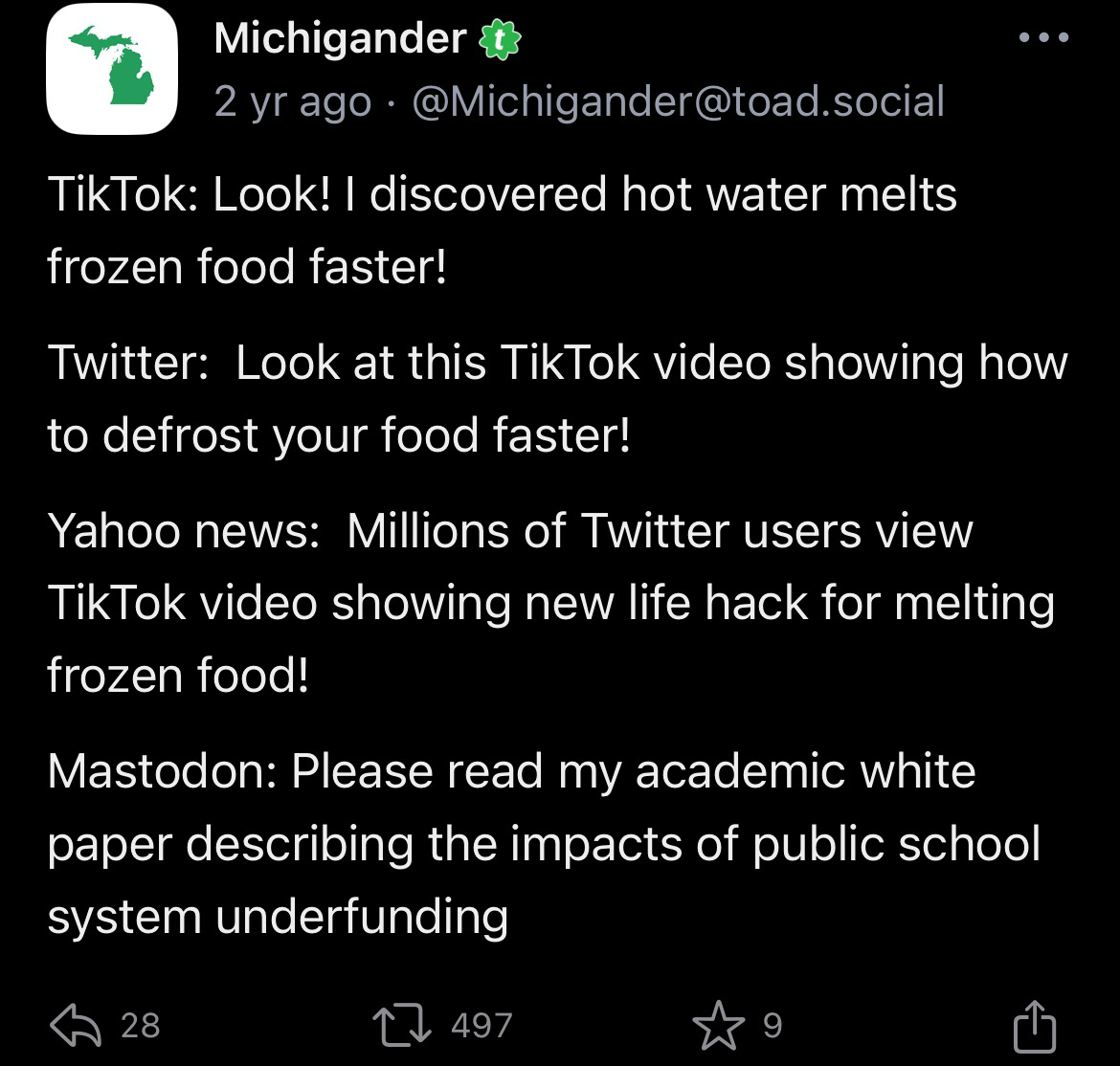
For anyone who missed out on learning food safety guidelines at some point, which I don’t blame anyone for - Don’t thaw your food in hot or even warm water. Even if you don’t accidentally cook your food before you meant to, allowing the outer layer of the food to spend time in the temperature danger zone while the inner parts thaw will allow bacteria to start causing trouble. Now, if your frozen thing is small or thin enough to completely thaw in like 5 minutes, you’re probably fine using warmer water, but in general, try to keep everything under 40°F(4°C) until you’re actually ready to cook it.
Also, I’ve found that things just thaw faster in cold water. My theory is the large temperature differential creates a sort of cold barrier, like the Leidenfrost effect. Or maybe the outside cooks enough to slow the heat transfer.
But moving cold water is the trick for a fast thaw.
Moving water is the key. If the water is stationary, the liquid nearest the food cools, thus reducing the thawing effect, and convection alone isn’t enough to bring in fresh water to that region. Either hold the item to be defrosted under a running tap, which is rather wasteful, or put it in a bowl of water and stir it.