This is not a SFW instance. NSFW communities will be tagged, and efforts will be made to keep SFW communities clean, but proceed at your own comfort level.
The mechanism happens in the way LLMs generate text sequentially. So as the LLM generates text, each time the LLM encounters a choice between two or more equally probable words and has to pick one, it chooses from a known pseudorandom key instead of its previous practice of actually relying on a source of randomness.
If you run the text through a checker script that tries to predict the next word, and takes note of every choice made in any given fork in the probabilistic flowchart, you can see that whole sequence of choices and compare to whether it matches a known key.
You’d need to know the model itself well enough to know when the text reaches a particular fork, and what the choices are in that fork, and the key itself, so even OpenAI/Google/Anthropic may not be able to run this watermark detection on their competitors’ models. But they’d be able to know it themselves, for their own models.
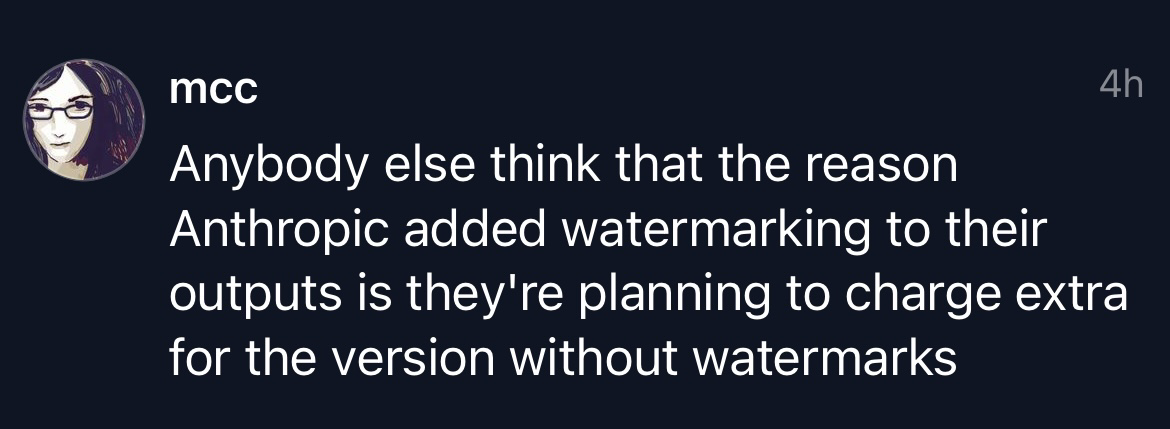
The mechanism happens in the way LLMs generate text sequentially. So as the LLM generates text, each time the LLM encounters a choice between two or more equally probable words and has to pick one, it chooses from a known pseudorandom key instead of its previous practice of actually relying on a source of randomness.
If you run the text through a checker script that tries to predict the next word, and takes note of every choice made in any given fork in the probabilistic flowchart, you can see that whole sequence of choices and compare to whether it matches a known key.
You’d need to know the model itself well enough to know when the text reaches a particular fork, and what the choices are in that fork, and the key itself, so even OpenAI/Google/Anthropic may not be able to run this watermark detection on their competitors’ models. But they’d be able to know it themselves, for their own models.