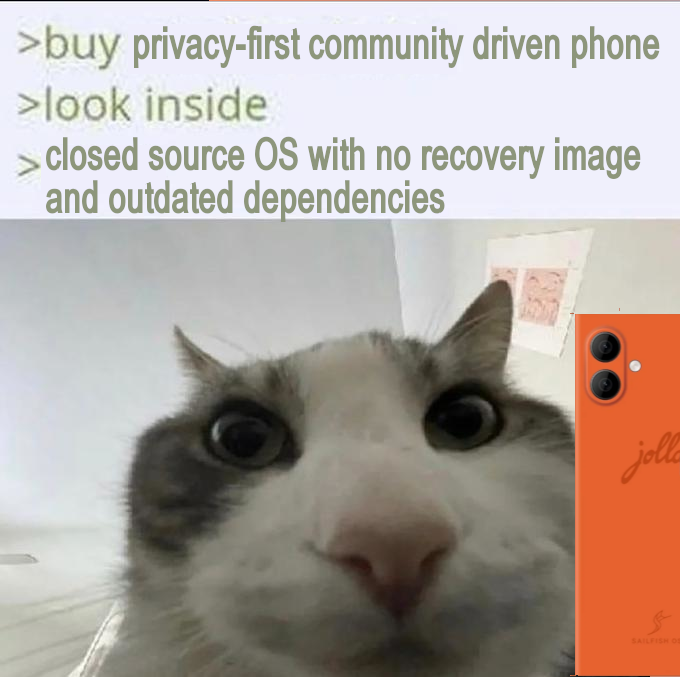
No thanks, I’d rather use a Google Pixel with GrapheneOS
Image transcription:
buy privacy-first community driven phone look inside closed source OS with no recovery image and outdated dependencies
Uh even this short stab is quite wrong. Here notes from Jolla itself for Sailfish OS 5.2
- As promised, users can unlock the Jolla Phone bootloader. A corresponding menu item can now be found at the System Settings / Developer tools
- Users can do factory reset from the System Settings
- Users can enter the recovery mode with the volume up key + power key combination
- Flashable images and fastboot will be provided (coming soon)
- The initial version of the Privacy Switch was implemented. The function is end user configurable and to start with, the users can control e.g. Bluetooth, WLAN, Location and AppSupport status with the switch. Further implementations are coming and the framework is available for community contributions.
The base of Sailfish OS is a full blown Linux, way more open than Android (more options for the user, less secure than Graphene, which has that as main goal) you can easily install/compile Linux software on it.
Close source components are used. Parts of the UI (Jolla is open sourcing more and more), libhybris to run closed source Android drivers, Android App Support.
So yes its not as open source as debian, but offers more freedom to modify the OS than Graphene and gives you near full control.
The base of Sailfish OS is a full blown Linux, way more open than Android
Sorry, but no. AOSP and Graphene do not use any proprietary blobs. They are 100% open.
By your own post, SailfishOS uses closed source components.
So does Graphene.
Both ship: Firmware, the HAL components (which are way more critical in my eyes as they have low level hardware access and could hide anything from the OS) Example for these are: The Camera Stack, the Audio Stack, under Graphene the Widevine DRM components.
Sailfish can run without these, e.g. on the Pinephone. Graphene OS can’t Graphene additionally comes with an eSIM binary, which is disabled by default Sailfish comes with proprietary UI components, a choice the company made because of their limited manpower as it allowed them to provide features where currently no open source solution exists or existed at the time of implementation) examples are swipe gestures for the keyboard, MS Exchange support, Android App support. That not great, but far from a closed source system where everything is closed source. There exist many patches for UI components because they are partly open source.
The OS ist still Linux, that is true. It is even LInux+GNU which Android is not. It is Linux with closed source components, thats true too.
Both ship: Firmware, the HAL components (which are way more critical in my eyes as they have low level hardware access and could hide anything from the OS)
Aren’t firmware and HAL in hardware/devices in the source tree for graphene? Also the camera stack/etc isn’t Google’s, it’s Graphene’s.
The Widevine comment is fair, but Sailfish needs to support DRM, too, so they’re in the same boat, there.
It may be a private phone, but you don’t really know whats going on under those proprietary blobs.
Sailfish OS is the definition of proprietary software. You need to buy a subscription if you even want to install it on third party devices.
It’s like Windows but it claims to be private and commnunity driven while not providing the source code to the entire OS. It’s a little misleading to me
It may be a private phone, but you don’t really know whats going on under those proprietary blobs.
Yes thats not good, but also a problem of many common Linux distributions. If you have any linux-firmware-* packages installed on your system, they also contain similar binary blobs for the firmware. E.g. Intel or Qualcom wireless cards. But you can utilize all tools up to strace under Sailfish OS, to see what those drivers are accessing and check that they don’t do anything bad. Under Graphene OS, you can not do this. (But its resonable to trust the very privacy focused developer that they have checked and tested this and isolated them as far as possible on the OS level)
Sailfish OS is the definition of proprietary software. You need to buy a subscription if you even want to install it on third party devices.
Again this is not correct. If what you claim is true, how comes that the OS is available on all these devices?. Sailfish OS is open Source at its core and easily ported to new devices. What you can do is pay for the licensed content on official devices. That enables automatic updates and proprietary software as the MS Exchange support and the Android App Support. Though for the later you can also install Waydroid because, you know, its Linux! Paying Jolla however gives access to a more comfortable solution and support development of the platform.
It’s like Windows
Um… no. Can you port Windows to a new device? No, its source is closed. Does Microsoft support people hacking their OS? No, Jolla has community meetings for that. Do you have full Access udner Windows? No. Does Sailfish send your data to a third party? No. Does Sailfish show you adds? No, Does it force you to use AI? No and so on and so forth.
Please don’t hate on the one European company trying to do things right. Support them in making things better.
GrapheneOS fanboy btw 🤡
I don’t even use it…
I’d like to try Mobian tho
isn’t sailfish open source since 2016?
SailfishOS’s underlying system and applications are open source. Jolla has a proprietary UI and android compatibility layer they run on top of it. The UI can be replaced with open source community ones. Its similar to Android in its open source nature.
The most fascinating thing is how some in the open source community go wild against a tiny player delivering one of the most daily driveable phones with an OS other than from the big-tech duopoly (besides Huawei but that’s another topic). It doesn’t help that a system that is partially closed source (with the closed parts basically being only the home screen UI and the qt implementation) is misleadingly called “closed source OS”.
Especially the frenzy within the GrapheneOS community in this regard is curious.
Why can’t everyone just choose what they prefer without firing against other small alternative OS projects as if they were made by the devil?
I’ve been using Linux and Graphene for a long time and welcome all third party OS phones not controlled by Google and Apple. Jolla never marketed theirs in the USA and it always seemed more like a prototype phone for hobbyists more than a daily driver (same as all of the others).
This will probably continue to be the case until someone with deep pockets in the USA does a deal with a friendly phone OEM who makes a decent quality product and a mobile OS group who can make it at least as user friendly as Android. Considering the Byzantine labyrinth that Android’s user interface is today, the last part should not be that difficult. I heard they were even putting a small LLM onto Android phones, which is a feature nobody asked for.
I really like the idea of the Jolla and am seriously considering getting one. I’m also the exact target audience (Linux nerd, privacy conscious, FOSS advocate, want to own MY device fully, hate having to use a US-based duopoly in my current daily life).
That’s exactly why I don’t understand their decision to keep parts of their system closed. The overlap between people who want a Linux phone and who are OK with that Linux phone not being fully open seems to be tiny.
dont have a smart phone. get a land line. write letters. if your job requires you have a cellphone. no you dont, get a new job. or live illegally in a handmade cabin in the woods.
better yet, deny your brain oxygen until you are legally brain dead. that way the government cant read your thoughts.
i would say you can thank me later, but if you follow my advice, you likely wont be able to. so, you’re welcome.