This is not a SFW instance. NSFW communities will be tagged, and efforts will be made to keep SFW communities clean, but proceed at your own comfort level.
Solar power + battery? Or hydropower? That way there won’t be, well, nuclear waste at the end? You know, the kind of waste that’s highly radioactive? The waste that doesn’t have a plan to be safely stored away for tens of thousands of years?
I can see why people have been scared by the waste, but it’s really not a concern. There are long term storage solutions, but they just haven’t been implemented in many places. Kyle Hill actually just did a video on one the other day.
The waste just isn’t a big enough concern to have put the resources into long term storage yet. The radiation level around the casks is so low that you can be around them and hug them without concern. Flying in a plane is more concerning. This argument is mostly fear mongering so we don’t phase out dirty energy. We could have thousands of reactors running, but they’ve made us scared of the solution so we don’t replace them.
Fun fact: nuclear waste can be used again, it isn’t a widely spread practice but some countries do it (i forgot which tho), oh and wel all forgot about the fact that in the next years thorium could be used instead of uranium?
You can “recycle” the waste. Which means extracting the remaining uranium and concentrating the remaining waste which is more radioactive after that.
Which is done because it is cheaper than new uranium.
Thorium will be working before fusion reactors?
Also there is technology that indeed can use current radioactive waste and make power from it and break it into less radioactive waste. However the technology seems not that cost efficient yet. (well normal nuclear plants aren’t either)
It’s not even the waste, that we still need to learn how to recycle. Or the apparent incapacity of any operator to reliably follow the theoretical safety guidelines…
If we put all our effort into a nuclear boom today, the plants will only arrive a decade or two after the planet has been cooked, it won’t be enough to replace anything, and we will have to learn entire new ways to mine the fuel in a few decades before the stuff we can get easily is gone.
Meanwhile we are about half-way done with renewables, and the nuclear fans keep denying that…
The anti-nuclear crowd still doesn’t have an answer for base load power when there is no wind or solar. What are you going to do, have massive back up batteries? For an entire electric grid? Of an entire country? And do that worldwide?
We can’t even mine lithium fast enough to make enough batteries for all the cars to switch to EV’s in the next decade.
I’m open to alternatives, but I haven’t heard any yet.
There’s pumped hydro, geothermal energy, and biofuel, in the future we’ll likely see some wave power as well. The point isn’t to have one technology for the entire grid but to have a diverse and distributed energy system.
For storage there are also many more options than just lithium ion batteries. We have sodium ion if you just want to swap battery for battery, but then there are also for example iron-air batteries that are projected to be dirt cheap, redox flow batteries, pressurized air, cryogenic energy, sand batteries for storing heat, hydrogen electrolysis, etc.
Not only will this make this a power grid that is less dependent on supply chains that are impacted by geopolitical conflicts, but it will also make it more resilient as the weather continues becoming more extreme.
I’m not saying we need one technology for the entire grid. Of course you diversify. That is out of the question.
But the solutions you mentioned aren’t ready yet.
Pumped hydro isn’t feasible everywhere, nor is geothermal and is wildly expensive. Biofuel burning emits greenhouse gases.
Sodium ion batteries are a new technology and we don’t know how well it scales and we don’t have the production capacity. And the others aren’t proven technologies, so they may not be around for decades.
No, the point is that the anti-nuclear crowd is trying to make it seem like there is no role for nuclear energy in the future alongside renewable energy. They haven’t thought about baseload power and they think putting giant battery parks everywhere will be fast and easy, as well as —somehow— great for the environment.
Pumped hydro isn’t feasible everywhere, nor is geothermal
That’s the whole point of diversifying, use the sources that are available in the places where they are available.
Biofuel burning emits greenhouse gases
The point is that the greenhouse gases that they emit have already been captured from the atmosphere, which makes them carbon neutral.
Sodium ion batteries are a new technology and we don’t know how well it scales
It uses a lot of the same type of production as lithium ion, it is already being produced by some of the largest battery manufacturers on the planet, and being sold on the market, and we have years of research to give us a good idea of how it will evolve.
And the others aren’t proven technologies, so they may not be around for decades
Neither will fission plants. Even if we decided to start building out today, there are years before we actually see construction start, not to mention commissioning and eventually power production. We’re probably talking about the 2040s at that point.
No, the point is that the anti-nuclear crowd is trying to make it seem like there is no role for nuclear energy in the future alongside renewable energy
Some people, sure. But the person above wasn’t talking about completely removing all fission, just that we should have started building nuclear plants twenty years ago because it’s slow and comes with a massive up-front cost, and at this point we have other alternatives that are cheaper and faster to install. Nuclear fission plants are also a very centralized source of energy, so if there are issues in the future as a result of climate change (similar to what they’ve been experiencing in France) then you lose a lot of grid capacity all at once while trying to resolve it.
I think nuclear is a reliable source of power, I’ve been an advocate for it, but I don’t believe it’s the right solution at this point in time.
That’s the whole point of diversifying, use the sources that are available in the places where they are available.
Yes, but they are more niche solutions rather than widely available or feasible ones.
which makes them carbon neutral.
Only in theory, and only with some crop types. And as with all agriculture, it takes up a lot of space. If we simply used that space to plant trees we wouldn’t have to release those GHGs into the atmosphere at all. And then there is the labour intensive process of sowing, watering, harvesting, processing and transportation that emits GHGs of its own.
give us a good idea of how it will evolve.
Yes, but small scale projects do not tell you how it scales to grids worldwide. Nor how it holds up after years, or what happens when these batteries reach the end of their lifecycle. And it may be decades until we can make it on the scale that is necessary for worldwide deployment.
We already know all of this stuff for NPPs due to decades of experience with them.
We’re probably talking about the 2040s at that point.
Possibly, although SMR’s may be built quicker. The point is it’s not the same for a technology that still needs to be developed. All these ideas still need to be developed and then be produced and implemented. So that’s more like 2050s-2060s.
and at this point we have other alternatives that are cheaper and faster to install.
Yeah but the person above didn’t realize that these are not competing technologies. The NPP provides base load power, e.g. at night when the solar panels produce none. And solar panels provide peak load power during the day. They meet different demands, but the NPP is more stable and can also be turned up or down during the day depending on the weather.
NPPs are way more reliable than solar, so the current shutdown is big news just because it happens so rarely. And when there are extreme droughts there will probably be lots of sun around for solar to fill the gap.
There are some good ones and diverse ideas for many locations. The reason they are not yet implemented is because they are not prioritised.
Base load is not the concern. Adaptive load is what needs to be there to supplement the grid. Nuclear can not provide that.
Of course there are a lot of good ideas and I don’t think we should not explore them. But we need more than ideas. We need available solutions. We need scalable solutions.
Base load is definitely a concern. We still need base load power for when there is no sun, i.e. every night and when there is little to no wind. And especially when there is neither of those (no wind at night).
NPP’s can provide that base load power. During winter, but also during the night. On top of that, it is already adaptable:
Nuclear can not provide that.
This is simply not true.
Modern nuclear plans with light water reactors have strong manoeuvring capabilities. Nuclear power plants in France and in Germany operate in load-following mode, i.e. participate in the primary and secondary frequency control, and some units follow a variable load programme with one or two large power changes per day.
So, we can bet it all on unproven technologies that we don’t know the scalability of, or we can use a technology that has proven itself over decades, works on a large scale and is adaptable for baseload power and adaptable for when renewables aren’t available.
I’m a fan of both, but fully accept that fission is now too late to be useful. We also have fusion right on the tipping point of viability. That could likely fill the use cases of fusion quite well, with far less issues.
FYI, nuclear produces 3 sorts of nuclear waste. High activity is nasty, but short lived. Put it in a pool for a few years and it decays away. Low grade is the stuff like lab waste and contaminated pipes. You don’t really want it going in normal landfill, but it’s not going to kill anyone with radiation (heavy metal toxicity is another matter). It’s only the last type, medium activity that is problematic. It lasts a long time, while still putting out enough radiation to cause potential problems. Unfortunately, older “power” plants, were actually bomb factories. They were intended to make plutonium, and so produce a lot more of the medium activity waste than they could.
Forget it, i tried that argument a bunch of times. Also, you are depended on other countries, big plants are an easy target for a drone with some explosives, cost of nuclear is rising while all others are down, etc. People want to believe in a magic, water heating rock
Yes, but you need something with turbines to regulate power flow during off-peak. Hydropower can do that in some places, but not everywhere. That’s the gap that nuclear should be aiming for (replace coal plants as minimum power regulator)
Coal and nuclear re very bad for regulating power spikes because they are inflexible and can’t be turned on or off very fast. That’s why most country’s build gas as an intermediary power source right now
That’s why it’s for baseline power. No one is claiming it handles spikes. We have solutions for that though. Solar and wind also obviously don’t handle spikes. Many types of batteries do, and they don’t care where the power came from.
Rotational energy is actually a pretty good battery, which has no conversion cost with nuclear, since rotational energy is what it produces with the turbine. You spin your flywheel up, and you drain power from it as you need it. Chemical batteries also work, with the conversation cost that all sources pay equally.
solar + batteries scales to any size. The bigger it is the cheaper per w/wh. It is by far the cheapest energy. It does generate seasonal surpluses, and requires a “dump/optional” load. dump loads can be hydrogen/desalination, and optional loads can be datacenters that scale down during winter. Significant battery fraction can come from EV penetration. Some (mostly chinese) EVs can pay for cost of the car by just keeping it parked in driveway and earning 3c/kwh profit from night discharge rates relative to day charge rates.
Wait, is your claim still that EVs will form a significant portion of the grid? I thought that trope died sometime around 2020 when it was obvious that Elon is a megalomaniac.
Industries need massive amounts of energy, and reducing emissions necessitates a significant increase in electricity use (e.g. hydrogen synthesis which is required for many processes to go green is very energy intensive). EVs just aren’t going to feed that. Lithium batteries won’t feed that.
If we figure this out with batteries, it’s likely going to be sodium or some other storage method. So far large-scale storage methods have been utterly underwhelming and it often borders on sci fi.
Here’s the thing. I want to reduce carbon emissions now, not in 30 years. That means fusion is not under consideration, and it means that we need way more electricity. Solar and wind are, as you pointed out, cheap ways to add electricity to the grid, but there’s a reason why no grid runs solely on solar and wind for any meaningful amount of time, and that’s because it’s not physically possible. There’s not enough lithium on this planet to realize that fantasy. Sodium, yes.
So until we actually have an example of energy storage that can deliver to keep steel works and factories going, and that can scale, I’m gonna call bullshit.
s your claim still that EVs will form a significant portion of the grid? I thought that trope died sometime around 2020 when it was obvious that Elon is a megalomaniac.
China is over 60% car sales as EV share. Massive battery capacity just from EVs available, from an auto market 5x the size of the US. LFP continues to have advantages over Sodium Ion (that needs vanadium to be "useful competitor), and lithium is abundant.
but there’s a reason why no grid runs solely on solar and wind for any meaningful amount of time, and that’s because it’s not physically possible.
False but the only path forward is not thinking you must nuke all other energy from orbit and turn a switch. Path forward is ever more renewables additions, and using existing infrastructure as backup/winter generation. Getting to 100% renewables is a journey. More and more renewable additions every year. Not a “impossible because it is not current reality” conclusion.
In Finland we have a hydroelectric plant on every single river leading into the Baltic Ocean apart from Tornionjoki because half of it belongs to Sweden. We can’t have fish swimming upstream from ocean to lakes because of this. Don’t go overboard with hydro.
Exactly this. And remember, Finland has some of the best water resources on the planet (highest concentration of lakes anywhere in the world). So most countries couldn’t do what Finland is doing even if they wanted to, and Finland is still building new nuclear.
Germany opened a new battery storage just this week. It has so much capacity that it can power a city like Leipzig over a night completely. And there are plans to upgrade it from 500 megawatthours to 800 megawatthours before 2026 ends. That’s not just remote cabin scale to me.
Hydro, although great in many ways, causes immense ecological devastation and is not suitable for all places.
Okay, here i gotta agree with you.
Nuclear also has issues but a mix of wind+solar on a base of hydro+nuclear is probably the ideal.
“Issues”. Yeah. The deadly waste nuclear plants produce is just a minor “issue”. And I’m not even talking about safety in general (Chernobyl, Fukushima, Three Mile Island).
I’m not even necessarily against nuclear, but this is a weird argument. How many times have solar panels blown up and made entire cities uninhabitable for decades, and how many are there total in use ever?
The percentage of failures of nuclear power plants may be low, but the fallout (literally) is incredibly devastating.
Even comparing human deaths per unit of electricity, nuclear has a lower death count than wind and only slightly above solar, and that includes Chernobyl.
Solar panels have a lifespan of a decade or maybe two if you’re lucky, after which it becomes mostly e-waste. So there is more to consider than you would make it seem.
More like 2 to 3 decades minimum and then they can be recycled. Don’t forget the speed and the extreme low cost in which solar can be deployed. There really is no meaningful benefit of nuclear against solar.
Ah, well that’s good news, maybe I had some older data then. But even if it’s 25 years it’s still much less than the life cycle NPPs. And after that you have to go into another process of recycling that requires even more energy and time. And as we’ve seen with plastic recycling, it never works as well as promised.
There really is no meaningful benefit of nuclear against solar.
The meaningful benefit of nuclear over solar is the fact that we don’t have sun for at least 50% of the day and the NPP can continue to run around the clock.
In fact, solar panels have a maximum power capacity of only 25% compared to nuclear’s 93%.
So it’s actually much worse than just the 50% of the day when it is nighttime.
You still need baseload power during the times when solar or wind doesn’t cut it.
Battery storage is an option but we already can’t mine enough lithium to make batteries for all cars to transition to EVs. And while we’re hearing about new battery technologies every day and some kinetic or thermal storage technologies you will always need extra resources and space just to provide baseload power. You realistically can’t make enough storage capacity for the entire electric grid worldwide. So yes, there will always be a need for NPPs, since baseload power is now mainly provided by coal and gas plants.
I’m sure batteries will play an important role in the future, but it’s not significant today and I don’t see any indication of this changing rapidly in a meaningful way. I’d love to be wrong though.
Regarding the issues with nuclear power, the ecological impact is far better than hydro and health impact/deaths is also significantly better. I’m not trying to badmouth hydro here, but I think it’s important to be fair and acknowledge that on those two issues (ecological impact, human health) nuclear has a better track record.
Even in US, $100/kwh retail battery price points with bms, 48v, exist. Utility scale in rest of world is much cheaper. China is $51/kwh for a containerized full battery solution with (4 hour) inverter. At 7% ROI (to pay for full 30 year mortgage on LFP batteries as that is their life expectancy at slow charge/discharge rates) means just 1c/kwh discharge profit is required to pay for $55/kwh batteries. Similar calculation for just 4 sun hours/day. $600/kw installation costs at 7% ROI, means 3c/kwh daytime electricity rates.
There’s not just exponential growth as @Hellgruen@lemmy.zip pointed out, it is dumb to do anything else.
Ok man good luck with that. Since the economy is so overwhelmingly in your favor, we should see battery capacity outpace energy need growth any time now.
Not sure if you are actually pretending its out of reach. China’s battery additions including EVs is 39% of massive electricity production increases. Rate of growth in battery sales about double while energy growth is 5-8% range. That is much easier for any country that isn’t the absolute global manufacturing nexus.
For context, that’s growth, not total capacity. And after covid one would suspect ppl would understand exponential growth and to understand what that means for a business Modell $$$
Also we don’t need capacity for the whole output of a year.
That doesn’t change the fact that battery storage is a business case with exponential growth and is just taking off while nuclear power is expensive, takes long time to plan and build and all the new fancy stuff is still hypothetical and it’s not certain it will ever take off in regard of recent bankruptcy’s in the smr field
Yes, like those. Your three examples show how benign nuclear power is, factoting in the absolute worst of circumstances and most ridiculous levels of incompetence.
Maybe you should do your own homework before linking Wikipedia at me. Nuclear is safer than hydro in terms of human casualties per energy produced as well as per land mass destroyed, and if you want to make a counter-argument or add any other variable the burden of proof is on you.
Solar power + battery? Or hydropower? That way there won’t be, well, nuclear waste at the end? You know, the kind of waste that’s highly radioactive? The waste that doesn’t have a plan to be safely stored away for tens of thousands of years?
I can see why people have been scared by the waste, but it’s really not a concern. There are long term storage solutions, but they just haven’t been implemented in many places. Kyle Hill actually just did a video on one the other day.
The waste just isn’t a big enough concern to have put the resources into long term storage yet. The radiation level around the casks is so low that you can be around them and hug them without concern. Flying in a plane is more concerning. This argument is mostly fear mongering so we don’t phase out dirty energy. We could have thousands of reactors running, but they’ve made us scared of the solution so we don’t replace them.
Fun fact: nuclear waste can be used again, it isn’t a widely spread practice but some countries do it (i forgot which tho), oh and wel all forgot about the fact that in the next years thorium could be used instead of uranium?
You can “recycle” the waste. Which means extracting the remaining uranium and concentrating the remaining waste which is more radioactive after that.
Which is done because it is cheaper than new uranium.
Thorium will be working before fusion reactors?
Also there is technology that indeed can use current radioactive waste and make power from it and break it into less radioactive waste. However the technology seems not that cost efficient yet. (well normal nuclear plants aren’t either)
It’s not even the waste, that we still need to learn how to recycle. Or the apparent incapacity of any operator to reliably follow the theoretical safety guidelines…
If we put all our effort into a nuclear boom today, the plants will only arrive a decade or two after the planet has been cooked, it won’t be enough to replace anything, and we will have to learn entire new ways to mine the fuel in a few decades before the stuff we can get easily is gone.
Meanwhile we are about half-way done with renewables, and the nuclear fans keep denying that…
The anti-nuclear crowd still doesn’t have an answer for base load power when there is no wind or solar. What are you going to do, have massive back up batteries? For an entire electric grid? Of an entire country? And do that worldwide?
We can’t even mine lithium fast enough to make enough batteries for all the cars to switch to EV’s in the next decade.
I’m open to alternatives, but I haven’t heard any yet.
Nice example of denial. Thanks.
How so?
There’s pumped hydro, geothermal energy, and biofuel, in the future we’ll likely see some wave power as well. The point isn’t to have one technology for the entire grid but to have a diverse and distributed energy system.
For storage there are also many more options than just lithium ion batteries. We have sodium ion if you just want to swap battery for battery, but then there are also for example iron-air batteries that are projected to be dirt cheap, redox flow batteries, pressurized air, cryogenic energy, sand batteries for storing heat, hydrogen electrolysis, etc.
Not only will this make this a power grid that is less dependent on supply chains that are impacted by geopolitical conflicts, but it will also make it more resilient as the weather continues becoming more extreme.
I’m not saying we need one technology for the entire grid. Of course you diversify. That is out of the question.
But the solutions you mentioned aren’t ready yet.
Pumped hydro isn’t feasible everywhere, nor is geothermal and is wildly expensive. Biofuel burning emits greenhouse gases. Sodium ion batteries are a new technology and we don’t know how well it scales and we don’t have the production capacity. And the others aren’t proven technologies, so they may not be around for decades.
No, the point is that the anti-nuclear crowd is trying to make it seem like there is no role for nuclear energy in the future alongside renewable energy. They haven’t thought about baseload power and they think putting giant battery parks everywhere will be fast and easy, as well as —somehow— great for the environment.
That’s the whole point of diversifying, use the sources that are available in the places where they are available.
The point is that the greenhouse gases that they emit have already been captured from the atmosphere, which makes them carbon neutral.
It uses a lot of the same type of production as lithium ion, it is already being produced by some of the largest battery manufacturers on the planet, and being sold on the market, and we have years of research to give us a good idea of how it will evolve.
Neither will fission plants. Even if we decided to start building out today, there are years before we actually see construction start, not to mention commissioning and eventually power production. We’re probably talking about the 2040s at that point.
Some people, sure. But the person above wasn’t talking about completely removing all fission, just that we should have started building nuclear plants twenty years ago because it’s slow and comes with a massive up-front cost, and at this point we have other alternatives that are cheaper and faster to install. Nuclear fission plants are also a very centralized source of energy, so if there are issues in the future as a result of climate change (similar to what they’ve been experiencing in France) then you lose a lot of grid capacity all at once while trying to resolve it.
I think nuclear is a reliable source of power, I’ve been an advocate for it, but I don’t believe it’s the right solution at this point in time.
Yes, but they are more niche solutions rather than widely available or feasible ones.
Only in theory, and only with some crop types. And as with all agriculture, it takes up a lot of space. If we simply used that space to plant trees we wouldn’t have to release those GHGs into the atmosphere at all. And then there is the labour intensive process of sowing, watering, harvesting, processing and transportation that emits GHGs of its own.
Yes, but small scale projects do not tell you how it scales to grids worldwide. Nor how it holds up after years, or what happens when these batteries reach the end of their lifecycle. And it may be decades until we can make it on the scale that is necessary for worldwide deployment.
We already know all of this stuff for NPPs due to decades of experience with them.
Possibly, although SMR’s may be built quicker. The point is it’s not the same for a technology that still needs to be developed. All these ideas still need to be developed and then be produced and implemented. So that’s more like 2050s-2060s.
Yeah but the person above didn’t realize that these are not competing technologies. The NPP provides base load power, e.g. at night when the solar panels produce none. And solar panels provide peak load power during the day. They meet different demands, but the NPP is more stable and can also be turned up or down during the day depending on the weather.
NPPs are way more reliable than solar, so the current shutdown is big news just because it happens so rarely. And when there are extreme droughts there will probably be lots of sun around for solar to fill the gap.
There are some good ones and diverse ideas for many locations. The reason they are not yet implemented is because they are not prioritised. Base load is not the concern. Adaptive load is what needs to be there to supplement the grid. Nuclear can not provide that.
Of course there are a lot of good ideas and I don’t think we should not explore them. But we need more than ideas. We need available solutions. We need scalable solutions.
Base load is definitely a concern. We still need base load power for when there is no sun, i.e. every night and when there is little to no wind. And especially when there is neither of those (no wind at night).
NPP’s can provide that base load power. During winter, but also during the night. On top of that, it is already adaptable:
This is simply not true.
Source
So, we can bet it all on unproven technologies that we don’t know the scalability of, or we can use a technology that has proven itself over decades, works on a large scale and is adaptable for baseload power and adaptable for when renewables aren’t available.
I’m a fan of both, but fully accept that fission is now too late to be useful. We also have fusion right on the tipping point of viability. That could likely fill the use cases of fusion quite well, with far less issues.
FYI, nuclear produces 3 sorts of nuclear waste. High activity is nasty, but short lived. Put it in a pool for a few years and it decays away. Low grade is the stuff like lab waste and contaminated pipes. You don’t really want it going in normal landfill, but it’s not going to kill anyone with radiation (heavy metal toxicity is another matter). It’s only the last type, medium activity that is problematic. It lasts a long time, while still putting out enough radiation to cause potential problems. Unfortunately, older “power” plants, were actually bomb factories. They were intended to make plutonium, and so produce a lot more of the medium activity waste than they could.
Forget it, i tried that argument a bunch of times. Also, you are depended on other countries, big plants are an easy target for a drone with some explosives, cost of nuclear is rising while all others are down, etc. People want to believe in a magic, water heating rock
Doesn’t Sweden or someplace have a giant abandoned salt mine to store a thousand years of nuclear waste somewhere?
Not that I’m in favor of building nuclear anymore, we should’ve done that in the sixties.
Finland., although many places have looked at old mines for this purpose. It’s a fairly obvious solution.
Yes, but you need something with turbines to regulate power flow during off-peak. Hydropower can do that in some places, but not everywhere. That’s the gap that nuclear should be aiming for (replace coal plants as minimum power regulator)
Coal and nuclear re very bad for regulating power spikes because they are inflexible and can’t be turned on or off very fast. That’s why most country’s build gas as an intermediary power source right now
That’s why it’s for baseline power. No one is claiming it handles spikes. We have solutions for that though. Solar and wind also obviously don’t handle spikes. Many types of batteries do, and they don’t care where the power came from.
Rotational energy is actually a pretty good battery, which has no conversion cost with nuclear, since rotational energy is what it produces with the turbine. You spin your flywheel up, and you drain power from it as you need it. Chemical batteries also work, with the conversation cost that all sources pay equally.
Crazy idea but what if we launch waste into space
Because dirty bombs violate international humanitarian laws
Sure, until you oopsie a nuclear waste filled rocket and spread it over half a continent.
Solar+battery is not an actual thing. We’re talking society scale here, not remote cabin.
Hydro, although great in many ways, causes immense ecological devastation and is not suitable for all places.
Nuclear also has issues but a mix of wind+solar on a base of hydro+nuclear is probably the ideal.
solar + batteries scales to any size. The bigger it is the cheaper per w/wh. It is by far the cheapest energy. It does generate seasonal surpluses, and requires a “dump/optional” load. dump loads can be hydrogen/desalination, and optional loads can be datacenters that scale down during winter. Significant battery fraction can come from EV penetration. Some (mostly chinese) EVs can pay for cost of the car by just keeping it parked in driveway and earning 3c/kwh profit from night discharge rates relative to day charge rates.
Wait, is your claim still that EVs will form a significant portion of the grid? I thought that trope died sometime around 2020 when it was obvious that Elon is a megalomaniac.
Industries need massive amounts of energy, and reducing emissions necessitates a significant increase in electricity use (e.g. hydrogen synthesis which is required for many processes to go green is very energy intensive). EVs just aren’t going to feed that. Lithium batteries won’t feed that.
If we figure this out with batteries, it’s likely going to be sodium or some other storage method. So far large-scale storage methods have been utterly underwhelming and it often borders on sci fi.
Here’s the thing. I want to reduce carbon emissions now, not in 30 years. That means fusion is not under consideration, and it means that we need way more electricity. Solar and wind are, as you pointed out, cheap ways to add electricity to the grid, but there’s a reason why no grid runs solely on solar and wind for any meaningful amount of time, and that’s because it’s not physically possible. There’s not enough lithium on this planet to realize that fantasy. Sodium, yes.
So until we actually have an example of energy storage that can deliver to keep steel works and factories going, and that can scale, I’m gonna call bullshit.
China is over 60% car sales as EV share. Massive battery capacity just from EVs available, from an auto market 5x the size of the US. LFP continues to have advantages over Sodium Ion (that needs vanadium to be "useful competitor), and lithium is abundant.
False but the only path forward is not thinking you must nuke all other energy from orbit and turn a switch. Path forward is ever more renewables additions, and using existing infrastructure as backup/winter generation. Getting to 100% renewables is a journey. More and more renewable additions every year. Not a “impossible because it is not current reality” conclusion.
In Finland we have a hydroelectric plant on every single river leading into the Baltic Ocean apart from Tornionjoki because half of it belongs to Sweden. We can’t have fish swimming upstream from ocean to lakes because of this. Don’t go overboard with hydro.
Exactly this. And remember, Finland has some of the best water resources on the planet (highest concentration of lakes anywhere in the world). So most countries couldn’t do what Finland is doing even if they wanted to, and Finland is still building new nuclear.
https://www.pv-magazine.de/2026/08/13/batteriespeicher-mit-rund-500-megawattstunden-kapazitaet-in-sachsen-anhalt-eingeweiht/
Germany opened a new battery storage just this week. It has so much capacity that it can power a city like Leipzig over a night completely. And there are plans to upgrade it from 500 megawatthours to 800 megawatthours before 2026 ends. That’s not just remote cabin scale to me.
Okay, here i gotta agree with you.
“Issues”. Yeah. The deadly waste nuclear plants produce is just a minor “issue”. And I’m not even talking about safety in general (Chernobyl, Fukushima, Three Mile Island).
You named 3 incidents. Now name all nuclear power plants ever. Compare the numbers.
I’m not even necessarily against nuclear, but this is a weird argument. How many times have solar panels blown up and made entire cities uninhabitable for decades, and how many are there total in use ever?
The percentage of failures of nuclear power plants may be low, but the fallout (literally) is incredibly devastating.
Even comparing human deaths per unit of electricity, nuclear has a lower death count than wind and only slightly above solar, and that includes Chernobyl.
Solar panels have a lifespan of a decade or maybe two if you’re lucky, after which it becomes mostly e-waste. So there is more to consider than you would make it seem.
More like 2 to 3 decades minimum and then they can be recycled. Don’t forget the speed and the extreme low cost in which solar can be deployed. There really is no meaningful benefit of nuclear against solar.
Ah, well that’s good news, maybe I had some older data then. But even if it’s 25 years it’s still much less than the life cycle NPPs. And after that you have to go into another process of recycling that requires even more energy and time. And as we’ve seen with plastic recycling, it never works as well as promised.
The meaningful benefit of nuclear over solar is the fact that we don’t have sun for at least 50% of the day and the NPP can continue to run around the clock.
In fact, solar panels have a maximum power capacity of only 25% compared to nuclear’s 93%.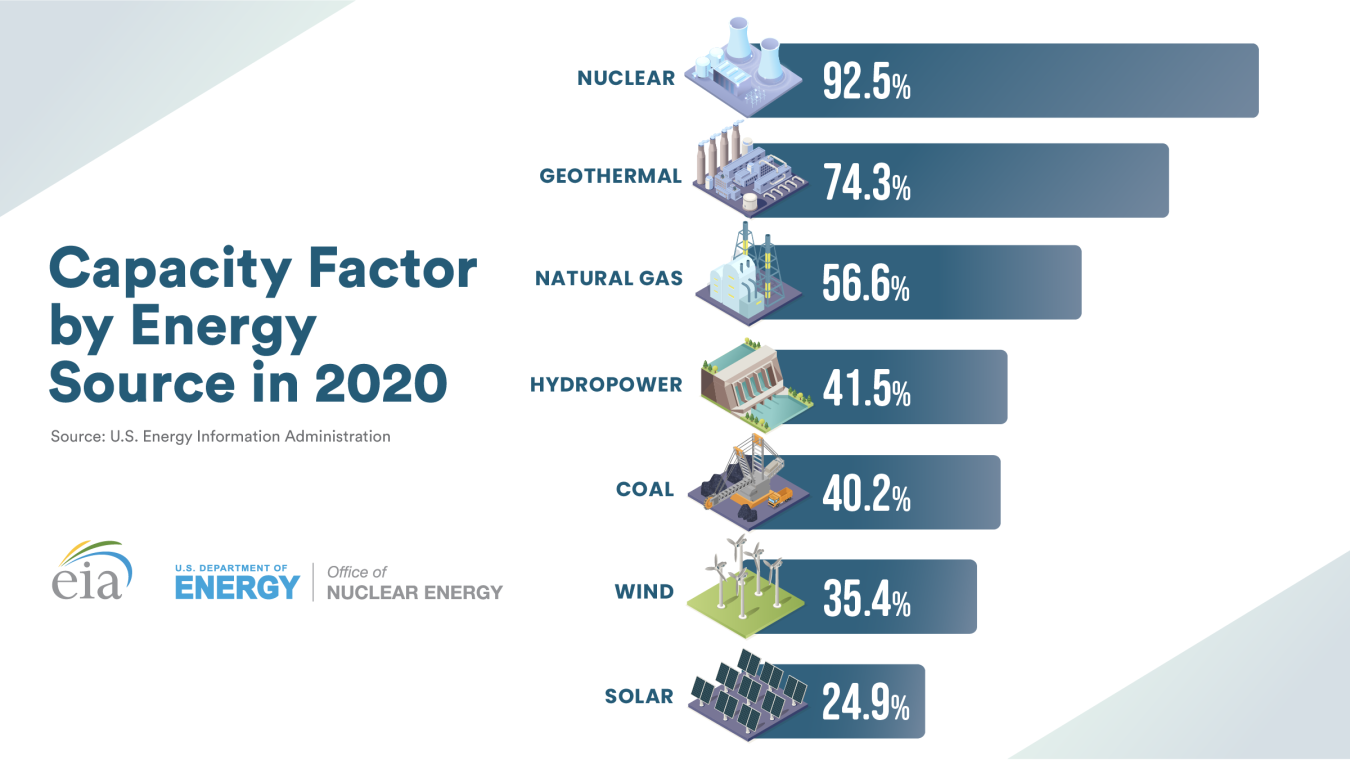
So it’s actually much worse than just the 50% of the day when it is nighttime.
You still need baseload power during the times when solar or wind doesn’t cut it.
Battery storage is an option but we already can’t mine enough lithium to make batteries for all cars to transition to EVs. And while we’re hearing about new battery technologies every day and some kinetic or thermal storage technologies you will always need extra resources and space just to provide baseload power. You realistically can’t make enough storage capacity for the entire electric grid worldwide. So yes, there will always be a need for NPPs, since baseload power is now mainly provided by coal and gas plants.
I’m sure batteries will play an important role in the future, but it’s not significant today and I don’t see any indication of this changing rapidly in a meaningful way. I’d love to be wrong though.
Regarding the issues with nuclear power, the ecological impact is far better than hydro and health impact/deaths is also significantly better. I’m not trying to badmouth hydro here, but I think it’s important to be fair and acknowledge that on those two issues (ecological impact, human health) nuclear has a better track record.
Even in US, $100/kwh retail battery price points with bms, 48v, exist. Utility scale in rest of world is much cheaper. China is $51/kwh for a containerized full battery solution with (4 hour) inverter. At 7% ROI (to pay for full 30 year mortgage on LFP batteries as that is their life expectancy at slow charge/discharge rates) means just 1c/kwh discharge profit is required to pay for $55/kwh batteries. Similar calculation for just 4 sun hours/day. $600/kw installation costs at 7% ROI, means 3c/kwh daytime electricity rates.
There’s not just exponential growth as @Hellgruen@lemmy.zip pointed out, it is dumb to do anything else.
Ok man good luck with that. Since the economy is so overwhelmingly in your favor, we should see battery capacity outpace energy need growth any time now.
Not sure if you are actually pretending its out of reach. China’s battery additions including EVs is 39% of massive electricity production increases. Rate of growth in battery sales about double while energy growth is 5-8% range. That is much easier for any country that isn’t the absolute global manufacturing nexus.
https://www.iea.org/data-and-statistics/charts/global-battery-storage-capacity-additions-2010-2023
Well fortunately you are wrong
For context, global energy output is 30k TWh/year. That’s T for tera.
For context, that’s growth, not total capacity. And after covid one would suspect ppl would understand exponential growth and to understand what that means for a business Modell $$$
Also we don’t need capacity for the whole output of a year.
For even more context, the annual growth in electricity output is about 5x the addition of battery capacity.
That doesn’t change the fact that battery storage is a business case with exponential growth and is just taking off while nuclear power is expensive, takes long time to plan and build and all the new fancy stuff is still hypothetical and it’s not certain it will ever take off in regard of recent bankruptcy’s in the smr field
Like Fukushima, three miles island or Tschernobyl?
Yes, like those. Your three examples show how benign nuclear power is, factoting in the absolute worst of circumstances and most ridiculous levels of incompetence.
Oh, there are so many more incidents.
Maybe you should do your own homework before linking Wikipedia at me. Nuclear is safer than hydro in terms of human casualties per energy produced as well as per land mass destroyed, and if you want to make a counter-argument or add any other variable the burden of proof is on you.
Sure it is, buddy
Grid battery storage is booming right now, one of the biggest scaling technologies right now. No cabins involved.
This guy has no idea what he’s talking about.